Comprehensive Discrimination of Amomi Fructus From Different Origins Using UHPLC‐Q‐Orbitrap MS, HS–GC–MS/MS, NMR and MIR Technologies Based On Data Fusion Strategies
Yuxin Zhang, Yihang Li, Ze Li, Zhonglian Zhang, Yue Zhang, Biying Chen, Lixia Zhang, Meifang Song, Miaomiao Jiang

TL;DR
This study uses advanced analytical techniques and data fusion strategies to accurately identify the origin of Amomi Fructus, an important spice and traditional Chinese medicine.
Contribution
The study introduces a mid-level data fusion model combining random forest algorithms for improved classification of Amomi Fructus origins.
Findings
A mid-level data fusion model using random forest algorithms achieved the best classification of Amomi Fructus origins.
27 differential compounds were identified and verified to significantly improve classification accuracy.
The combined use of multiple analytical techniques provided a more comprehensive and accurate analysis method.
Abstract
Amomi Fructus (SR) is an important edible herb widely used as a spice and traditional Chinese medicine. To comprehensively solve the serious practical problems of origins and species confusion in SR, the systematic characterization methods were established by liquid chromatography–mass spectrometer, gas chromatography–mass spectrometer, nuclear magnetic resonance and infrared spectroscopy. A total of 286 compounds and functional group information were detected. The classification of SR from different origins was performed by data fusion models built using random forest (RF) and other algorithms. A mid‐level data fusion model (an RF model established after combining the features selected by RF and RF–RF) performed the best classification. Then 27 differential compounds (including flavonoids, polyphenols and terpenoids) and their functional group information were screened for external…
Genes, proteins, chemicals, diseases, species, mutations and cell lines named across the full text — each resolved to its canonical identifier and authoritative record.
Click any figure to enlarge with its caption.
 Figure 1
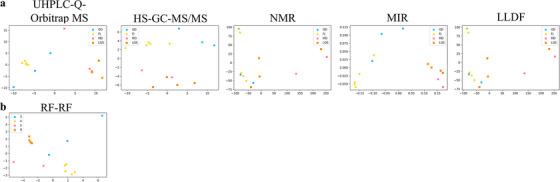 Figure 2
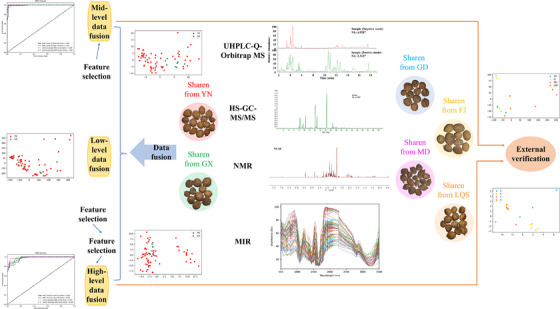 Figure 3
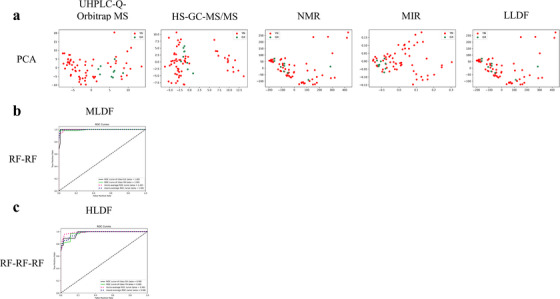 Figure 4
Peer Reviews
No public reviews on file for this paper yet. If you reviewed it on a platform where reviews are public (OpenReview, ICLR, NeurIPS, ICML), you can paste yours below so the community can read it here.
Videos
No videos yet. Explain this paper in a talk, walkthrough, or lecture? Add one.
Taxonomy
TopicsTraditional Chinese Medicine Analysis · Metabolomics and Mass Spectrometry Studies · Spectroscopy and Chemometric Analyses