Finite Element Analysis of Stress and Displacement Patterns in the Maxillary Dentition During Miniscrew-Assisted en-Masse Retraction Using Variable Gable Bend Angles
Amit Maheshwari, Rushikesh Sonwane, Veerendra Kerudi, Anama Mahevi, Jay Patil, Mahavir Kotecha, Seema Gupta

TL;DR
This study uses 3D modeling to show how different gable bend angles affect tooth movement and stress during orthodontic treatment.
Contribution
The study introduces a finite element analysis of variable gable bend angles in miniscrew-assisted orthodontic retraction.
Findings
Higher gable bend angles (15° and 20°) increased von Mises stress around the implant site and canine PDL.
Anterior teeth showed enhanced retraction and intrusion with 15° and 20° gable bends.
Posterior teeth maintained anchorage with minimal displacement across all models.
Abstract
Introduction: Efficient anterior tooth retraction with simultaneous intrusion is critical for the orthodontic treatment of deep bites. Gable bends incorporated into archwires can influence the direction and magnitude of force application. This study aimed to evaluate the effect of different gable bend angles (0°, 10°, 15°, and 20°) on stress distribution and displacement patterns in the maxillary dentition using three-dimensional (3D) finite element analysis (FEA) in the context of miniscrew-assisted en-masse retraction. Methodology: A 3D geometric model of the adult maxilla was constructed using high-resolution computed tomography (CT) scan data. The maxilla was segmented using MIMICS 8.11 (Materialise NV, Leuven, Belgium), and surface refinement was performed using RapidForm (INUS Technology Inc., 3D Systems, Rock Hill, SC). The model was meshed in HyperMesh 13.0 (Altair Engineering,…
Genes, proteins, chemicals, diseases, species, mutations and cell lines named across the full text — each resolved to its canonical identifier and authoritative record.
Click any figure to enlarge with its caption.
 Figure 1
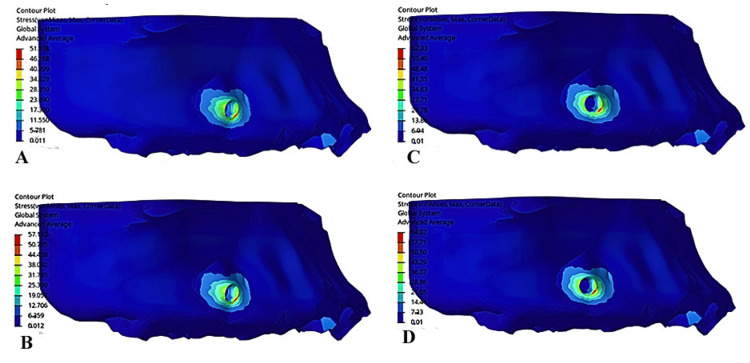 Figure 2
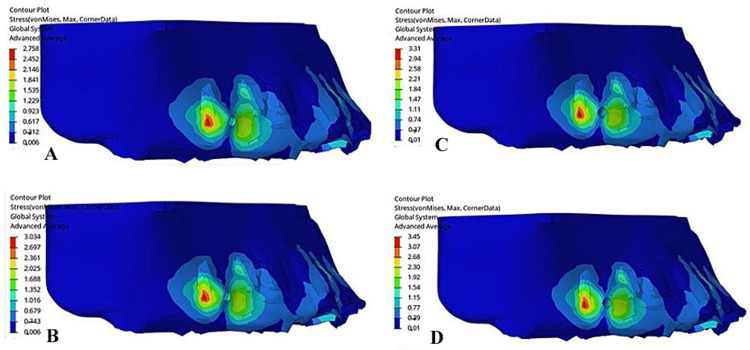 Figure 3
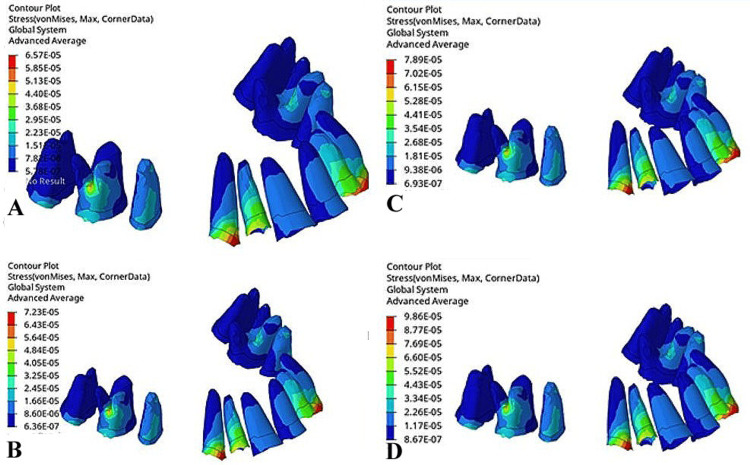 Figure 4
Peer Reviews
No public reviews on file for this paper yet. If you reviewed it on a platform where reviews are public (OpenReview, ICLR, NeurIPS, ICML), you can paste yours below so the community can read it here.
Videos
No videos yet. Explain this paper in a talk, walkthrough, or lecture? Add one.
Taxonomy
TopicsOrthodontics and Dentofacial Orthopedics · Dental Implant Techniques and Outcomes · dental development and anomalies