Orofacial myofunctional and anthropometric characteristics of children with and without microcephaly: a case-control study
Andréa Monteiro Correia MEDEIROS, Gabriela Rodrigues Dourado NOBRE, Geyse do Espírito Santo REZENDE, Íkaro Daniel de Carvalho BARRETO, Jonan Emi Valencia CARDENAS, Sarah Catarina Santos NASCIMENTO, Anna Luiza dos Santos MATOS, Asenate Soares de Matos PEREIRA

TL;DR
This study compares orofacial and anthropometric traits in children with and without Zika-related microcephaly, finding significant differences in swallowing and facial features.
Contribution
The study provides new insights into orofacial myofunctional and anthropometric differences in children with Zika-related microcephaly.
Findings
Children with microcephaly had lower swallowing efficiency scores between 13–18 months.
Significant differences were found in facial, cheek, and stomatognathic function scores between the groups.
Anthropometric measurements showed altered proportions in the upper third of the face and lip features in microcephaly cases.
Abstract
This study aimed to describe and compare morphofunctional orofacial aspects between subjects with and without Zika virus-related microcephaly. This was a descriptive, cross-sectional, case-control study with both qualitative and quantitative components. All subjects were born between 2015 and 2016, during the Zika virus outbreak in the Northeast region of Brazil. A total of 48 children were included: 24 with Zika-related microcephaly (MG) and 24 without the condition (CG). We performed the Preliminary Expanded Protocol of Orofacial Myofunctional Evaluation with Scores (OMES-E) for all subjects. Orofacial anthropometric measurements were obtained from 36 of the 48 participants, including 18 from the MG and 18 from the CG. We found lower swallowing efficiency scores in children with microcephaly aged 13–18 months. Significant differences (p<.001) were found between the MG and CG for…
Genes, proteins, chemicals, diseases, species, mutations and cell lines named across the full text — each resolved to its canonical identifier and authoritative record.
Click any figure to enlarge with its caption.
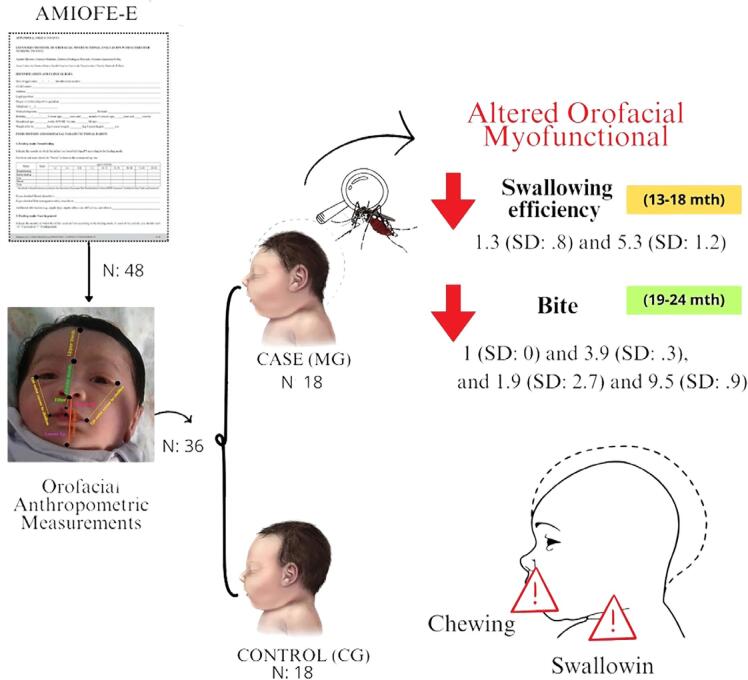 Figure 1
Peer Reviews
No public reviews on file for this paper yet. If you reviewed it on a platform where reviews are public (OpenReview, ICLR, NeurIPS, ICML), you can paste yours below so the community can read it here.
Videos
No videos yet. Explain this paper in a talk, walkthrough, or lecture? Add one.
Taxonomy
TopicsCerebral Palsy and Movement Disorders · Autism Spectrum Disorder Research · Craniofacial Disorders and Treatments