Resting-State EEG Alpha Asymmetry as a Potential Marker of Clinical Features in Parkinson’s Disease
Thalita Frigo da Rocha, Valton Costa, Lucas Camargo, Elayne Borges Fernandes, Anna Carolyna Gianlorenço

TL;DR
This study explores how brainwave patterns, specifically alpha asymmetry in resting-state EEG, may serve as a marker for Parkinson’s disease symptoms and progression.
Contribution
The study identifies alpha asymmetry as a potential neurophysiological marker for motor and cognitive features in Parkinson’s disease.
Findings
Lower alpha asymmetry in the parietal region was observed in Parkinson’s patients compared to controls.
Alpha asymmetry in the frontal and central regions was associated with motor symptoms and physical activity levels.
Disease progression and specific clinical features correlate with reduced alpha asymmetry.
Abstract
Background: Asymmetrical brain oscillations may be characteristic of Parkinson’s disease (PD). We investigated differences in oscillation asymmetry between individuals with PD and healthy controls and explored associations between the asymmetry and clinical features. Methods: Clinical and resting-state EEG data from 37 patients and 24 controls were cross-sectionally analyzed. EEG asymmetry indices were calculated for the delta, theta, alpha, and beta frequencies in the frontal, central, and parietal regions. Independent t-tests and linear regression models were employed. Results: Patients exhibited lower alpha asymmetry than controls in the parietal region (t(59) = 2.12, p = 0.03). In the frontal alpha asymmetry models, there were associations with time since diagnosis (β = −0.042) and attention/orientation (β = 0.061), and with Movement Disorder Society-Unified Parkinson’s Disease…
Genes, proteins, chemicals, diseases, species, mutations and cell lines named across the full text — each resolved to its canonical identifier and authoritative record.
Click any figure to enlarge with its caption.
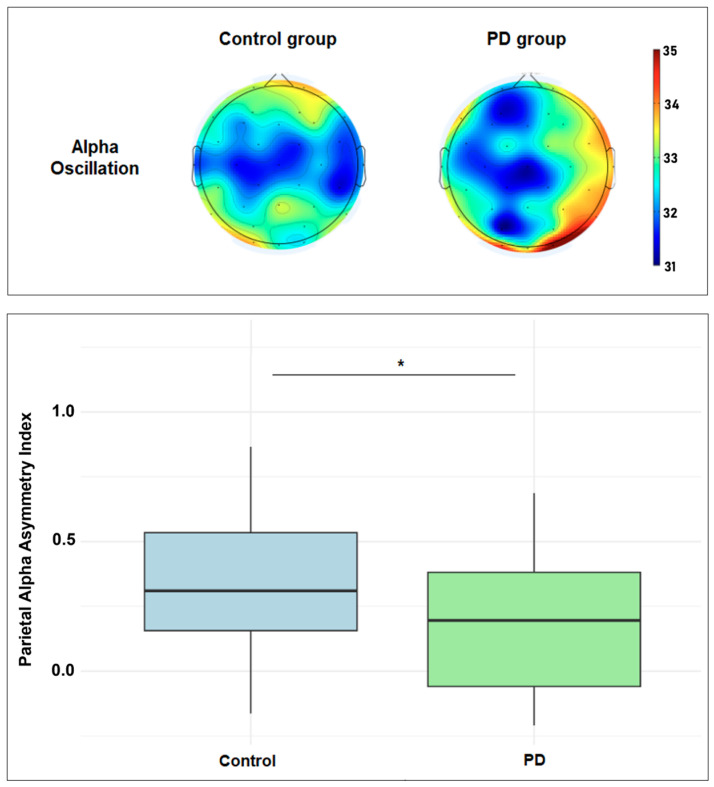 Figure 1
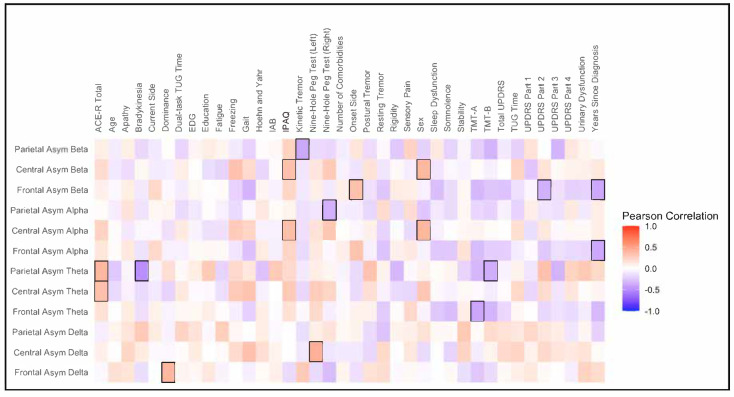 Figure 2
Peer Reviews
No public reviews on file for this paper yet. If you reviewed it on a platform where reviews are public (OpenReview, ICLR, NeurIPS, ICML), you can paste yours below so the community can read it here.
Videos
No videos yet. Explain this paper in a talk, walkthrough, or lecture? Add one.
Taxonomy
TopicsEEG and Brain-Computer Interfaces · Functional Brain Connectivity Studies · Neural dynamics and brain function