Damage Potential and Feeding Preference of Halyomorpha halys (Stål), Nezara viridula (L.), and Leptoglossus zonatus (Dallas) Among Different Ripening Stages of Tomato
Md Tafsir Nur Nabi Rashed, Adam G. Dale, Gideon Alake, Simon S. Riley, Nicole Benda, Amanda C. Hodges

TL;DR
This study finds that stink bugs and leaf-footed bugs prefer feeding on unripe or pink tomatoes, with fully ripe tomatoes being least preferred, helping guide pest management strategies.
Contribution
The study identifies specific ripening stage preferences of three insect pests on tomatoes, which is novel for pest monitoring and management.
Findings
Southern Green Stink Bug and Western Leaf-footed Bug prefer green tomatoes.
Brown Marmorated Stink Bug prefers pink tomatoes.
Fully ripe red tomatoes are least preferred by all three insect species.
Abstract
Stink bugs and leaf-footed bugs are common insect pests of tomato that cause feeding damage by creating yellowish spots on the fruit surface. Green, unripe tomatoes undergo multiple ripening stages: the fully unripe green stage, the yellowish–green colored breaker stage, the orange-colored pink stage, and the fully ripe red stage. It has not been well studied whether stink bugs and leaf-footed bugs have a preferred tomato ripening stage to feed on. This is critical information for growers, because the most preferred ripening stage is the most vulnerable to stink bug infestation and damage. We conducted two experiments to determine the most preferred tomato ripening stage for some common stink bugs, including the Brown Marmorated Stink Bug (BMSB), the Southern Green Stink Bug (SGSB), and the Western Leaf-footed Bug (WLB). Our experiments indicated that green is the most preferred…
Genes, proteins, chemicals, diseases, species, mutations and cell lines named across the full text — each resolved to its canonical identifier and authoritative record.
Click any figure to enlarge with its caption.
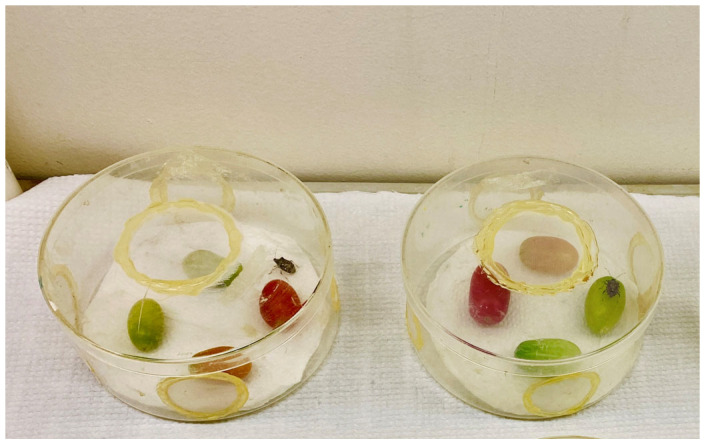 Figure 1
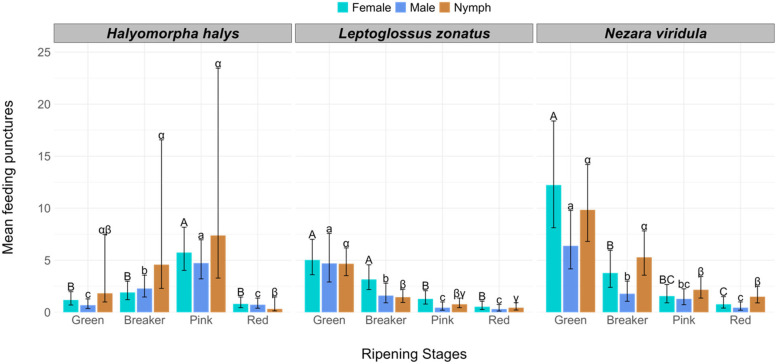 Figure 2
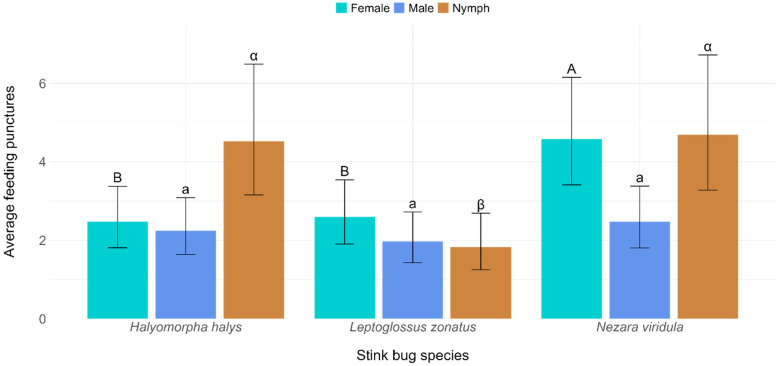 Figure 3
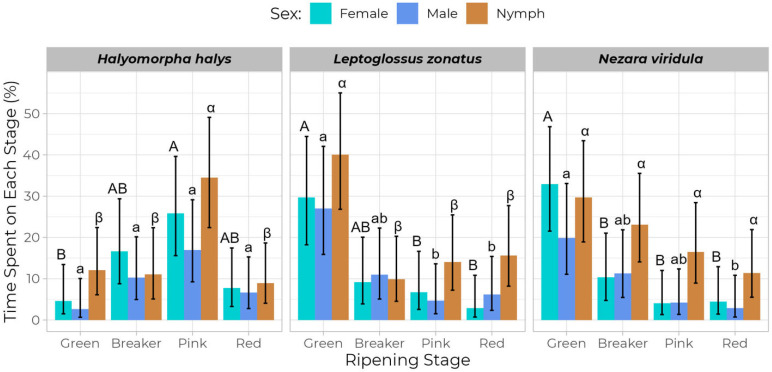 Figure 4
Peer Reviews
No public reviews on file for this paper yet. If you reviewed it on a platform where reviews are public (OpenReview, ICLR, NeurIPS, ICML), you can paste yours below so the community can read it here.
Videos
No videos yet. Explain this paper in a talk, walkthrough, or lecture? Add one.
Taxonomy
TopicsSeed Germination and Physiology · Berry genetics and cultivation research · Hemiptera Insect Studies