Evaluation of Laboratory Toxicities and Field Application of Plant Spray Oil and Its Mixture with Metarhizium anisopliae Against Diaphorina citri Kuwayama (Hemiptera: Liviidae)
Dasong Chen, Jiaqi Suo, Jianquan Yan, Lijia Chen, Fenghao Chen, Jianying Huang, Haitao Duan, Gecheng Ouyang, Xiang Meng

TL;DR
This study introduces an eco-friendly pesticide made from soy sauce waste and a fungus that effectively controls citrus pests, offering a sustainable alternative to chemicals.
Contribution
A new plant spray oil and its synergistic mixture with Metarhizium anisopliae provide effective, eco-friendly pest control for Diaphorina citri.
Findings
The plant spray oil and M. anisopliae mixture achieved over 80% control efficacy against D. citri within 6 days.
The optimal 5:5 mixing ratio showed the strongest synergistic effect in pest control.
The treatment reached 96.28% efficacy by day 8, comparable to chemical control methods.
Abstract
Diaphorina citri, the natural transmission vector of the destructive disease Huanglongbing, is the most important pest in citrus production. This research provides a method for the eco-friendly control of D. citri. A new plant spray oil, based on plant glycerides extracted from soy sauce waste residue, was developed into an environmentally friendly pesticide, which can quickly and effectively control D. citri. When mixed with Metarhizium anisopliae, it had a significant synergistic effect. Field application showed that the control efficacy of the plant spray oil and M. anisopliae mixture on D. citri was equivalent to that of chemical control, presenting a viable alternative for eco-friendly pest management. This study provides a scientific basis for effectively controlling D. citri and preventing the further spread of Huanglongbing in the field. Overusing chemicals to manage Diaphorina…
Genes, proteins, chemicals, diseases, species, mutations and cell lines named across the full text — each resolved to its canonical identifier and authoritative record.
Click any figure to enlarge with its caption.
 Figure 1
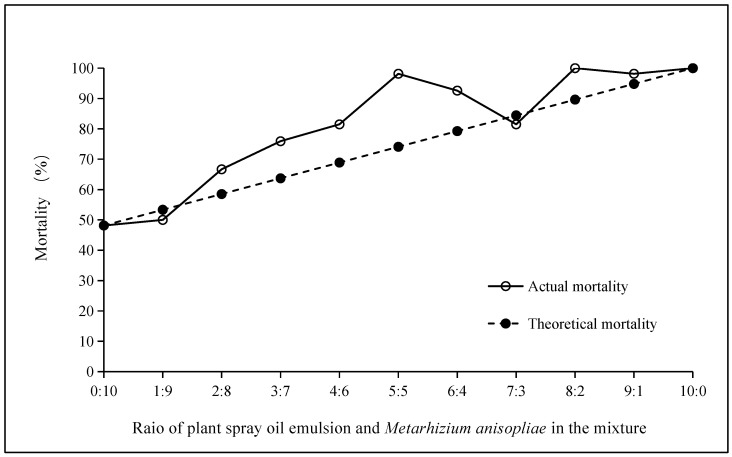 Figure 2
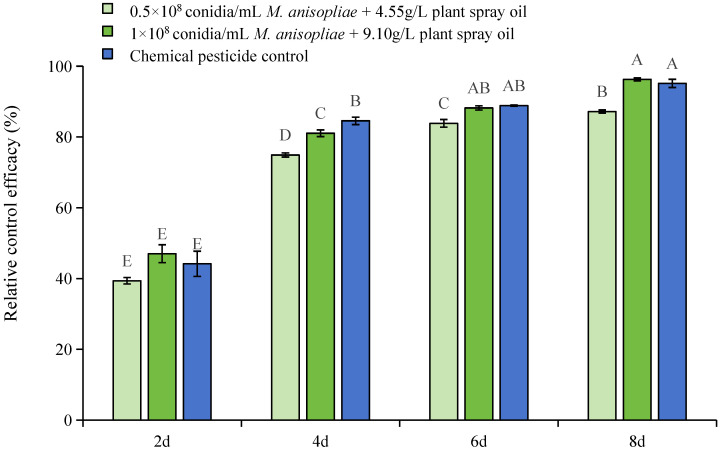 Figure 3
Peer Reviews
No public reviews on file for this paper yet. If you reviewed it on a platform where reviews are public (OpenReview, ICLR, NeurIPS, ICML), you can paste yours below so the community can read it here.
Videos
No videos yet. Explain this paper in a talk, walkthrough, or lecture? Add one.
Taxonomy
TopicsEntomopathogenic Microorganisms in Pest Control · Phytoplasmas and Hemiptera pathogens · Insect-Plant Interactions and Control