A Clinical Case of Aneurysmal Dilatation of the Aortic Arch Distal to the Origin of an Aberrant Right Subclavian Artery Treated with Castor Single-Branch Stent Graft Implantation and Right Carotid-Subclavian Bypass
Antonio Rizza, Silvia Di Sibio, Angela Buonpane, Giancarlo Trimarchi, Marta Casula, Michele Murzi, Pierandrea Farneti, Cataldo Palmieri, Marco Solinas, Sergio Berti

TL;DR
A 78-year-old patient with a complex aortic aneurysm near an abnormal artery was successfully treated using a specialized stent graft and a bypass procedure.
Contribution
Demonstrates the feasibility of using a Castor single-branch stent graft in treating distal aortic arch aneurysms with vascular anomalies.
Findings
A hybrid procedure combining a carotid-to-subclavian bypass and stent graft implantation successfully treated a complex aortic arch aneurysm.
Plug embolization of the ARSA origin prevented a type II endoleak following stent graft deployment.
Abstract
Advancements in endovascular stent graft design have enabled the treatment of distal aortic arch pathologies. However, the length of the proximal landing zone remains a limitation, especially with vascular anomalies like an aberrant right subclavian artery (ARSA) posing additional challenges. A 78-year-old patient underwent computed tomography angiography (CTA), which revealed progressive enlargement of a distal aortic arch aneurysm located beyond an ARSA that coursed between the esophagus and trachea. Following evaluation by the multidisciplinary Aortic Team, a hybrid procedure was planned. A right carotid-to-ARSA bypass was performed and a Castor single-branched stent graft (CSBSG) was deployed in the aortic arch with its side branch directed into the left subclavian artery (LSA), thereby covering the origin of the ARSA. To prevent a type II endoleak, plug embolization of the ARSA…
Genes, proteins, chemicals, diseases, species, mutations and cell lines named across the full text — each resolved to its canonical identifier and authoritative record.
Click any figure to enlarge with its caption.
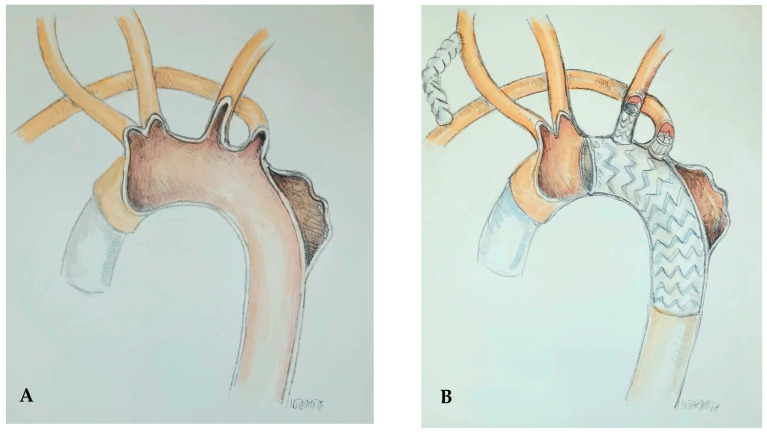 Figure 1
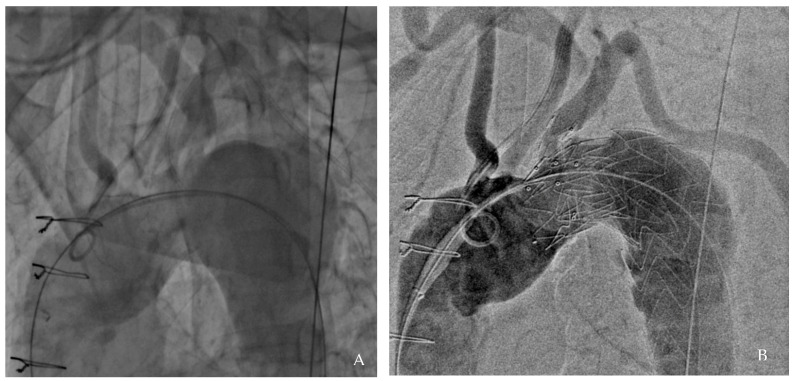 Figure 2
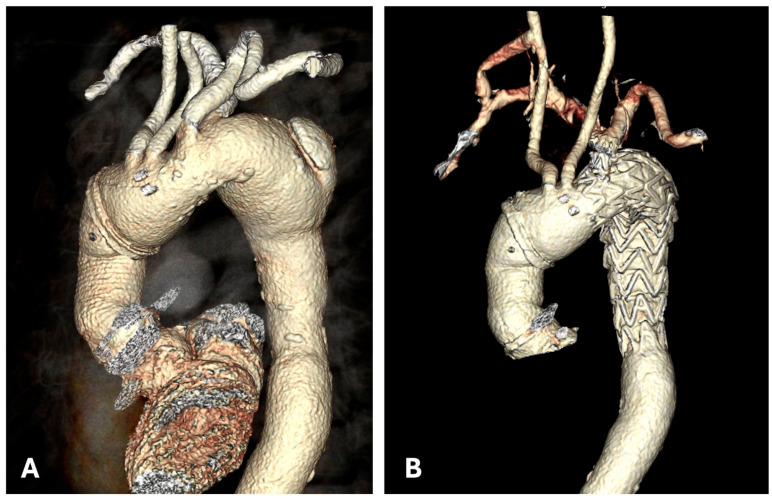 Figure 3
Peer Reviews
No public reviews on file for this paper yet. If you reviewed it on a platform where reviews are public (OpenReview, ICLR, NeurIPS, ICML), you can paste yours below so the community can read it here.
Videos
No videos yet. Explain this paper in a talk, walkthrough, or lecture? Add one.
Taxonomy
TopicsAortic Disease and Treatment Approaches · Aortic aneurysm repair treatments · Congenital Heart Disease Studies