Nationwide Spatial Patterns and Maternal and Birth-Related Factors Associated with Orofacial Clefts in Brazil
Luis Gustavo Souza Santos, Vandilson Rodrigues, Jessilene Ribeiro Rocha, Mila Roselaine Lima de Assunção, Marcio Vinícius Campos Borges, Maria Carmen Fontoura Nogueira da Cruz

TL;DR
This study found that orofacial clefts in Brazil are spatially clustered and linked to maternal and birth-related factors like age, education, and race.
Contribution
The study identifies nationwide spatial patterns and maternal factors associated with orofacial clefts in Brazil using a large national dataset.
Findings
High–high clusters of orofacial clefts were found in the South and Southeast of Brazil.
Maternal age and education levels differ significantly between high–high and low–low clusters.
Preterm births and low birth weight are more common in high–high clusters.
Abstract
This study aimed to identify spatial clustering and maternal and birth-related factors associated with the incidence of orofacial clefts in Brazil from 2001 to 2022. A nationwide ecological study was conducted in Brazil using data from 2001 to 2022 obtained from the Brazilian Live Birth Information System (SINASC). The municipality was used as the spatial unit of analysis. Variables included maternal age and education, newborn sex, gestational age, birth weight, and skin color/ethnicity. Univariate and bivariate global and local Moran’s I indices were used to assess spatial autocorrelation. A total of 234 municipalities (4.2%) formed high–high spatial clusters, primarily in the South and Southeast, while 431 municipalities (7.7%) formed low–low clusters, mostly in the Northeast (Moran’s I = 0.121, 95% CI: 0.107 to 0.135). High–high clusters had a lower median proportion of adolescent…
Genes, proteins, chemicals, diseases, species, mutations and cell lines named across the full text — each resolved to its canonical identifier and authoritative record.
Click any figure to enlarge with its caption.
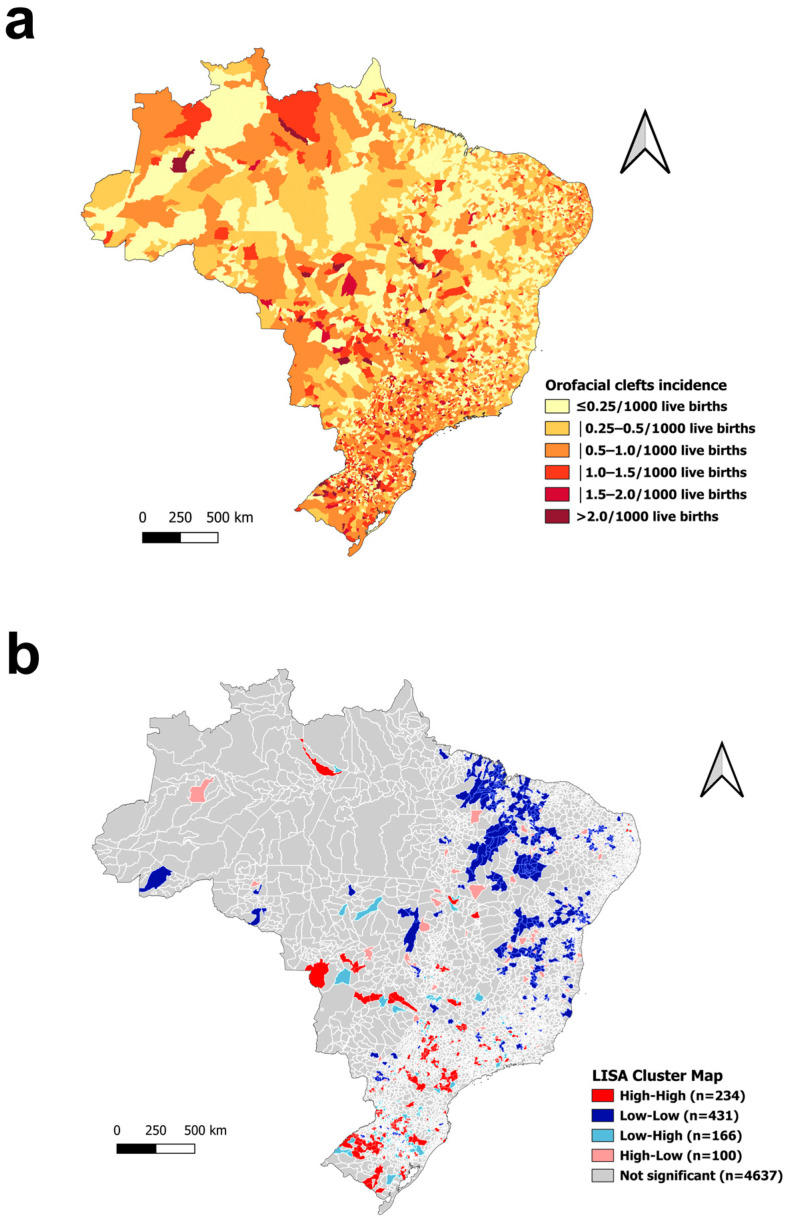 Figure 1
Peer Reviews
No public reviews on file for this paper yet. If you reviewed it on a platform where reviews are public (OpenReview, ICLR, NeurIPS, ICML), you can paste yours below so the community can read it here.
Videos
No videos yet. Explain this paper in a talk, walkthrough, or lecture? Add one.
Taxonomy
TopicsCleft Lip and Palate Research · Craniofacial Disorders and Treatments · Dental Health and Care Utilization