Impact of Tumor Necrosis Factor Antagonist Therapy on Circulating Angiopoietin-like Protein 8 (ANGPTL8) Levels in Crohn’s Disease—A Prospective Multi-Center Study
Mohammad Shehab, Sharifa Al-Fajri, Ahmed Alanqar, Mohammad Alborom, Fatema Alrashed, Fatemah Alshammaa, Ahmad Alfadhli, Sriraman Devarajan, Irina Alkhairi, Preethi Cherian, Jehad Abubaker, Mohamed Abu-Farha, Fahd Al-Mulla

TL;DR
This study shows that ANGPTL8 levels are higher in Crohn’s disease patients and drop after anti-TNF therapy, suggesting it could be a useful biomarker for treatment response.
Contribution
The study is the first to show that ANGPTL8 levels decrease significantly after anti-TNF therapy in Crohn’s disease patients.
Findings
ANGPTL8 levels were significantly higher in Crohn’s disease patients compared to healthy controls.
Anti-TNF therapy led to a significant reduction in ANGPTL8 levels in treatment-naïve Crohn’s disease patients.
ANGPTL8 may serve as a potential biomarker for inflammation and treatment response in Crohn’s disease.
Abstract
Background: Crohn’s disease (CD) is a chronic disease perpetuated through key pro-inflammatory molecules, including tumor necrosis factor-alpha (TNFα). Angiopoietin-like protein 8 (ANGPTL8) may contribute to inflammation cascades. This study aimed to investigate how ANGPTL8 levels are influenced in patients with CD prior to and following anti-TNF therapy. Methods: Patients were divided into 3 groups. Patients with CD in clinical remission receiving IFX for at least 24 weeks (IFX-experienced group), patients scheduled to start IFX (IFX-naïve group), and healthy controls (control group). In the IFX-experienced group, ANGPTL8 levels were measured 24 h before the next maintenance IFX dose. In the IFX-naïve group, levels were measured at week 0 and week 24, and in the control group, they were measured randomly. Results: The total number of participants was 166. The numbers of…
Genes, proteins, chemicals, diseases, species, mutations and cell lines named across the full text — each resolved to its canonical identifier and authoritative record.
Click any figure to enlarge with its caption.
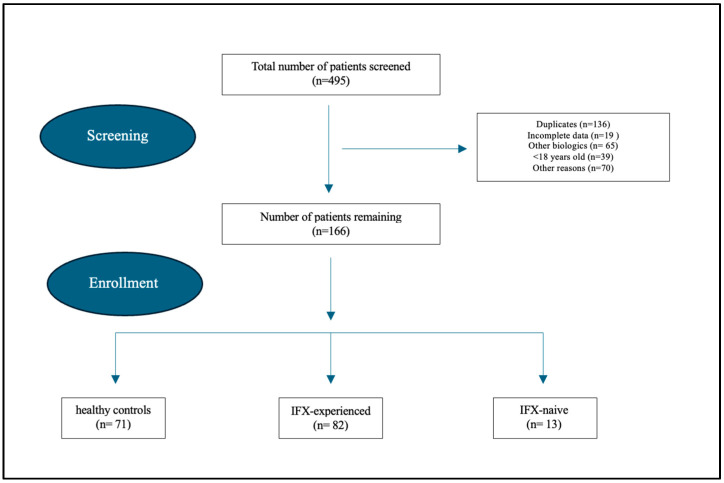 Figure 1
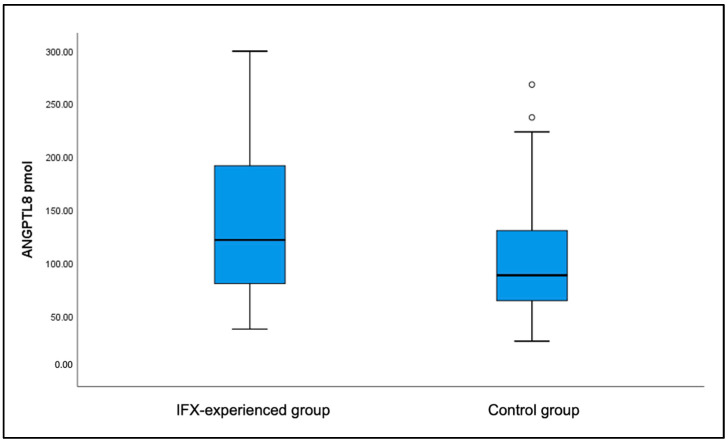 Figure 2
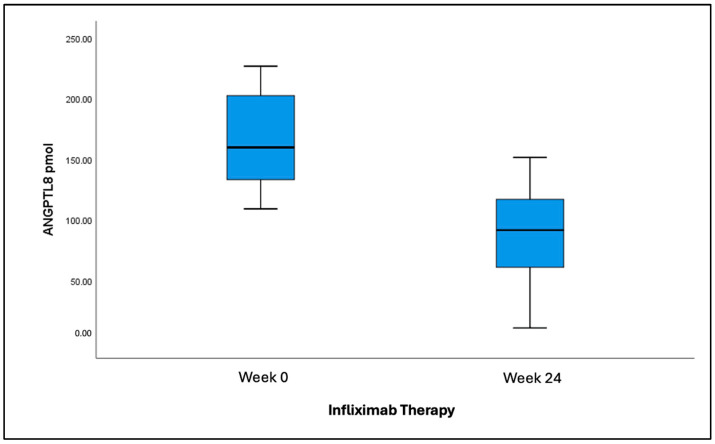 Figure 3
Peer Reviews
No public reviews on file for this paper yet. If you reviewed it on a platform where reviews are public (OpenReview, ICLR, NeurIPS, ICML), you can paste yours below so the community can read it here.
Videos
No videos yet. Explain this paper in a talk, walkthrough, or lecture? Add one.
Taxonomy
TopicsLipid metabolism and disorders