Identification of Molecular Subtypes of B-Cell Acute Lymphoblastic Leukemia in Mexican Children by Whole-Transcriptome Analysis
Norberto Sánchez-Escobar, María de los Ángeles Romero-Tlalolini, Haydeé Rosas-Vargas, Elva Jiménez-Hernández, Juan Carlos Núñez Enríquez, Angélica Rangel-López, José Manuel Sánchez López, Daniela Rojo-Serrato, América Mariana Jasso Mata, Efraín Abimael Márquez Aguilar

TL;DR
This study identifies molecular subtypes of B-cell acute lymphoblastic leukemia in Mexican children using RNA sequencing, revealing key mutations and gene fusions for better diagnosis and treatment.
Contribution
The study provides a detailed molecular classification of B-ALL in Mexican pediatric patients using whole-transcriptome analysis.
Findings
High hyperdiploidy was the most common molecular subtype in Mexican B-ALL patients.
RNA-seq successfully detected gene fusions and mutations across various B-ALL subtypes.
Ph-like subtype showed specific mutations and CRLF2 overexpression, while DUX4 had PDGFRa variants.
Abstract
B-lineage acute lymphoblastic leukemia (B-ALL) is classified into more than 20 molecular subtypes, and next-generation sequencing has facilitated the identification of these with high sensitivity. Bulk RNA-seq analysis of bone marrow was realized to identify molecular subtypes in Mexican pediatric patients with B-ALL. High hyperdiploidy (27.3%) was the most frequent molecular subtype, followed by DUX4 (13.6%), TCF3::PBX1 (9.1%), ETV6::RUNX1 (9.1%), Ph-like (9.1%), ETV6::RUNX1-like (9.1%), PAX5alt (4.5%), Ph (4.5%), KMT2A (4.5%), and ZNF384 (4.5%), with one patient presenting both the PAX5alt and low hypodiploidy subtypes (4.5%). The genes TYK2, SEMA6A, FLT3, NRAS, SETD2, JAK2, NT5C2, RAG1, and SPATS2L harbor deleterious missense variants across different B-ALL molecular subtypes. The Ph-like subtype exhibited mutations in STAT2, ADGRF1, TCF3, BCR, JAK2, and NRAS with overexpression of…
Genes, proteins, chemicals, diseases, species, mutations and cell lines named across the full text — each resolved to its canonical identifier and authoritative record.
Click any figure to enlarge with its caption.
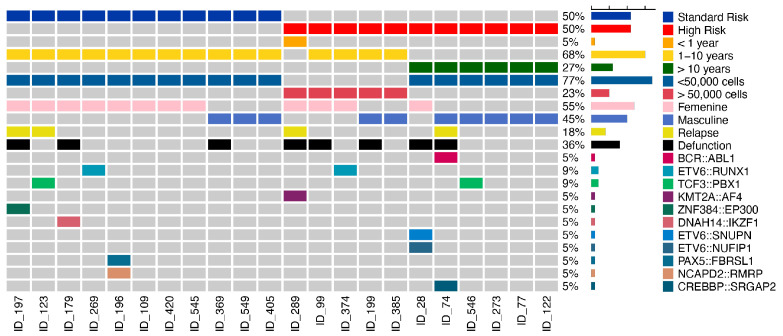 Figure 1
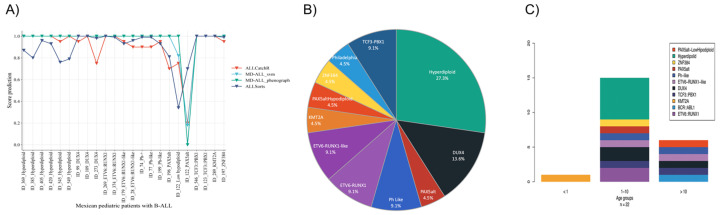 Figure 2
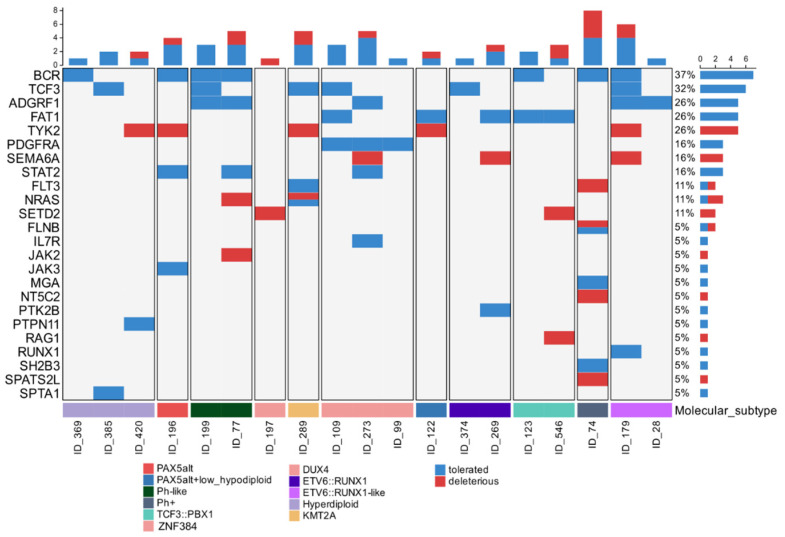 Figure 3
Peer Reviews
No public reviews on file for this paper yet. If you reviewed it on a platform where reviews are public (OpenReview, ICLR, NeurIPS, ICML), you can paste yours below so the community can read it here.
Videos
No videos yet. Explain this paper in a talk, walkthrough, or lecture? Add one.
Taxonomy
TopicsAcute Lymphoblastic Leukemia research · Acute Myeloid Leukemia Research · Chronic Myeloid Leukemia Treatments