A Tale of Two “Unexpected” Asystoles
Giacomo Mugnai, Bruna Bolzan, Elena Franchi, Luca Tomasi

TL;DR
This paper discusses two cases where patients with heart devices experienced unexpected heart stoppage, highlighting the importance of monitoring and backup pacing.
Contribution
The paper emphasizes the need to identify patients with conduction disorders who may benefit from backup pacing despite using non-pacing devices.
Findings
Two cases of prolonged asystoles were successfully managed with WCD and subcutaneous ICD.
Monitoring features of these devices can detect bradyarrhythmias.
Patients with paroxysmal conduction disorders may require backup pacing.
Abstract
We report two cases of prolonged “unexpected” asystoles in patients with a wearable cardioverter-defibrillator (WCD) and a subcutaneous implantable cardioverter-defibrillator (ICD), respectively, which were promptly recognized and successfully managed. As these devices are designed to recognize and treat malignant tachyarrhythmias but do not provide pacing capabilities, it is crucial to identify patients with paroxysmal conduction disorders who might require backup pacing. For this reason, it is also important to leverage the monitoring features of both devices and their ability to detect the occurrence of bradyarrhythmias.
Genes, proteins, chemicals, diseases, species, mutations and cell lines named across the full text — each resolved to its canonical identifier and authoritative record.
Click any figure to enlarge with its caption.
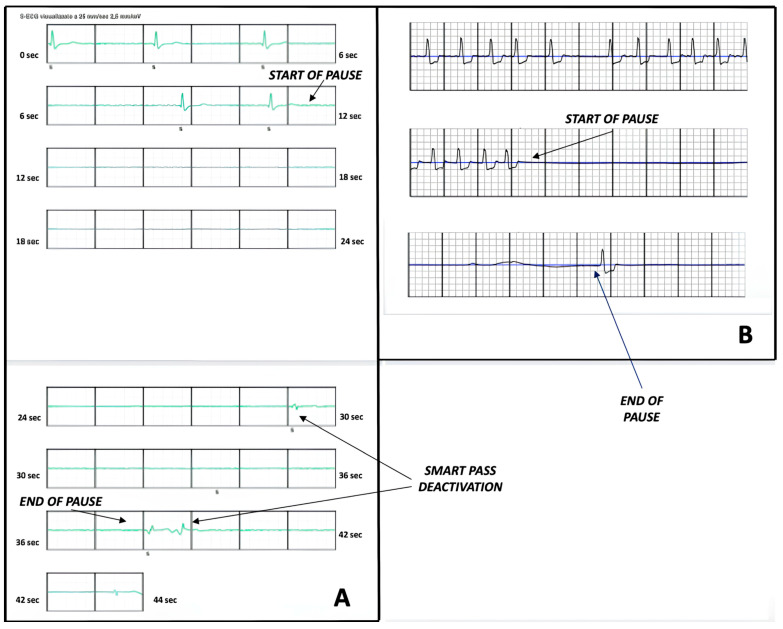 Figure 1
Peer Reviews
No public reviews on file for this paper yet. If you reviewed it on a platform where reviews are public (OpenReview, ICLR, NeurIPS, ICML), you can paste yours below so the community can read it here.
Videos
No videos yet. Explain this paper in a talk, walkthrough, or lecture? Add one.
Taxonomy
TopicsSympathectomy and Hyperhidrosis Treatments · Medical Imaging and Pathology Studies · Glycogen Storage Diseases and Myoclonus