A Dual-Branch Fusion Model for Deepfake Detection Using Video Frames and Microexpression Features
Georgios Petmezas, Vazgken Vanian, Manuel Pastor Rufete, Eleana E. I. Almaloglou, Dimitris Zarpalas

TL;DR
This paper introduces a new deepfake detection method that combines video frames and microexpression features to achieve high accuracy.
Contribution
A dual-branch fusion model that integrates 3D ResNet18 and a transformer for deepfake detection.
Findings
The model achieves 99.81% accuracy on the FaceForensics++ dataset.
It obtains a perfect ROC-AUC score of 100%.
The method outperforms existing state-of-the-art deepfake detection approaches.
Abstract
Deepfake detection has become a critical issue due to the rise of synthetic media and its potential for misuse. In this paper, we propose a novel approach to deepfake detection by combining video frame analysis with facial microexpression features. The dual-branch fusion model utilizes a 3D ResNet18 for spatiotemporal feature extraction and a transformer model to capture microexpression patterns, which are difficult to replicate in manipulated content. We evaluate the model on the widely used FaceForensics++ (FF++) dataset and demonstrate that our approach outperforms existing state-of-the-art methods, achieving 99.81% accuracy and a perfect ROC-AUC score of 100%. The proposed method highlights the importance of integrating diverse data sources for deepfake detection, addressing some of the current limitations of existing systems.
Genes, proteins, chemicals, diseases, species, mutations and cell lines named across the full text — each resolved to its canonical identifier and authoritative record.
Click any figure to enlarge with its caption.
 Figure 1
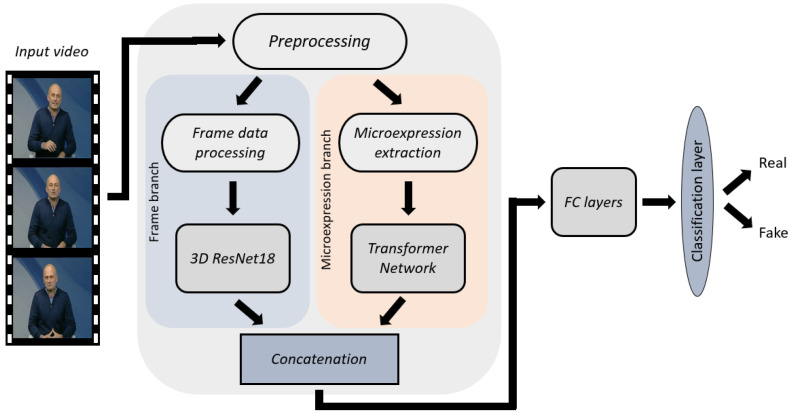 Figure 2
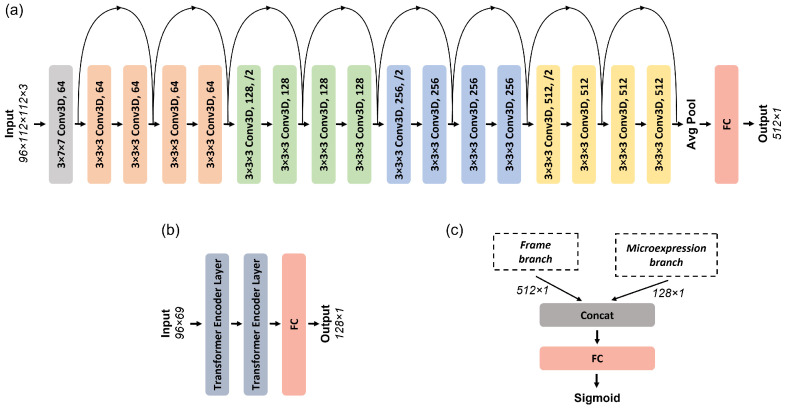 Figure 3
Peer Reviews
No public reviews on file for this paper yet. If you reviewed it on a platform where reviews are public (OpenReview, ICLR, NeurIPS, ICML), you can paste yours below so the community can read it here.
Videos
No videos yet. Explain this paper in a talk, walkthrough, or lecture? Add one.
Taxonomy
TopicsDigital Media Forensic Detection · Generative Adversarial Networks and Image Synthesis · Advanced Image Processing Techniques