Numerical Generation of Trajectories Statistically Consistent with Stochastic Differential Equations
Mykhaylo Evstigneev

TL;DR
This paper introduces a new numerical method for simulating stochastic differential equations with high accuracy.
Contribution
The novel method generates trajectories by matching cumulants using Gaussian variables, achieving second-order accuracy.
Findings
The method reproduces the first three cumulants of the state variable to second-order accuracy.
It outperforms the Milstein algorithm in accuracy when tested on Büttiker’s ratchet.
The approach can be extended to generate higher-order terms in the stochastic Taylor expansion.
Abstract
A weak second-order numerical method for generating trajectories based on stochastic differential equations (SDE) is developed. The proposed approach bypasses direct noise realization by updating the system’s state using independent Gaussian random variables so as to reproduce the first three cumulants of the state variable at each time step to the second order in the time-step size. The update rule for the state variable is derived based on the system’s Fokker–Planck equation in an arbitrary number of dimensions. The high accuracy of the method as compared to the standard Milstein algorithm is demonstrated on the example of Büttiker’s ratchet. While the method is second-order accurate in the time step, it can be extended to systematically generate higher-order terms of the stochastic Taylor expansion approximating the solution of the SDE.
Genes, proteins, chemicals, diseases, species, mutations and cell lines named across the full text — each resolved to its canonical identifier and authoritative record.
Click any figure to enlarge with its caption.
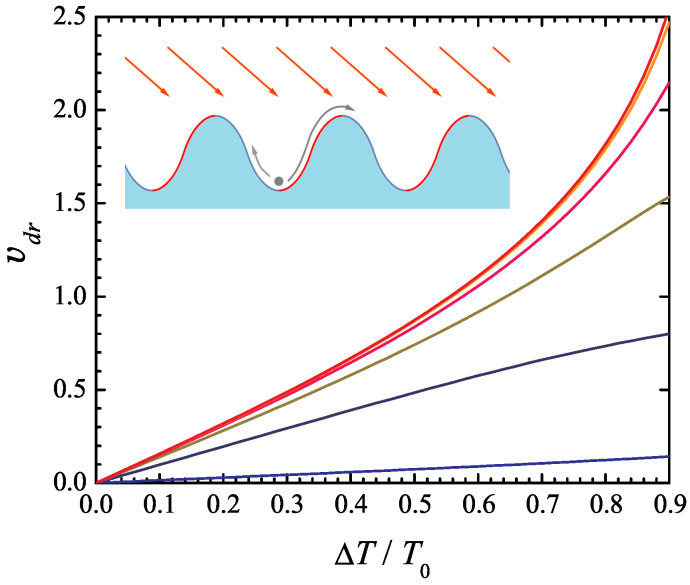 Figure 1
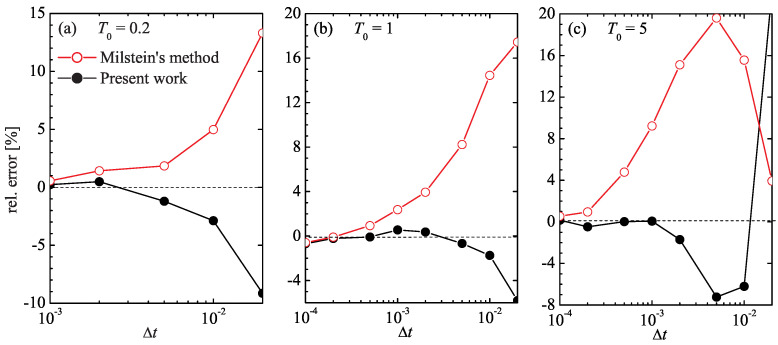 Figure 2
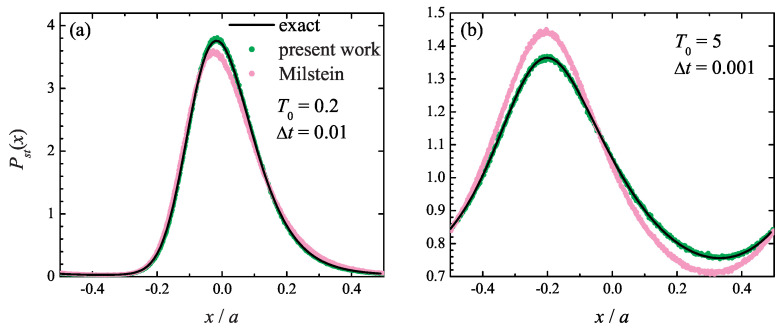 Figure 3
Peer Reviews
No public reviews on file for this paper yet. If you reviewed it on a platform where reviews are public (OpenReview, ICLR, NeurIPS, ICML), you can paste yours below so the community can read it here.
Videos
No videos yet. Explain this paper in a talk, walkthrough, or lecture? Add one.
Taxonomy
Topicsstochastic dynamics and bifurcation · Probabilistic and Robust Engineering Design · Diffusion and Search Dynamics