Animal Venoms as Potential Antitumor Agents Against Leukemia and Lymphoma
Geovanna M. Malachias-Pires, Eloise T. M. Filardi, Marcela Romanazzi, Julia Lopes-de-Oliveira, Isabela C. dos Santos, Guilherme Melo-dos-Santos, Ana Beatriz Rossi, Michele Procópio Machado, Thiago A. da Silva, Manuela B. Pucca

TL;DR
Animal venoms may offer new cancer treatments by targeting leukemia and lymphoma cells in ways that reduce side effects.
Contribution
This review highlights venom-derived molecules as novel antitumor agents with mechanisms like apoptosis and immune modulation.
Findings
Venom components like LAAOs and PLA2s induce cancer cell death through oxidative stress and apoptosis.
Peptides such as melittin show selective antitumor activity by targeting cell cycle and survival pathways.
Venom molecules modulate immune responses and inhibit cancer-promoting signaling pathways like NF-κB.
Abstract
Leukemia and lymphoma are types of blood cancer that affect many people worldwide and often have limited treatment options, especially when the disease returns after therapy. In recent years, scientists have explored natural sources to discover new ways to fight these cancers. Animal venoms—such as those from snakes, bees, and scorpions—contain substances that can eliminate cancer cells or prevent them from multiplying. This review examines how certain venom components act on leukemia and lymphoma cells in laboratory studies. These substances can cause cancer cells to lose their function, stop dividing, or undergo controlled cell death. Some venom molecules may also help the immune system recognize and attack cancer cells. Although these findings are mostly from laboratory research and are not yet used in standard medical treatments, they offer promising ideas for developing new…
Genes, proteins, chemicals, diseases, species, mutations and cell lines named across the full text — each resolved to its canonical identifier and authoritative record.
Click any figure to enlarge with its caption.
 Figure 1
 Figure 2
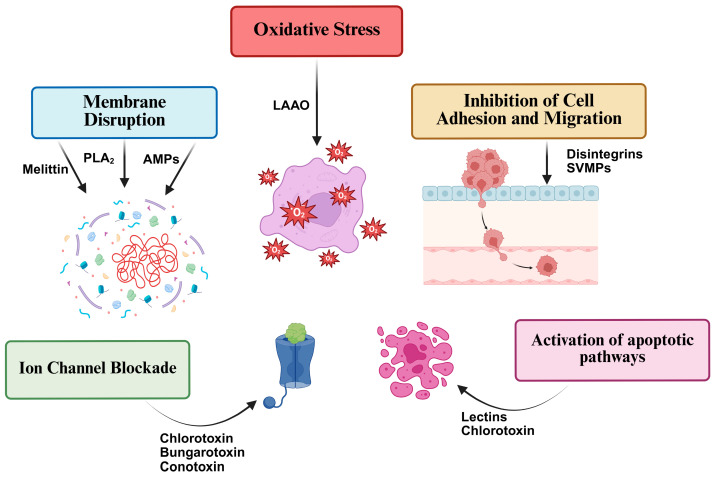 Figure 3
Peer Reviews
No public reviews on file for this paper yet. If you reviewed it on a platform where reviews are public (OpenReview, ICLR, NeurIPS, ICML), you can paste yours below so the community can read it here.
Videos
No videos yet. Explain this paper in a talk, walkthrough, or lecture? Add one.
Taxonomy
TopicsVenomous Animal Envenomation and Studies · Healthcare and Venom Research · Biochemical and Structural Characterization