A Dual-Encoder Contrastive Learning Model for Knowledge Tracing
Yanhong Bai, Xingjiao Wu, Tingjiang Wei, Liang He

TL;DR
This paper introduces a new model for tracking student knowledge that works better with limited data.
Contribution
The novel dual-encoder contrastive learning framework improves knowledge state representation in sparse educational data.
Findings
DECKT outperforms existing methods in benchmark experiments.
The model enhances representation quality for low-frequency knowledge concepts.
Contrastive learning and graph constraints improve embedding consistency.
Abstract
Knowledge tracing (KT) models learners’ evolving knowledge states to predict future performance, serving as a fundamental component in personalized education systems. However, existing methods suffer from data sparsity challenges, resulting in inadequate representation quality for low-frequency knowledge concepts and inconsistent modeling of students’ actual knowledge states. To address this challenge, we propose Dual-Encoder Contrastive Knowledge Tracing (DECKT), a contrastive learning framework that improves knowledge state representation under sparse data conditions. DECKT employs a momentum-updated dual-encoder architecture where the primary encoder processes current input data while the momentum encoder maintains stable historical representations through exponential moving average updates. These encoders naturally form contrastive pairs through temporal evolution, effectively…
Genes, proteins, chemicals, diseases, species, mutations and cell lines named across the full text — each resolved to its canonical identifier and authoritative record.
Click any figure to enlarge with its caption.
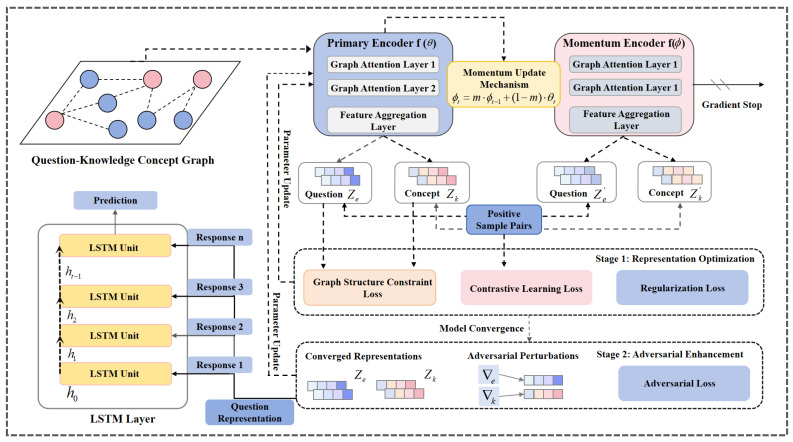 Figure 1
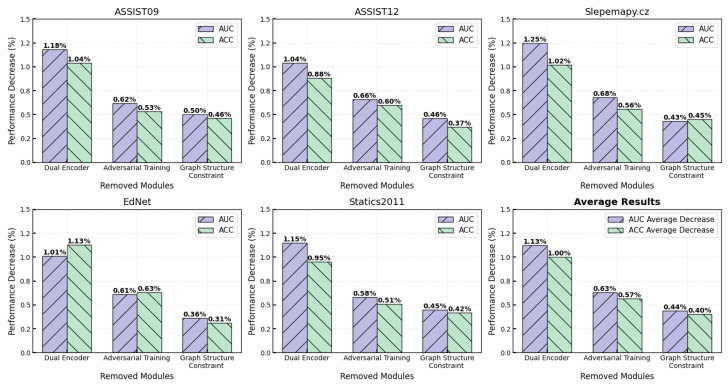 Figure 2
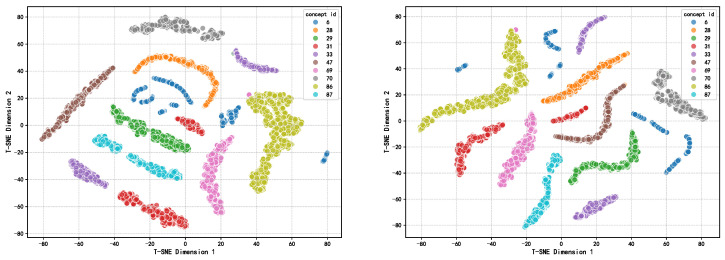 Figure 3
 Figure 4
 Figure 5
Peer Reviews
No public reviews on file for this paper yet. If you reviewed it on a platform where reviews are public (OpenReview, ICLR, NeurIPS, ICML), you can paste yours below so the community can read it here.
Videos
No videos yet. Explain this paper in a talk, walkthrough, or lecture? Add one.
Taxonomy
TopicsIntelligent Tutoring Systems and Adaptive Learning · Machine Learning in Healthcare · Topic Modeling