Prognostic Value of the Goutallier Scale for Paravertebral Muscle Atrophy in Predicting Disability and Pain Outcomes in Degenerative Lumbar Spinal Stenosis: A Longitudinal Cohort Study of 100 Patients
Giuseppe Corazzelli, Sergio Corvino, Chiara Di Domenico, Federico Russo, Vincenzo Meglio, Settimio Leonetti, Valentina Pizzuti, Marco Santilli, Alessandro D’Elia, Francesco Ricciardi, Sergio Paolini, Raffaele de Falco, Oreste de Divitiis, Vincenzo Esposito, Gualtiero Innocenzi

TL;DR
This study shows that muscle degeneration in the back, measured by the Goutallier Scale, predicts worse recovery after spinal surgery for elderly patients with lumbar spinal stenosis.
Contribution
The study demonstrates the Goutallier Scale's value in predicting postoperative disability and pain in elderly LSS patients.
Findings
Higher Goutallier grades correlate with greater residual disability and pain after surgery.
Patients with higher Goutallier grades show smaller improvements in disability and pain scores.
Females are more likely to have higher Goutallier grades, though no differences in comorbidities were found.
Abstract
Background/Objectives: Degenerative lumbar spinal stenosis (LSS) is a prevalent cause of disability in elderly populations, often treated with decompressive surgery. However, postoperative functional outcomes are variable and influenced by factors beyond neural compression alone. This study aimed to investigate the prognostic significance of the Goutallier Classification System (GS), a radiological index of paravertebral muscle fatty degeneration, in predicting long-term postoperative disability and pain in elderly patients undergoing decompression for LSS. Methods: A retrospective cohort study was conducted on 100 elderly patients who underwent primary lumbar decompression surgery for LSS between January 2020 and July 2022, with a minimum two-year follow-up. Patients were stratified according to their preoperative GS grades assessed via MRI. The Oswestry Disability Index (ODI) and…
Genes, proteins, chemicals, diseases, species, mutations and cell lines named across the full text — each resolved to its canonical identifier and authoritative record.
Click any figure to enlarge with its caption.
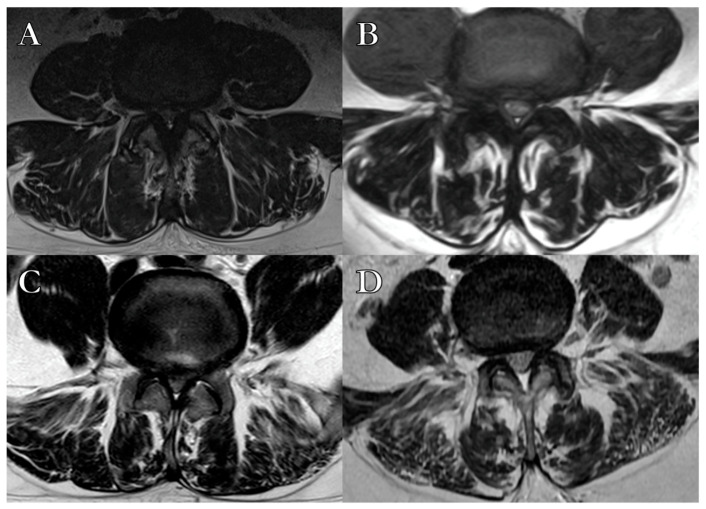 Figure 1
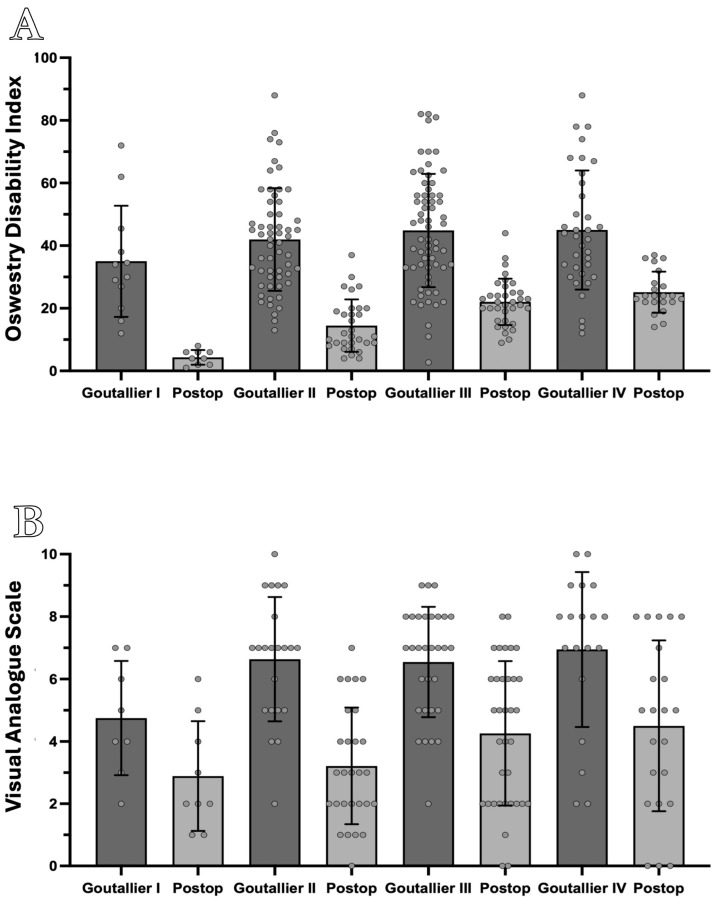 Figure 2
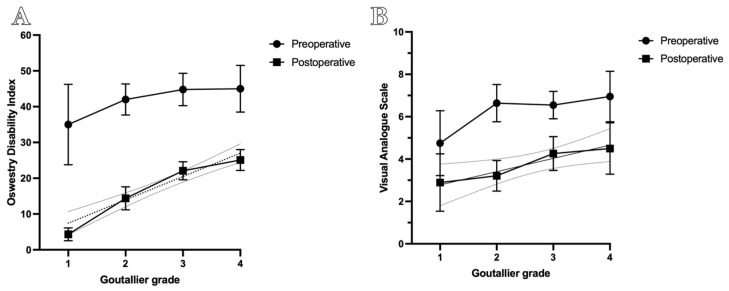 Figure 3
Peer Reviews
No public reviews on file for this paper yet. If you reviewed it on a platform where reviews are public (OpenReview, ICLR, NeurIPS, ICML), you can paste yours below so the community can read it here.
Videos
No videos yet. Explain this paper in a talk, walkthrough, or lecture? Add one.
Taxonomy
TopicsSpine and Intervertebral Disc Pathology · Musculoskeletal pain and rehabilitation · Spinal Fractures and Fixation Techniques