The Power of Old Hats: Rediscovering Inosine-EpPCR to Create Starting Libraries for Whole-Cell-SELEX
Grigory Bolotnikov, Ann-Kathrin Kissmann, Daniel Gruber, Andreas Bellmann, Roger Hasler, Christoph Kleber, Wolfgang Knoll, Frank Rosenau

TL;DR
This paper shows that an old method using inosine in PCR can effectively create diverse DNA libraries for selecting aptamers that bind to various cells.
Contribution
The study demonstrates that inosine-mediated epPCR is a novel, cost-effective way to generate functional aptamer libraries for whole-cell SELEX.
Findings
Enriched aptamers showed new binding specificities against diverse cell targets.
The epPCR method successfully generated functional starting libraries from a single oligonucleotide.
The approach lowers the barrier for initiating SELEX campaigns without commercial oligo pools.
Abstract
Shaking off the forgetfulness towards the methodological power of inosine-mediated error-prone PCR (epPCR), this study reintroduces an often-underappreciated method as a considerably powerful approach for generating aptamer libraries from a single decameric ATCG-repeat-oligonucleotide. The aim was to demonstrate that this simple way of creating sequence diversity was suitable for delivering functional starting libraries for a set of ten whole-cell-SELEX (Systematic Evolution of Ligands by Exponential Enrichment) processes. This epPCR method uses inosine to introduce targeted mutations, avoiding the need for commercial oligo pools or large-scale synthesis. We applied this method to a “universal aptamer” and subjected the three resulting libraries to two rounds of selection against ten diverse targets including probiotic and pathogenic bacteria (Gram-negative and -positive) as well as…
Genes, proteins, chemicals, diseases, species, mutations and cell lines named across the full text — each resolved to its canonical identifier and authoritative record.
Click any figure to enlarge with its caption.
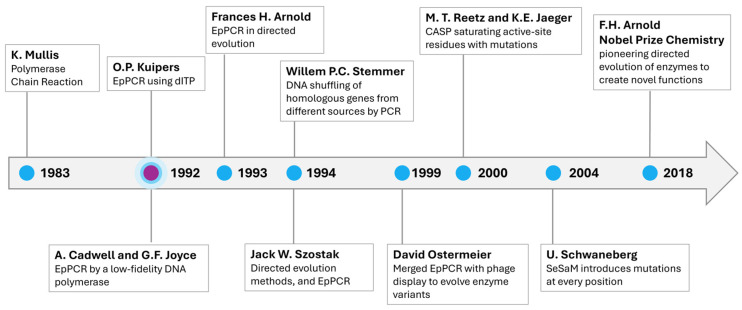 Figure 1
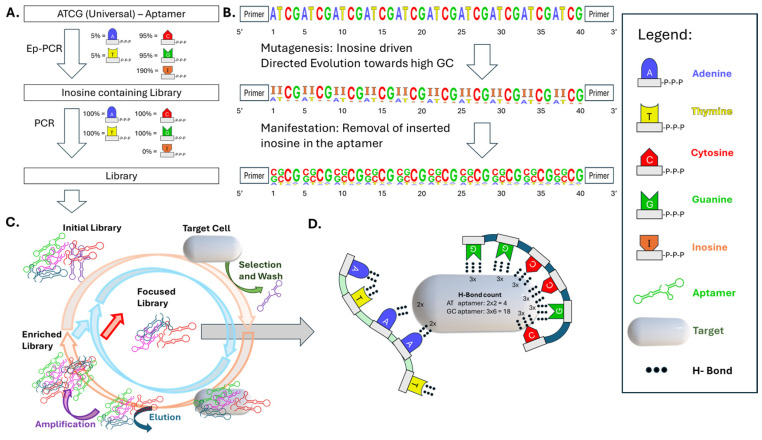 Figure 2
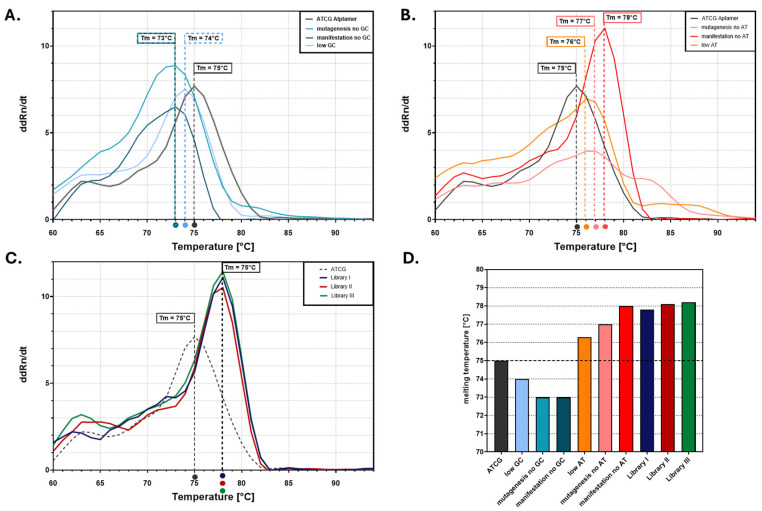 Figure 3
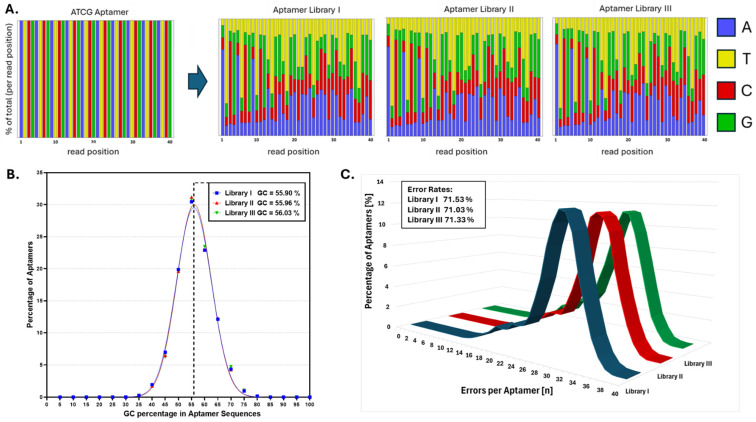 Figure 4
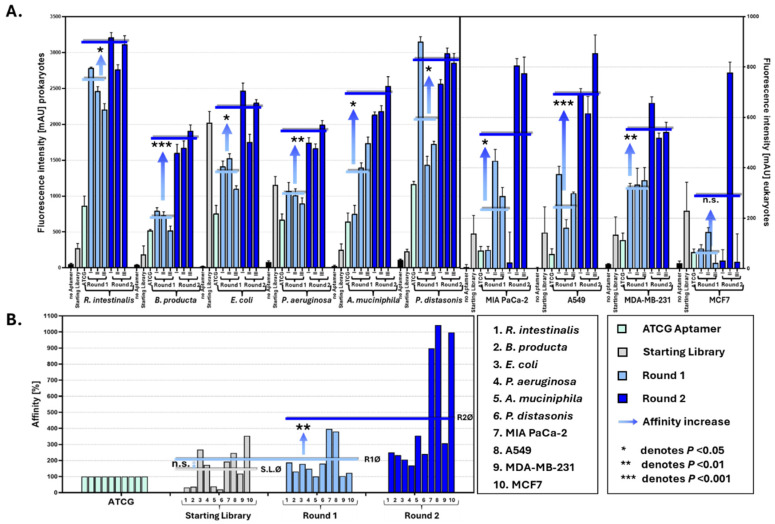 Figure 5
Peer Reviews
No public reviews on file for this paper yet. If you reviewed it on a platform where reviews are public (OpenReview, ICLR, NeurIPS, ICML), you can paste yours below so the community can read it here.
Videos
No videos yet. Explain this paper in a talk, walkthrough, or lecture? Add one.
Taxonomy
TopicsCRISPR and Genetic Engineering · Advanced biosensing and bioanalysis techniques · Click Chemistry and Applications