Improving Clinical Prediction of Pulmonary Embolism in Pregnancy and Postpartum by Modifying Wells Score with a Population Specific Risk Factor: A retrospective study
Maryam Al Shukri, AlBayan Al Masalami, Karolina Stachyra, Elias Houari, Vaidyanathan Gowri, Sumaya Al Amri, Waoud Al Saidi, Khadija D. B. Ishaq, Silja A. Pillai

TL;DR
This study improves the prediction of pulmonary embolism in pregnant and postpartum women by adjusting the Wells score to account for sickle cell disease.
Contribution
Modifying the Wells score with a population-specific risk factor (sickle cell disease) improves diagnostic accuracy for pulmonary embolism in pregnant and postpartum women.
Findings
The Wells score had a 95.2% negative predictive value for low-risk patients.
Incorporating sickle cell disease increased the sensitivity and specificity of the modified score.
Women with sickle cell disease had a significantly higher incidence of pulmonary embolism.
Abstract
Pulmonary embolism (PE) is a significant cause of maternal mortality, necessitating accurate clinical prediction tools to optimise diagnosis and reduce unnecessary imaging. This study aimed to examine the Wells score's (WS) predictive value for PE, the effect of incorporating sickle cell disease (SCD) on its predictive accuracy and to estimate prevalence of PE in pregnanct and postpartum women. This retrospective study included pregnant and postpartum women who underwent computed tomography-pulmonary angiography (CTPA) for suspected PE at two tertiary hospitals (Sultan Qaboos University Hospital and Royal Hospital in Muscat, Oman) from 2013 to 2019. The relationship between WS and CTPA was evaluated before and after adding 3 points for SCD. A total of 193 pregnant and postpartum women with a mean age of 31.45 ± 5.60 years underwent CTPA for suspected PE. PE incidence was 0.31 in 1,000…
Genes, proteins, chemicals, diseases, species, mutations and cell lines named across the full text — each resolved to its canonical identifier and authoritative record.
Click any figure to enlarge with its caption.
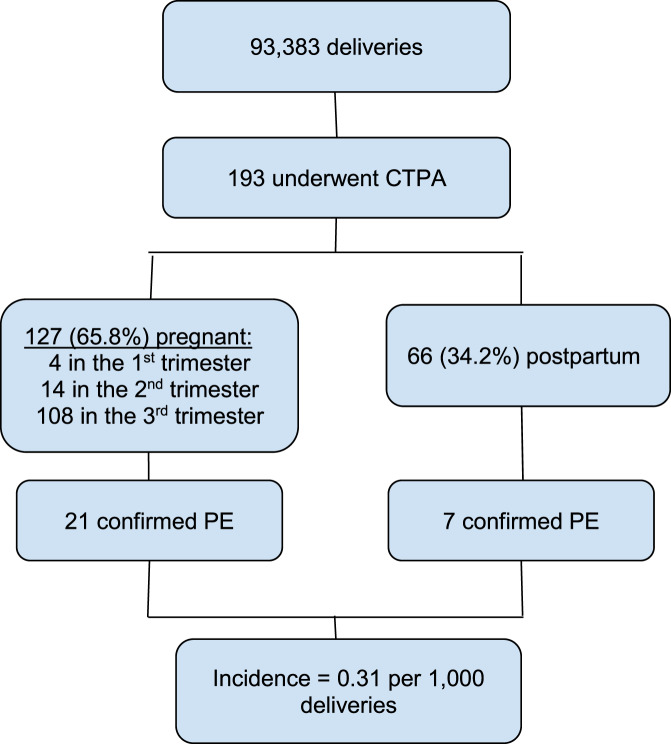 Figure 1
Peer Reviews
No public reviews on file for this paper yet. If you reviewed it on a platform where reviews are public (OpenReview, ICLR, NeurIPS, ICML), you can paste yours below so the community can read it here.
Videos
No videos yet. Explain this paper in a talk, walkthrough, or lecture? Add one.
Taxonomy
TopicsVenous Thromboembolism Diagnosis and Management · Blood Coagulation and Thrombosis Mechanisms