Differential Cortical Activations Among Young Adults Who Fall Versus Those Who Recover Successfully Following an Unexpected Slip During Walking
Rudri Purohit, Shuaijie Wang, Tanvi Bhatt

TL;DR
This study finds that young adults who fall after a slip show increased brain activity in a specific frequency range shortly after the slip, suggesting higher cortical involvement in error detection.
Contribution
The study identifies differential cortical beta power activation in young adults who fall versus those who recover from a slip, linking early post-perturbation brain activity to fall outcomes.
Findings
Participants who fell showed significantly higher beta power in the 0–150 milliseconds post-perturbation period compared to those who recovered.
There were no differences in beta power between groups during the 150–300 milliseconds post-perturbation period.
Increased early beta power correlates with a larger mismatch between expected and actual postural states during a slip.
Abstract
Background: Biomechanical and neuromuscular differences between falls and recoveries have been well-studied; however, the cortical correlations remain unclear. Using mobile brain imaging via electroencephalography (EEG), we examined differences in sensorimotor beta frequencies between falls and recoveries during an unpredicted slip in walking. Methods: We recruited 22 young adults (15 female; 18–35 years) who experienced a slip (65 cm) during walking. Raw EEG signals were band-pass filtered, and independent component analysis was performed to remove non-neural sources, eventually three participants were excluded due to excessive artifacts. Peak beta power was extracted from three time-bins: 400 milliseconds pre-, 0–150 milliseconds post and 150–300 milliseconds post-perturbation from the midline (Cz) electrode. A 2 × 3 Analysis of Covariance assessed the interaction between time-bins…
Genes, proteins, chemicals, diseases, species, mutations and cell lines named across the full text — each resolved to its canonical identifier and authoritative record.
Click any figure to enlarge with its caption.
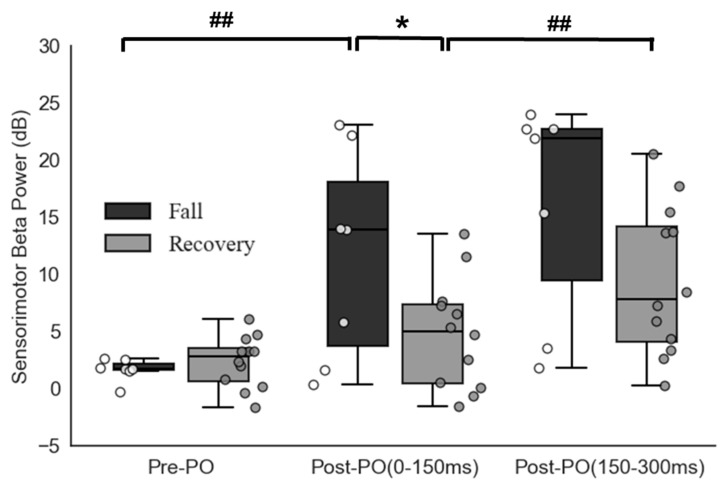 Figure 1
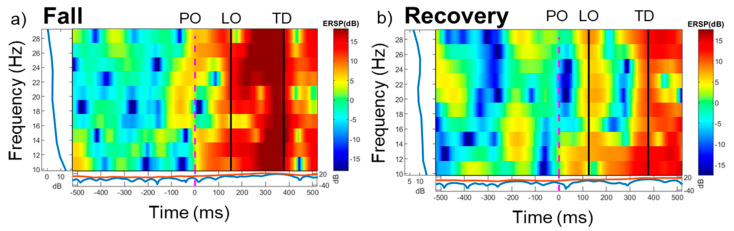 Figure 2
Peer Reviews
No public reviews on file for this paper yet. If you reviewed it on a platform where reviews are public (OpenReview, ICLR, NeurIPS, ICML), you can paste yours below so the community can read it here.
Videos
No videos yet. Explain this paper in a talk, walkthrough, or lecture? Add one.
Taxonomy
TopicsBalance, Gait, and Falls Prevention · Stroke Rehabilitation and Recovery · Cerebral Palsy and Movement Disorders