The Promise of Intranasal Oxytocin in Treating Borderline Personality Disorder: A Narrative Review
Eleni Giannoulis, Christos Nousis, Lydia-Angeliki Eytaxia, Olga Kaimakami, Ioannis Malogiannis

TL;DR
This paper reviews how intranasal oxytocin might help treat borderline personality disorder by improving emotional regulation and social cognition, though results are mixed.
Contribution
The paper provides a narrative synthesis of oxytocin’s potential as an adjunct therapy for BPD, highlighting neurobiological mechanisms and variability in clinical responses.
Findings
Intranasal oxytocin modulates amygdala reactivity and prefrontal-limbic connectivity in BPD.
Oxytocin improves emotional regulation and interpersonal sensitivity, especially in trauma-exposed individuals.
Effect sizes vary widely, with some trials reporting adverse effects like increased hypermentalization.
Abstract
Background/Objectives: Borderline personality disorder (BPD) is a complex psychiatric condition marked by emotional dysregulation, interpersonal instability, and impulsivity. Despite the advances in psychotherapy and pharmacotherapy, many patients show a partial or unstable response. Recent research suggests that oxytocin, a neuropeptide involved in social cognition and emotional regulation, may offer novel therapeutic avenues. Methods: We systematically synthesize evidence from PubMed, PsycINFO, Web of Science, and Google Scholar on oxytocin’s role in BPD, prioritizing studies on neurobiology, emotion regulation, clinical interventions, and adjunctive therapy models. Thirty studies were included and critically appraised using PRISMA and Cochrane’s tools. Due to methodological heterogeneity, no meta-analysis was conducted; instead, the findings were integrated through a narrative…
Genes, proteins, chemicals, diseases, species, mutations and cell lines named across the full text — each resolved to its canonical identifier and authoritative record.
Click any figure to enlarge with its caption.
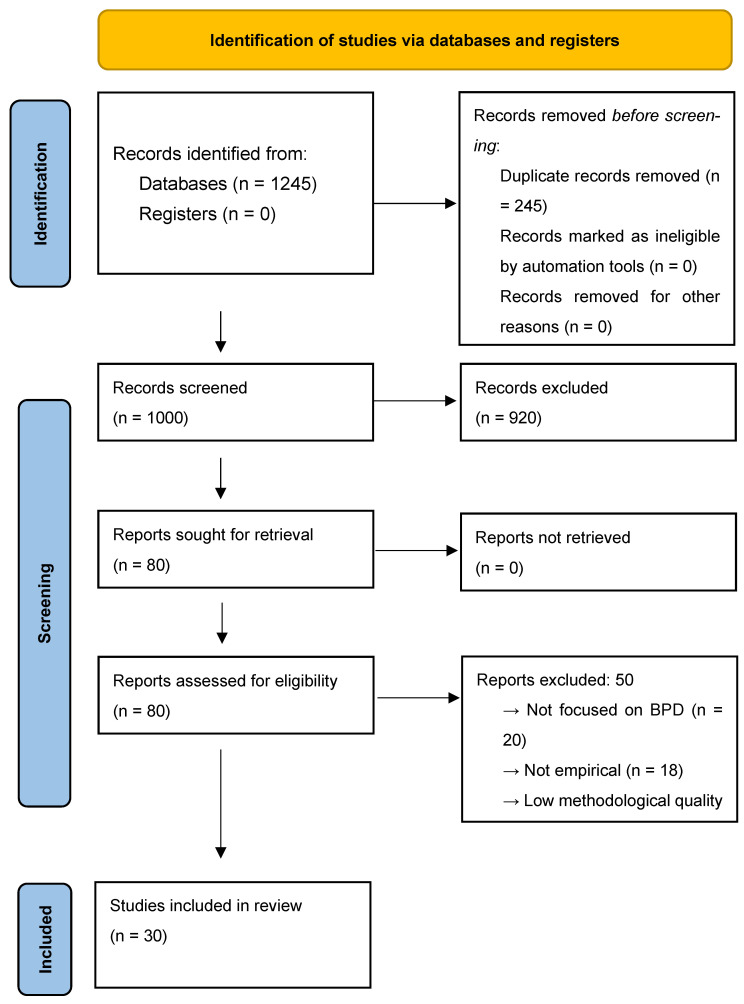 Figure 1
Peer Reviews
No public reviews on file for this paper yet. If you reviewed it on a platform where reviews are public (OpenReview, ICLR, NeurIPS, ICML), you can paste yours below so the community can read it here.
Videos
No videos yet. Explain this paper in a talk, walkthrough, or lecture? Add one.
Taxonomy
TopicsNeuroendocrine regulation and behavior · Evolutionary Psychology and Human Behavior · Attachment and Relationship Dynamics