Associations Between Symptom Complexity and Acute Care Utilization Among Adult Advanced Cancer Patients Followed by a Palliative Care Service
Philip Pranajaya, Vincent Ho, Mengzhu Jiang, Vance Tran, Aynharan Sinnarajah

TL;DR
This study shows that a new symptom complexity algorithm can help predict which advanced cancer patients are more likely to use emergency hospital services in the short term.
Contribution
A novel symptom complexity algorithm using the ESAS-r is introduced to predict acute care utilization in advanced cancer patients.
Findings
High-complexity patients were 2.83 times more likely to use acute care within seven days compared to low-complexity patients.
Symptom complexity did not significantly predict acute care use within fourteen days after adjusting for other factors.
The algorithm may help clinicians identify patients needing more frequent follow-ups to reduce unnecessary hospital visits.
Abstract
Advanced cancer symptoms can cause patients to go to the emergency department or stay in the hospital. Clinicians can use the Edmonton Symptom Assessment System—Revised (ESAS-r) to monitor these symptoms. We investigated if a new “symptom complexity” algorithm, which uses the ESAS-r to identify patients with “low”, “medium”, or “high” symptom complexity, could predict whether adult advanced cancer patients will use these hospital services. Of 559 patients, we identified 125 (22.4%) low-complexity, 180 (32.2%) medium-complexity, and 254 (45.4%) high-complexity patients. In total, 61 (10.9%) patients used these hospital services in seven days and 108 (19.3%) used them in fourteen days. High-complexity patients were 2.83 times more likely than low-complexity patients to access these hospital services within seven days. However, these groups of patients used these services equally as often…
Genes, proteins, chemicals, diseases, species, mutations and cell lines named across the full text — each resolved to its canonical identifier and authoritative record.
Click any figure to enlarge with its caption.
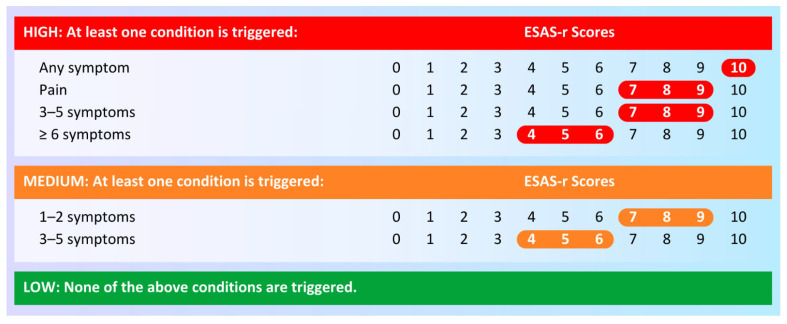 Figure 1
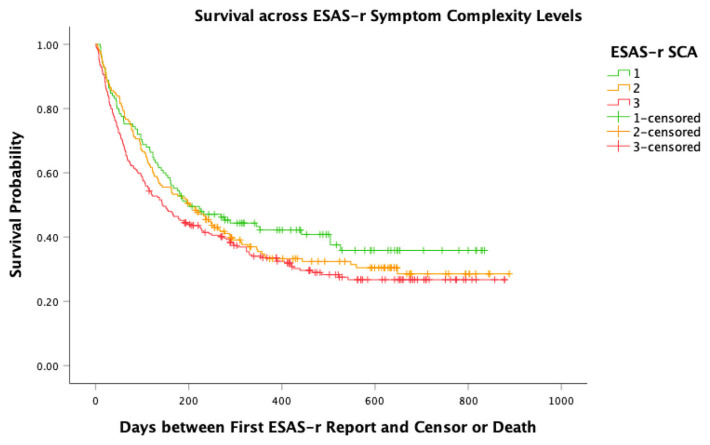 Figure 2
Peer Reviews
No public reviews on file for this paper yet. If you reviewed it on a platform where reviews are public (OpenReview, ICLR, NeurIPS, ICML), you can paste yours below so the community can read it here.
Videos
No videos yet. Explain this paper in a talk, walkthrough, or lecture? Add one.
Taxonomy
TopicsPalliative Care and End-of-Life Issues · Cancer survivorship and care · Childhood Cancer Survivors' Quality of Life