First Episode Psychosis in Patients Aged 18 to 30 Admitted Involuntarily: Characteristics and Risk Factors for Functional Non-Remission
Maria El Helou, Matthieu Hein, Beni-Champion Cimpaye, Benjamin Wacquier, Anaïs Mungo

TL;DR
This study examines why some young adults with first-time psychosis do not recover well after hospitalization, finding that longer untreated psychosis and social issues are key factors.
Contribution
The study identifies duration of untreated psychosis and psychosocial vulnerabilities as independent predictors of functional non-remission in first episode psychosis.
Findings
Only 48.8% of patients achieved functional remission at discharge.
DUP ≥ 4 weeks remained an independent predictor of functional non-remission after multivariate analysis.
Social isolation, low socioeconomic status, and lack of structured activities were associated with poor outcomes.
Abstract
Introduction: This study aimed to explore the clinical and psychosocial characteristics associated with functional non-remission in young adults involuntarily hospitalized for a first episode of psychosis (FEP), focusing on the role of duration of untreated psychosis (DUP) and contextual vulnerabilities. Material and method: We conducted a retrospective monocentric study including 123 patients aged 18–30 who were involuntarily admitted between 2013 and 2023 for a first psychotic episode. Sociodemographic, clinical, and care-related data were extracted from medical records. Functional remission was defined as a Global Assessment of Functioning (GAF) score ≥70 at discharge. Univariate and multivariate logistic regressions were used to identify predictors of functional non-remission. Results: Only 48.8% of patients achieved functional remission at discharge. Social isolation, low…
Genes, proteins, chemicals, diseases, species, mutations and cell lines named across the full text — each resolved to its canonical identifier and authoritative record.
Click any figure to enlarge with its caption.
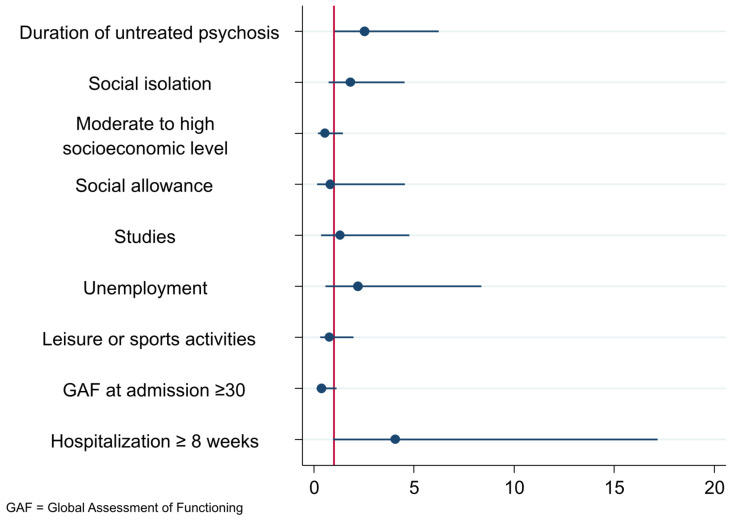 Figure 1
Peer Reviews
No public reviews on file for this paper yet. If you reviewed it on a platform where reviews are public (OpenReview, ICLR, NeurIPS, ICML), you can paste yours below so the community can read it here.
Videos
No videos yet. Explain this paper in a talk, walkthrough, or lecture? Add one.
Taxonomy
TopicsSchizophrenia research and treatment · Mental Health and Psychiatry · Psychosomatic Disorders and Their Treatments