Toxicity Profiles of Antibody–Drug Conjugates: Synthesis and Graphical Insights to Optimize Patient-Centered Treatment Strategies for HER2-Negative Metastatic Breast Cancer
Bérénice Collineau, Anthony Gonçalves, Marie Domon, Damien Bruyat, François Bertucci, Alexandre de Nonneville

TL;DR
This paper compares the toxicity profiles of two antibody-drug conjugates for HER2-negative metastatic breast cancer to help guide patient-centered treatment decisions.
Contribution
The study provides a graphical synthesis of toxicity data from pivotal trials to support shared decision-making in ADC treatment selection.
Findings
T-DXd showed high rates of nausea, fatigue, and neutropenia, with pneumonitis occurring in 10.7% of cases.
SG had higher rates of neutropenia and diarrhea, with grade ≥ 3 neutropenia in 51.3% of patients.
Graphical tools were developed to compare adverse events and support patient-centered treatment strategies.
Abstract
The advent of antibody–drug conjugates (ADCs) has reshaped the treatment landscape for HER2-negative metastatic breast cancer through their targeted cytotoxic delivery. Trastuzumab deruxtecan (T-DXd) and Sacituzumab govitecan (SG) have shown their efficacy but come with distinct toxicity profiles, including conventional adverse events, such as hematologic and digestive toxicity, and ADC-specific adverse events like pneumonitis for T-DXd. With a growing pipeline of ADCs and limited head-to-head or sequencing data, treatment choices may become increasingly complex. In clinical scenarios where both T-DXd and SG are treatment options, understanding and comparing their safety profiles is key to guiding shared decision-making. Decision-support tools synthesizing efficacy and toxicity data are essential to help oncologists and patients select the most appropriate ADC for each clinical…
Genes, proteins, chemicals, diseases, species, mutations and cell lines named across the full text — each resolved to its canonical identifier and authoritative record.
Click any figure to enlarge with its caption.
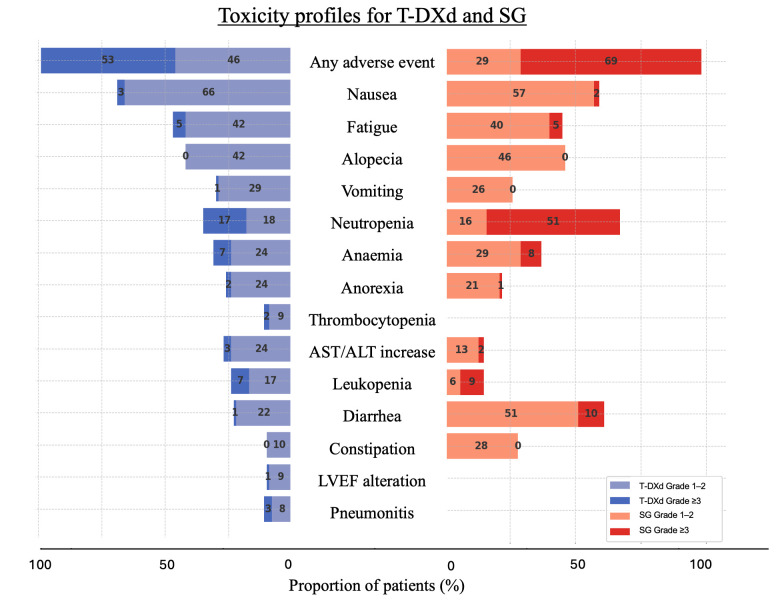 Figure 1
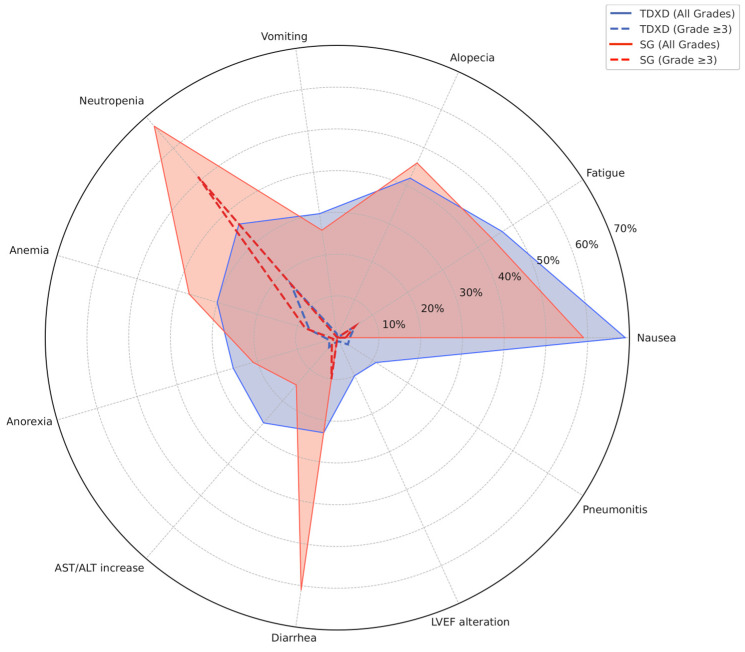 Figure 2
Peer Reviews
No public reviews on file for this paper yet. If you reviewed it on a platform where reviews are public (OpenReview, ICLR, NeurIPS, ICML), you can paste yours below so the community can read it here.
Videos
No videos yet. Explain this paper in a talk, walkthrough, or lecture? Add one.
Taxonomy
TopicsHER2/EGFR in Cancer Research · Advanced Breast Cancer Therapies · Cancer Treatment and Pharmacology