Performance of Computed Tomography of the Kidneys, Ureter and Bladder in Non-Calculus Diagnoses: A Comparative Review of Non-Enhanced with Intravenous Contrast-Enhanced Imaging
Alexander T. O’Mahony, Michael G. Waldron, David J. Ryan, Brian Carey, Sahil Shet, Eid Kakish, Patrick O’Regan, David Glynn, Josephine Barry, Owen J. O’Connor, Michael M. Maher

TL;DR
This study compares non-contrast and contrast-enhanced CT scans for kidney, ureter, and bladder imaging, finding that contrast-enhanced CT detects more alternative diagnoses but uses more radiation.
Contribution
The study provides a comparative analysis of CT protocols for non-calculus diagnoses in suspected kidney stone cases.
Findings
Contrast-enhanced CT detected 40% alternative findings versus 23% with non-contrast CT.
Contrast-enhanced CT had 85 findings compared to 48 with non-contrast CT.
Contrast-enhanced CT exposed patients to 2.4 times more radiation than non-contrast CT.
Abstract
Background/Objectives: Non-enhanced computed tomography of the kidneys, ureters and bladder (NECT KUB) is the initial imaging modality for suspected nephroureterolithiasis. However, for alternative diagnoses, NECT may not be the ideal technique. Our institution changed the protocol for this cohort from NECT to intravenous contrast-enhanced CT (CECT) KUB. We aimed to retrospectively compare the rate of alternative diagnosis seen and the rates of calculus detection in CECT versus NECT KUB as a means of assessing performance. Our secondary aim was to compare the radiation dose between CECT and NECT KUB. Methods: Patients referred from the emergency department with suspected nephroureterolithiasis who underwent NECT and CECT KUB over two years were included. Key performance metrics included calculus detection rate, alternative findings, and negative studies. The metrics were compared…
Genes, proteins, chemicals, diseases, species, mutations and cell lines named across the full text — each resolved to its canonical identifier and authoritative record.
Click any figure to enlarge with its caption.
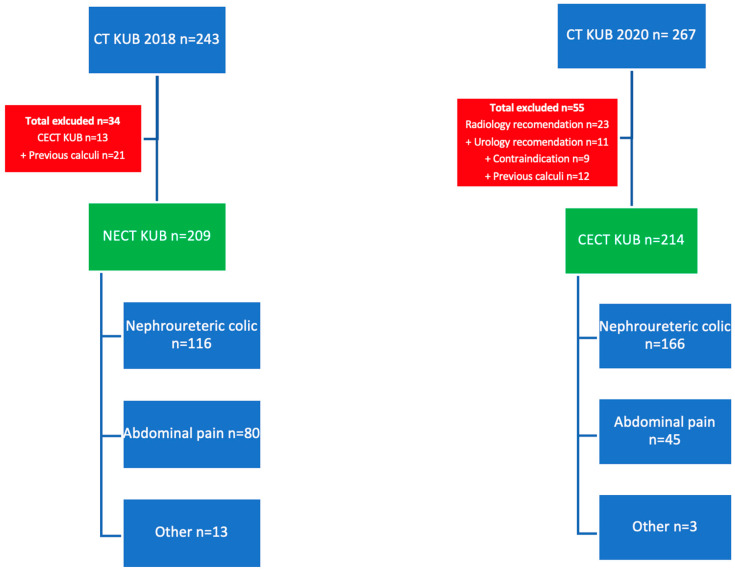 Figure 1
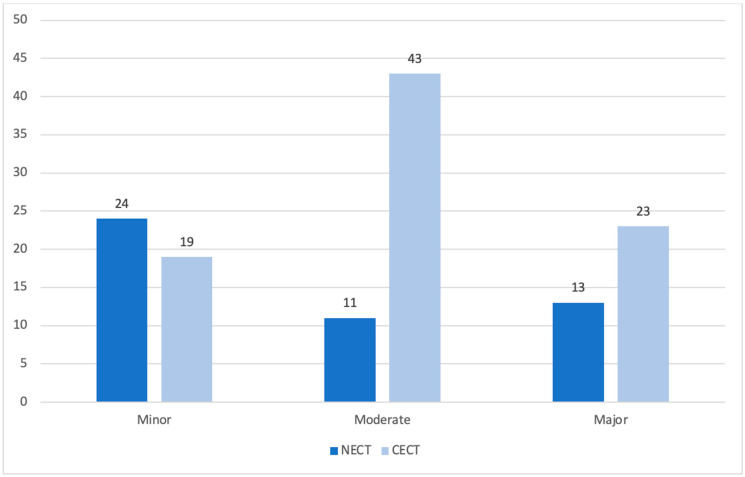 Figure 2
 Figure 3
Peer Reviews
No public reviews on file for this paper yet. If you reviewed it on a platform where reviews are public (OpenReview, ICLR, NeurIPS, ICML), you can paste yours below so the community can read it here.
Videos
No videos yet. Explain this paper in a talk, walkthrough, or lecture? Add one.
Taxonomy
TopicsKidney Stones and Urolithiasis Treatments · Advanced X-ray and CT Imaging · Pediatric Urology and Nephrology Studies