Telomere Length and Emotional and Behavioral Problems in Children from the Prospective Birth Cohort INfancia y Medio Ambiente (INMA) Study
Irene Campos-Sánchez, Eva María Navarrete-Muñoz, Josep Xavier Barber-Valles, Dries S. Martens, Isolina Riaño-Galán, Amaia Irizar, Sabrina Llop, Mónica Guxens, Cristina Rodríguez-Dehli, Izaro Babarro, Manuel Lozano, Martine Vrijheid, Tim Nawrot, Desirée Valera-Gran

TL;DR
This study investigated if telomere length in children at ages 4 and 8 is linked to emotional and behavioral issues at age 8, but found no significant associations.
Contribution
The study contributes a longitudinal analysis of telomere length and emotional/behavioral problems in children.
Findings
No significant association was found between telomere length at age 4 and emotional/behavioral problems at age 8.
Changes in telomere length between ages 4 and 8 were also not significantly associated with behavioral outcomes.
The results suggest telomere length may not be a reliable psychobiomarker for childhood emotional problems.
Abstract
Background/Objectives: This study aimed to examine the association between leukocyte telomere length (TL) measured at ages 4 and 8 and emotional and behavioral problems at age 8. We also explored whether changes in leukocyte TL between ages 4 and 8 were associated with outcomes. Methods: Data were obtained from a population-based birth cohort and included 647 children with TL at age 4 and emotional and behavioral assessments at age 8, 673 with TL and outcomes at age 8, and 315 with TL measured at both ages. TL was determined using quantitative PCR on blood samples and converted into z-scores for analysis. Emotional and behavioral problems—including internalizing, externalizing, and total difficulties—were assessed using the Strengths and Difficulties Questionnaire. Regression models were conducted using zero-inflated and negative binomial, adjusting for sociodemographic and lifestyle…
Genes, proteins, chemicals, diseases, species, mutations and cell lines named across the full text — each resolved to its canonical identifier and authoritative record.
Click any figure to enlarge with its caption.
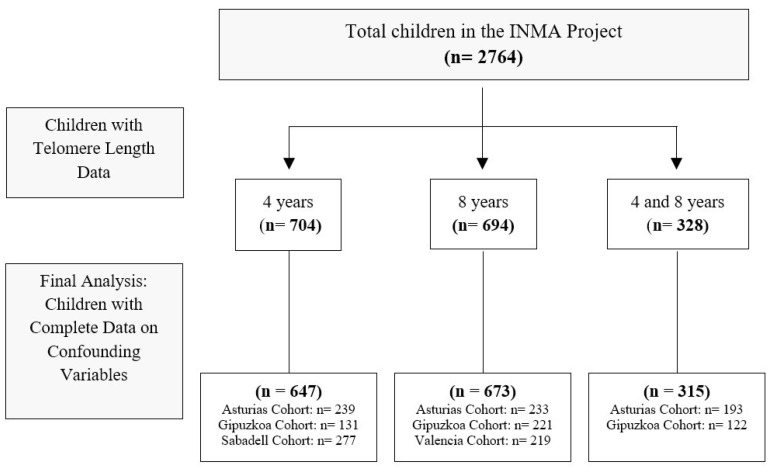 Figure 1
Peer Reviews
No public reviews on file for this paper yet. If you reviewed it on a platform where reviews are public (OpenReview, ICLR, NeurIPS, ICML), you can paste yours below so the community can read it here.
Videos
No videos yet. Explain this paper in a talk, walkthrough, or lecture? Add one.
Taxonomy
TopicsTelomeres, Telomerase, and Senescence · Birth, Development, and Health · Health, Environment, Cognitive Aging