Why Empirical Forgetting Curves Deviate from Actual Forgetting Rates: A Distribution Model of Forgetting
Nate Kornell, Robert A. Bjork

TL;DR
This paper explains why forgetting curves in memory research don't match actual forgetting rates, using a model based on memory strength distribution.
Contribution
The paper introduces a distribution model of memory that clarifies the discrepancy between empirical forgetting curves and item forgetting rates.
Findings
Forgetting curves are shaped by the distribution of memory strengths relative to a recall threshold.
The model predicts linear or concave forgetting curves when percent correct is high, supported by experimental evidence.
Memories just above the recall threshold help short-term performance but do not form lasting memories.
Abstract
For over a century, forgetting research has shown that recall decreases along a power or exponential function over time. It is tempting to assume that empirical forgetting curves are equivalent to the rate at which individual memories are forgotten. This assumption would be erroneous, because forgetting curves are influenced by an often-neglected factor: the distribution of memory strengths relative to a recall threshold. For example, if memories with normally distributed initial strengths were forgotten at a linear rate, percent correct would not be linear, it would decrease rapidly when the peak of the distribution was crossing the recall threshold and slowly when one of the tails was crossing the threshold. We describe a distribution model of memory that explains the divergence between forgetting curves and item forgetting rates. The model predicts that forgetting curves can be…
Genes, proteins, chemicals, diseases, species, mutations and cell lines named across the full text — each resolved to its canonical identifier and authoritative record.
Click any figure to enlarge with its caption.
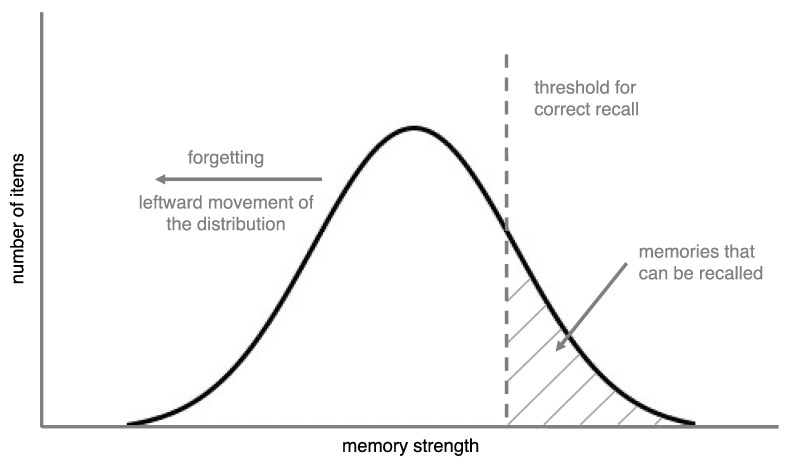 Figure 1
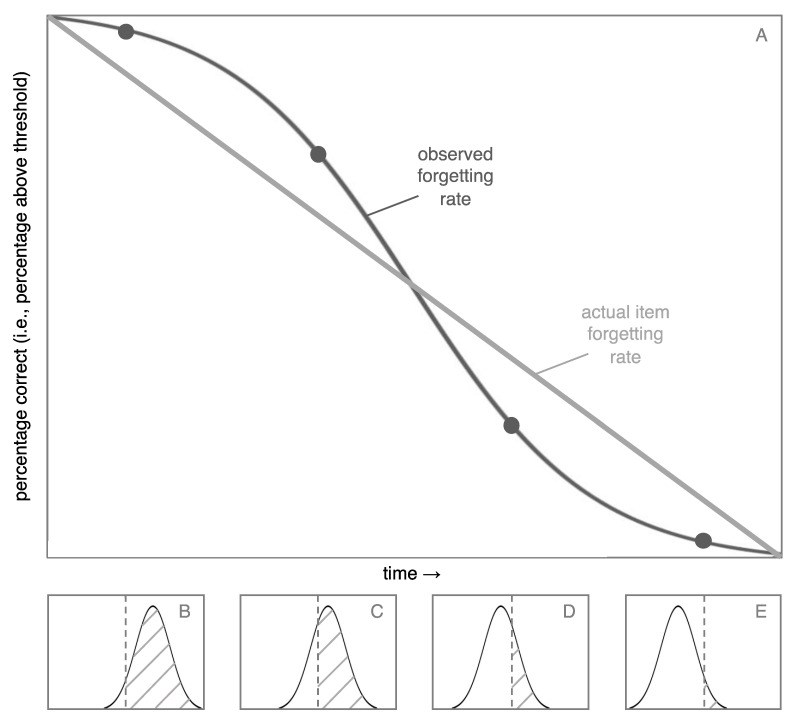 Figure 2
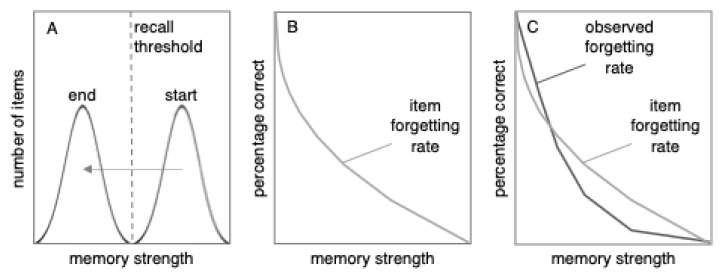 Figure 3
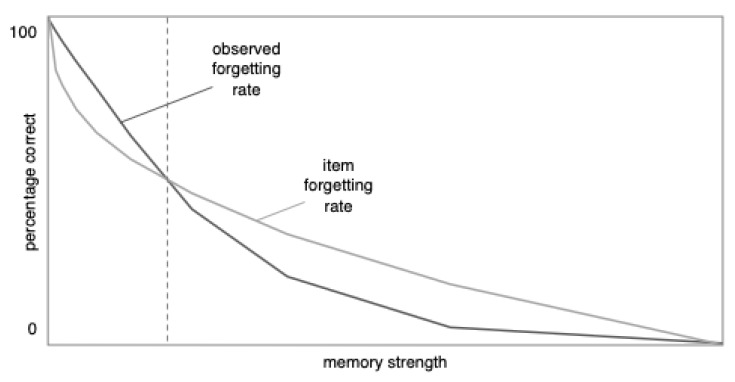 Figure 4
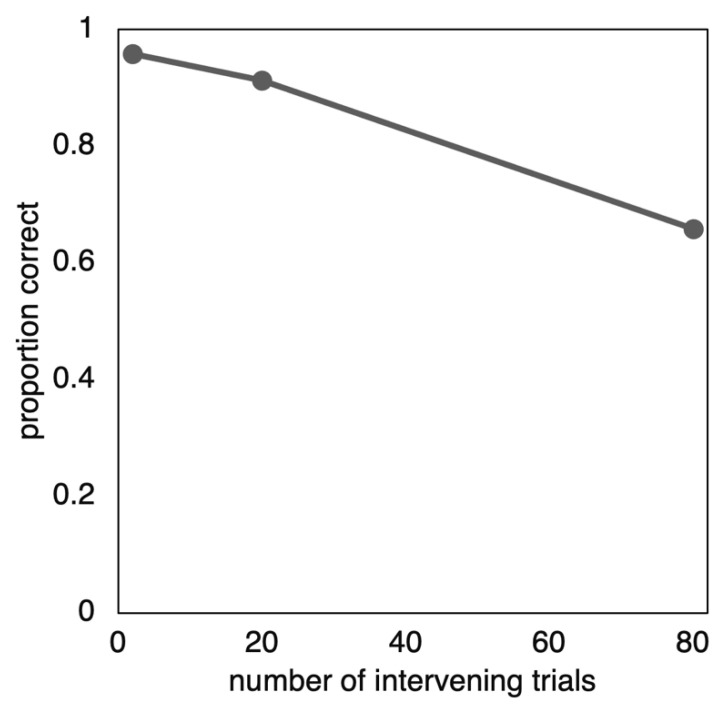 Figure 5
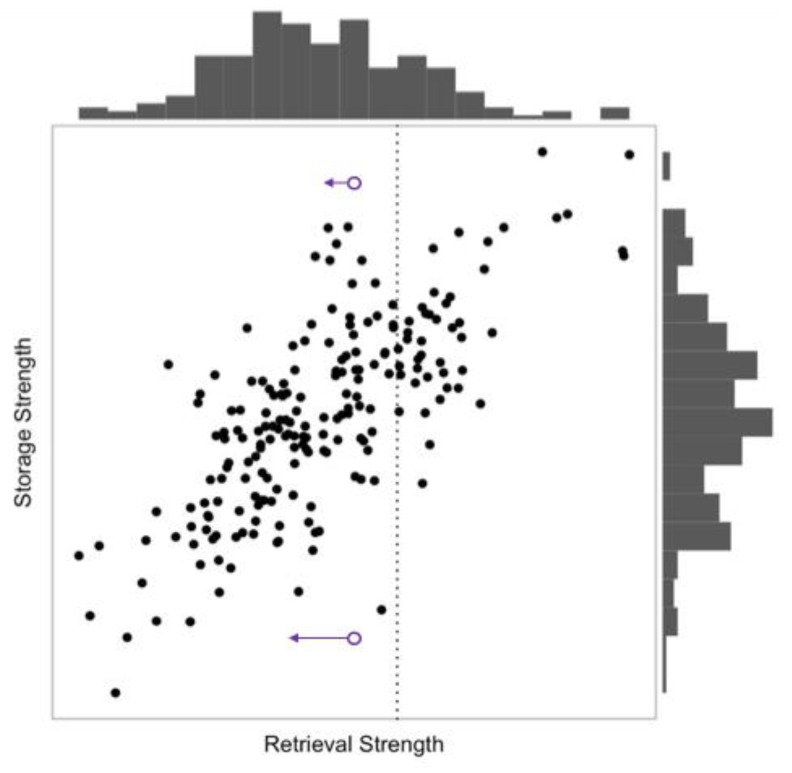 Figure 6
Peer Reviews
No public reviews on file for this paper yet. If you reviewed it on a platform where reviews are public (OpenReview, ICLR, NeurIPS, ICML), you can paste yours below so the community can read it here.
Videos
No videos yet. Explain this paper in a talk, walkthrough, or lecture? Add one.
Taxonomy
TopicsMemory Processes and Influences · Domain Adaptation and Few-Shot Learning · Intelligent Tutoring Systems and Adaptive Learning