Heterologous Production of the Structurally Complex Diterpenoid Forskolin in Synechocystis sp. PCC. 6803
Nadia Dodge, Lawrence Chuk Sutardja, Silas Mellor, Thiyagarajan Gnanasekaran, Lærke Marie Münter Lassen, Agnieszka Zygadlo Nielsen, Birger Lindberg Møller, Poul Erik Jensen

TL;DR
Scientists engineered cyanobacteria to produce forskolin, a complex plant compound with pharmaceutical uses, using sunlight as an energy source.
Contribution
The first successful heterologous production of forskolin in a phototrophic cyanobacterium using all six required biosynthetic genes.
Findings
Forskolin was produced at 25.0 ± 4.4 µg/L and fully secreted into the media.
Forskolin production did not hinder cyanobacterial growth or photosynthetic efficiency.
Forskolin accumulation began after four days of cultivation in a photobioreactor.
Abstract
Photosynthetic organisms such as cyanobacteria have the potential for the sustainable production of complex organic molecules due to their ability to use light as an energy source to fix CO2 and assimilate inorganic nutrients. Over the past decade, large efforts have been put into the metabolic engineering of cyanobacteria to produce various compounds such as alcohols, isoprenoids, biopolymers, and recombinant proteins. Forskolin is a structurally complex labdane-type diterpenoid with eight chiral carbon atoms and is naturally produced in the root cork of the plant Plectranthus barbatus. Forskolin is a potent cAMP activator indicated as a pharmaceutical for a variety of diseases. In the plant, forskolin biosynthesis from geranylgeranyl diphosphate involves six enzymes: two terpene synthases, three cytochrome P450s, and a single acetyltransferase. In this work, we express all six…
Genes, proteins, chemicals, diseases, species, mutations and cell lines named across the full text — each resolved to its canonical identifier and authoritative record.
Click any figure to enlarge with its caption.
 Figure 1
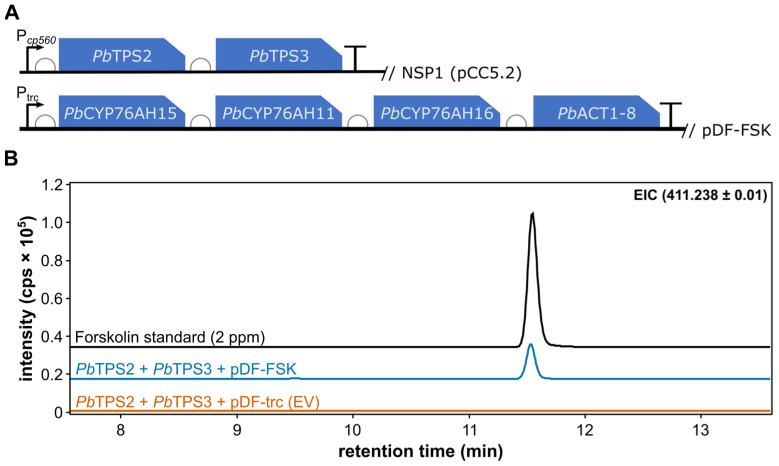 Figure 2
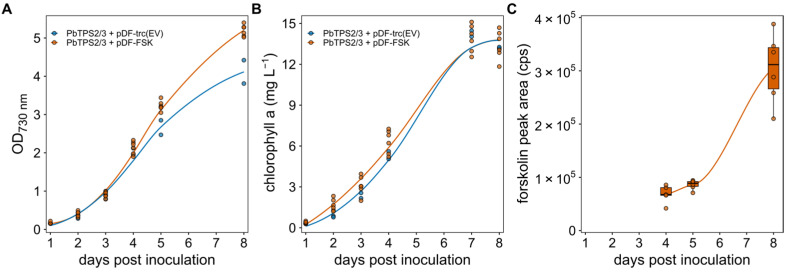 Figure 3
Peer Reviews
No public reviews on file for this paper yet. If you reviewed it on a platform where reviews are public (OpenReview, ICLR, NeurIPS, ICML), you can paste yours below so the community can read it here.
Videos
No videos yet. Explain this paper in a talk, walkthrough, or lecture? Add one.
Taxonomy
TopicsPlant biochemistry and biosynthesis · Photosynthetic Processes and Mechanisms · Algal biology and biofuel production