The Effect of Developmental Characteristics of Adolescents’ Perceived Social Support on Social–Emotional Competence from a Cumulative Ecological Resources Theory Perspective
Chao Ma, Chanjuan Zhang, Wenyin Zhao, Haibo Yu

TL;DR
This study explores how different types of perceived social support in adolescents affect their social-emotional competence over time.
Contribution
The study introduces a new framework for understanding how perceived social support influences social-emotional competence through developmental transitions.
Findings
Adolescents' perceived social support can be categorized into four distinct types: Poor, Moderate, Rich, and Separated.
Transitioning to or remaining in the Rich type of perceived social support positively predicts social-emotional competence.
Gender, age, and boarding status influence transitions between types of perceived social support.
Abstract
Cumulative Ecological Resources Theory offers an integrative perspective for social–emotional interventions by overcoming the traditional dichotomy between internal and external resources. As a crucial ecological resource, perceived social support is known to be heterogeneous, yet its mechanism of influence on social–emotional competence remains to be clarified. This study investigates the effect of developmental characteristics of adolescents’ perceived social support on social–emotional competence. A six-month longitudinal study tracked 995 adolescents using the Multidimensional Scale of Perceived Social Support and the Delaware Social and Emotional Competency Scale. Based on the results, (1) the adolescents’ perceived social support could be categorized into four types: Poor, Moderate, Rich, and Separated; (2) the Poor type exhibited greater category mobility, whereas the Moderate…
Genes, proteins, chemicals, diseases, species, mutations and cell lines named across the full text — each resolved to its canonical identifier and authoritative record.
Click any figure to enlarge with its caption.
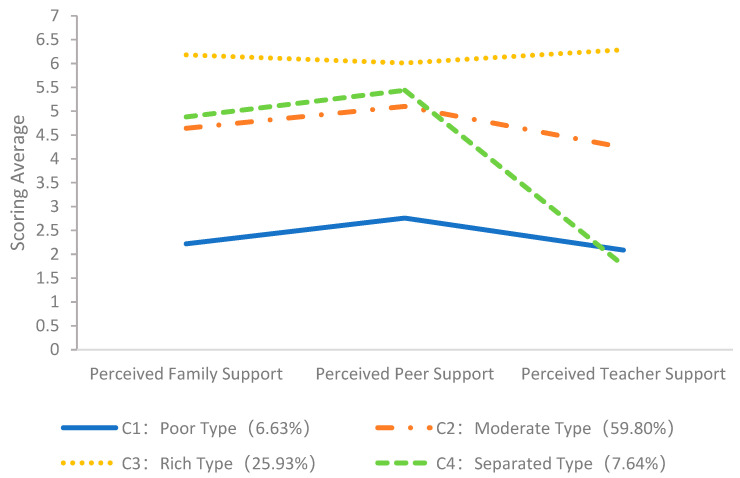 Figure 1
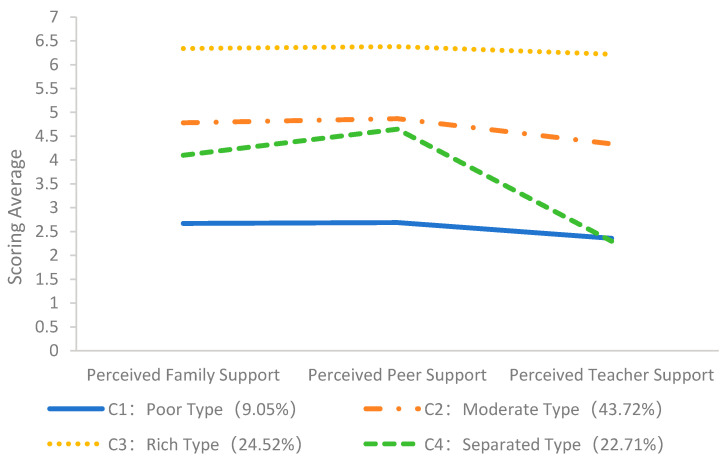 Figure 2
Peer Reviews
No public reviews on file for this paper yet. If you reviewed it on a platform where reviews are public (OpenReview, ICLR, NeurIPS, ICML), you can paste yours below so the community can read it here.
Videos
No videos yet. Explain this paper in a talk, walkthrough, or lecture? Add one.
Taxonomy
TopicsChild and Adolescent Psychosocial and Emotional Development · Attachment and Relationship Dynamics · Early Childhood Education and Development