Temporal Trends and Differences in Inpatient Palliative Care Use in Metastatic Penile Cancer Patients
Carolin Siech, Lukas Scheipner, Andrea Baudo, Mario de Angelis, Letizia Maria Ippolita Jannello, Francesco Di Bello, Fred Saad, Shahrokh F. Shariat, Nicola Longo, Luca Carmignani, Ottavio de Cobelli, Sascha Ahyai, Alberto Briganti, Séverine Banek, Luis A. Kluth, Felix K. H. Chun

TL;DR
This study examines how often inpatient palliative care is used for patients with metastatic penile cancer and finds that its use has increased over time, influenced by patient and hospital factors.
Contribution
The study provides new insights into temporal trends and geographic disparities in palliative care use for a rare cancer type.
Findings
Inpatient palliative care use increased from 6.5% in 2006 to 17.8% in 2019.
Bone and brain metastases independently predicted higher palliative care use.
Geographic regions like the South and Northeast had higher palliative care use than the Midwest.
Abstract
Objectives: To quantify inpatient palliative care use over time and to test whether patient or hospital characteristics represent determinants of inpatient palliative care use in patients with metastatic penile cancer. Methods: Relying on the National Inpatient Sample database (2006–2019), we identified 1017 metastatic penile cancer patients. Estimated annual percentage change analyses and multivariable logistic regression models addressing inpatient palliative care use were fitted. Results: Of 1017 metastatic penile cancer patients, 139 (13.7%) received inpatient palliative care. Over time, the proportion of inpatient palliative care use per year increased from 6.5% in 2006 to 17.8% in 2019 (estimated annual percentage change +6.7%; p = 0.001). In the multivariable logistic regression models, contemporary study years (odds ratio [OR] 1.80; p = 0.003), the presence of bone metastases…
Genes, proteins, chemicals, diseases, species, mutations and cell lines named across the full text — each resolved to its canonical identifier and authoritative record.
Click any figure to enlarge with its caption.
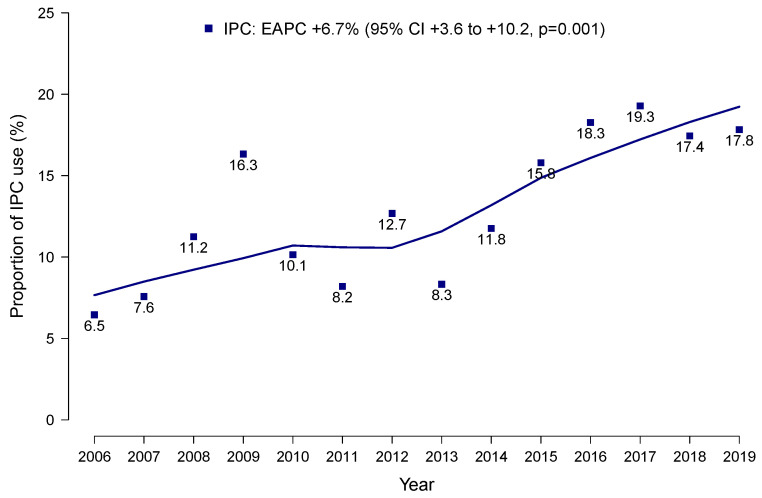 Figure 1
Peer Reviews
No public reviews on file for this paper yet. If you reviewed it on a platform where reviews are public (OpenReview, ICLR, NeurIPS, ICML), you can paste yours below so the community can read it here.
Videos
No videos yet. Explain this paper in a talk, walkthrough, or lecture? Add one.
Taxonomy
TopicsGenital Health and Disease · Palliative Care and End-of-Life Issues · Patient Dignity and Privacy