Inhibitory Effects of 3-(4-Hydroxy-3-methoxyphenyl) Propionic Acid on Amyloid β-Peptide Aggregation In Vitro
Makoto Mori, Hiroto Nakano, Sadao Hikishima, Jota Minamikawa, Daiki Muramatsu, Yasuhiro Sakashita, Tokuhei Ikeda, Moeko Noguchi-Shinohara, Kenjiro Ono

TL;DR
This study shows that HMPA, a polyphenol metabolite, can inhibit the aggregation of amyloid-beta peptides, which are linked to dementia.
Contribution
The study demonstrates HMPA's novel inhibitory effects on both nucleation and elongation phases of Aβ42 aggregation.
Findings
ThT assays showed HMPA inhibits nucleation and elongation phases of Aβ aggregation.
Electron microscopy revealed shorter Aβ42 fibrils in the presence of HMPA.
The EC50 of HMPA for low-molecular-weight Aβ42 was 5–6 mM.
Abstract
Objectives: The compound 3-(4-Hydroxy-3-methoxyphenyl) propionic acid (HMPA) is a terminal metabolite derived from polyphenol compounds. It has been studied for its potential to support brain health indirectly through its anti-oxidant effects and ability to enhance the gut environment; however, its role in dementia pathogenesis is unclear. Therefore, the aim of this study was to evaluate how HMPA inhibits Aβ42 aggregation in vitro. Methods: We examined the inhibitory effects of HMPA on amyloid-β protein (Aβ) aggregation using a thioflavin T (ThT) assay and electron microscopy (EM). Results: ThT assays demonstrated that HMPA inhibited both the nucleation and elongation phases of Aβ aggregation. Additionally, EM of low-molecular-weight (LMW) Aβ42 in the presence of HMPA demonstrated shorter fibrils compared to those formed without HMPA. The EC50 of HMPA in LMW Aβ42 was 5–6 mM.…
Genes, proteins, chemicals, diseases, species, mutations and cell lines named across the full text — each resolved to its canonical identifier and authoritative record.
Click any figure to enlarge with its caption.
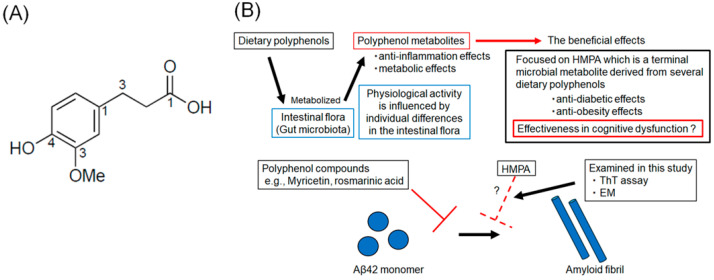 Figure 1
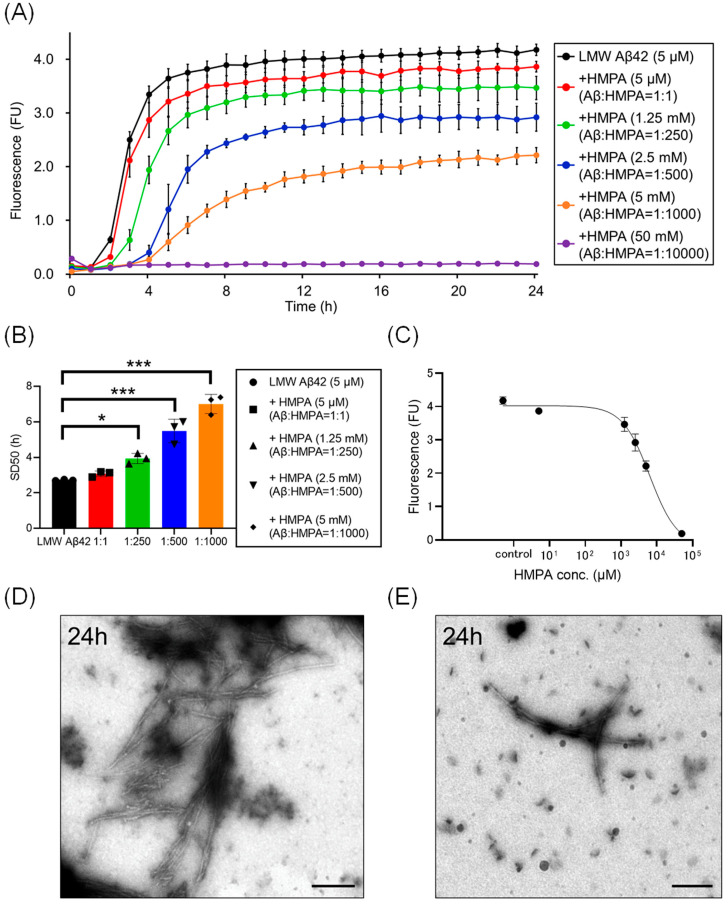 Figure 2
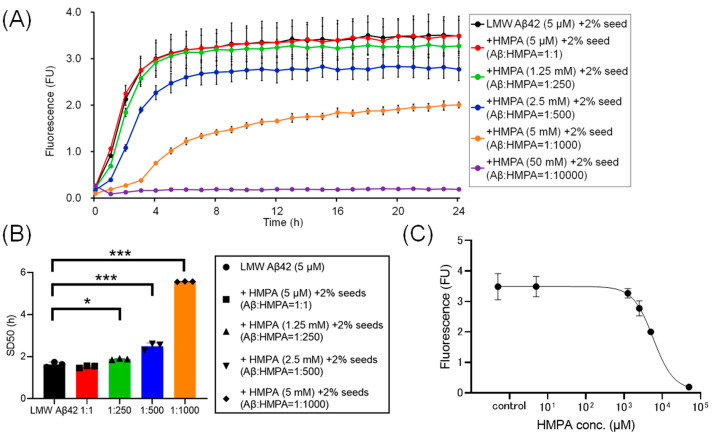 Figure 3
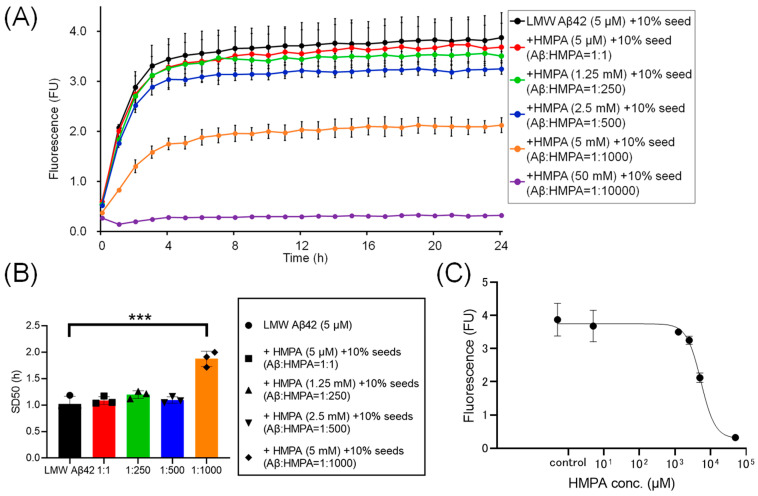 Figure 4
Peer Reviews
No public reviews on file for this paper yet. If you reviewed it on a platform where reviews are public (OpenReview, ICLR, NeurIPS, ICML), you can paste yours below so the community can read it here.
Videos
No videos yet. Explain this paper in a talk, walkthrough, or lecture? Add one.
Taxonomy
TopicsAlzheimer's disease research and treatments · Protein Hydrolysis and Bioactive Peptides · Biochemical effects in animals