Increased complexity of social category markers leads to diverse rule-based categorizations and reduced intergroup bias
Uri Hertz

TL;DR
This study shows that complex social markers lead to diverse personal rules for categorizing others, which reduces overall intergroup bias.
Contribution
The study introduces a novel approach to understanding how complex social markers influence individual categorization rules and intergroup bias.
Findings
Participants showed intergroup bias in all conditions but with reduced effect when social markers were complex.
Clustering analysis revealed diverse binary rules used by participants, increasing with marker complexity.
Differential treatment of dissimilar or intermediate-colour players led to less salient social categories.
Abstract
Social categories are key to human social life, often leading to intergroup bias and stereotypes. While traditional studies use binary social markers, real-world markers are more complex. This study explored whether such complexity results in complex social categories or less cognitively demanding binary rules. Participants (n = 784, prolific) played a multiplayer video game where they competed with other players for stars and could remove other players from their path by zapping them, with manipulated player appearances: binary colour, multidimensional shape and colour or a continuous colour gradient. In all conditions, participants showed an intergroup bias, zapping players who were similar to them less than dissimilar players. This effect was reduced when social markers were complex. However, the group pattern was shown to be driven by participants’ idiosyncratic binary rules in…
Genes, proteins, chemicals, diseases, species, mutations and cell lines named across the full text — each resolved to its canonical identifier and authoritative record.
Click any figure to enlarge with its caption.
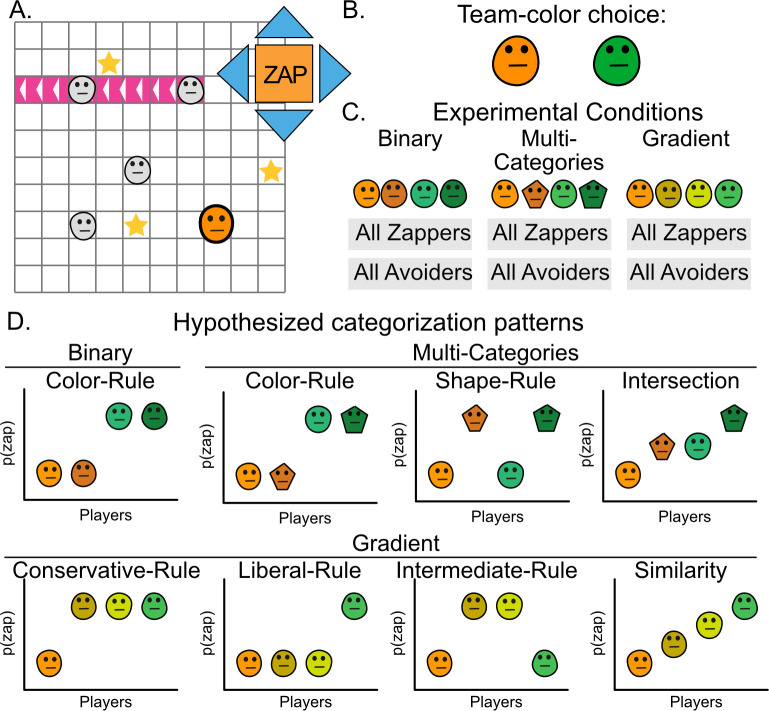 Figure 1
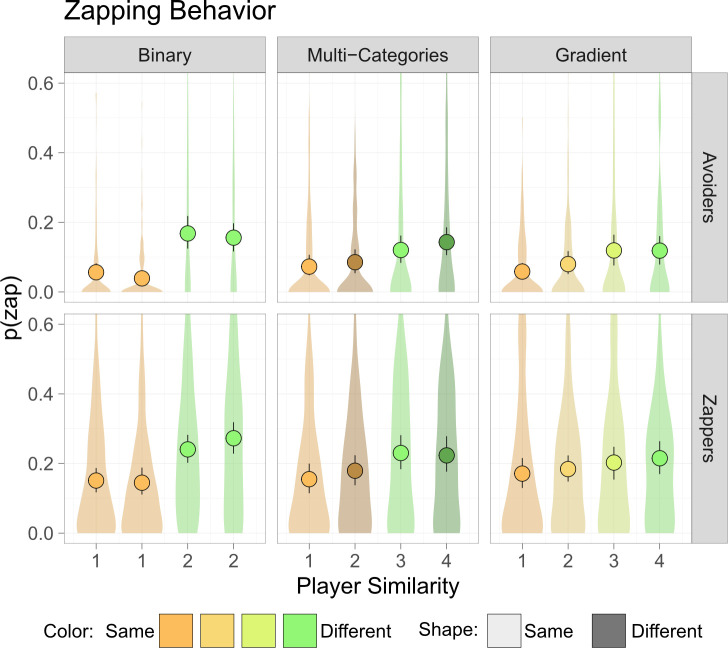 Figure 2
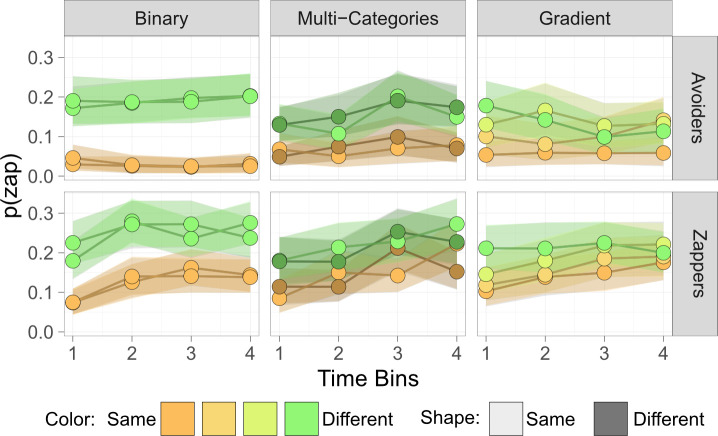 Figure 3
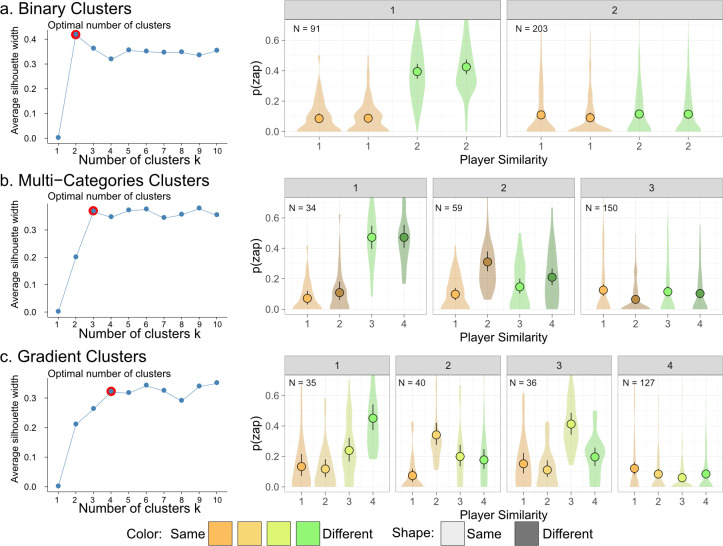 Figure 4
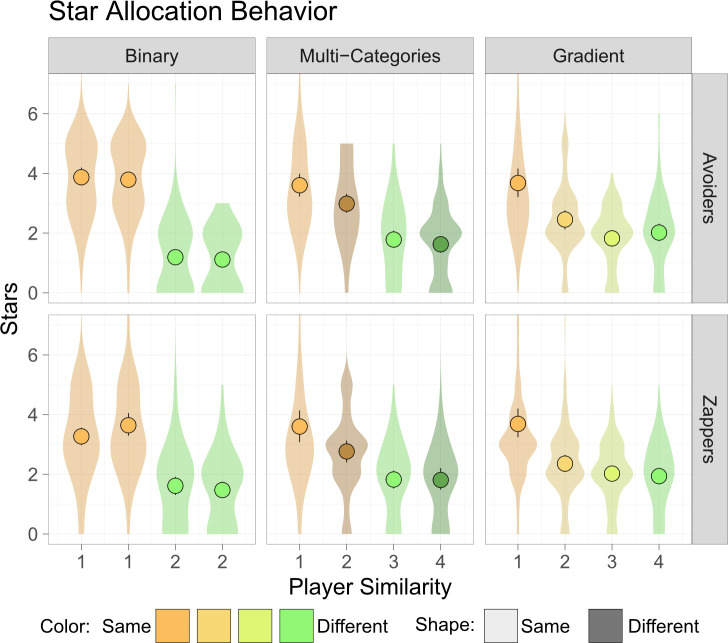 Figure 5
Peer Reviews
No public reviews on file for this paper yet. If you reviewed it on a platform where reviews are public (OpenReview, ICLR, NeurIPS, ICML), you can paste yours below so the community can read it here.
Videos
No videos yet. Explain this paper in a talk, walkthrough, or lecture? Add one.
Taxonomy
TopicsLanguage and cultural evolution