Effectiveness and Safety of Endovascular Treatment in Large Vessel Occlusion Stroke with an NIHSS Score of ≤5 Exhibiting Predominant Cortical Signs
Chulho Kim, Seung Joon Oh, Jae Jun Lee, Jong-Hee Sohn, Joo Hye Sung, Yerim Kim, Minwoo Lee, Mi Sun Oh, Kyung-Ho Yu, Hee Jung Mo, Sang-Hwa Lee

TL;DR
Endovascular treatment improves recovery and reduces bleeding risk in mild stroke patients with cortical signs, even with low NIHSS scores.
Contribution
Demonstrates that EVT benefits mild stroke patients with cortical signs, suggesting a need for individualized treatment decisions.
Findings
EVT group had a 65.3% rate of good functional recovery (mRS 0–1) compared to 39.3% in BMT group.
EVT reduced symptomatic hemorrhagic transformation risk (3.2% vs. 12.8%).
Patients with aphasia and spatial neglect had better outcomes with EVT.
Abstract
Background: Our study aimed to evaluate the impact of EVT on stroke outcomes in patients with LVO with a National Institute of Health Stroke Scale (NIHSS) score of ≤5, exhibiting primarily cortical signs. Methods: We conducted a multicenter registry-based analysis of patients with acute ischemic stroke with LVO who arrived within 12 h of onset. Among these, patients with low NIHSS scores and prominent cortical signs (Items 2, 3, 9, or 11) were included. Patients were divided into two groups: those who underwent EVT and those treated with the best medical therapy (BMT), which included intravenous thrombolysis where appropriate. The primary outcome measure was a modified Rankin scale (mRS) score of 0–1 at 3 months and symptomatic hemorrhagic transformation (SHT). We performed logistic regression analysis to evaluate the impact of EVT on the outcomes. Results: Of the 970 patients with LVO,…
Genes, proteins, chemicals, diseases, species, mutations and cell lines named across the full text — each resolved to its canonical identifier and authoritative record.
Click any figure to enlarge with its caption.
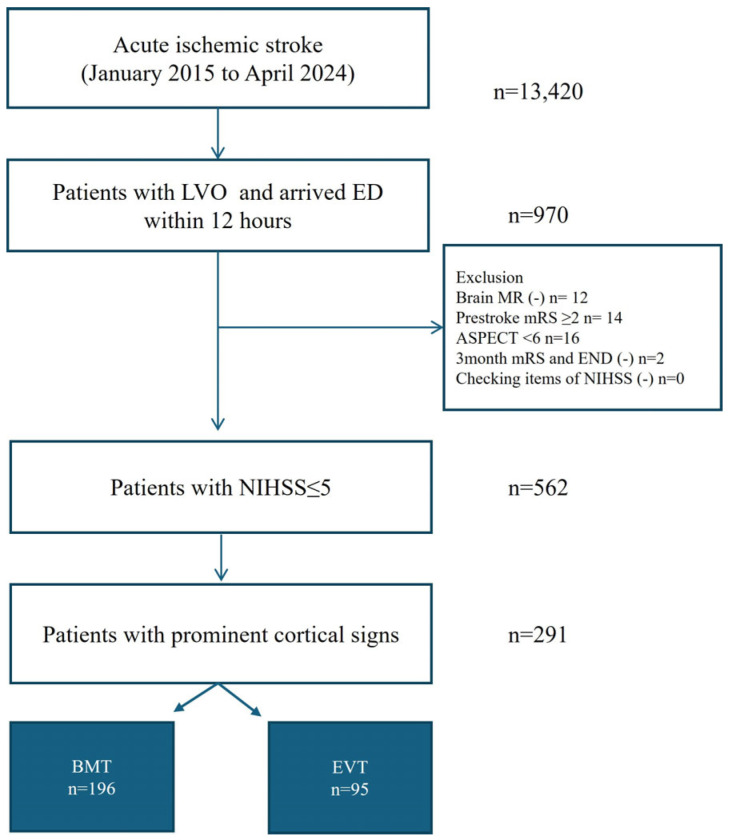 Figure 1
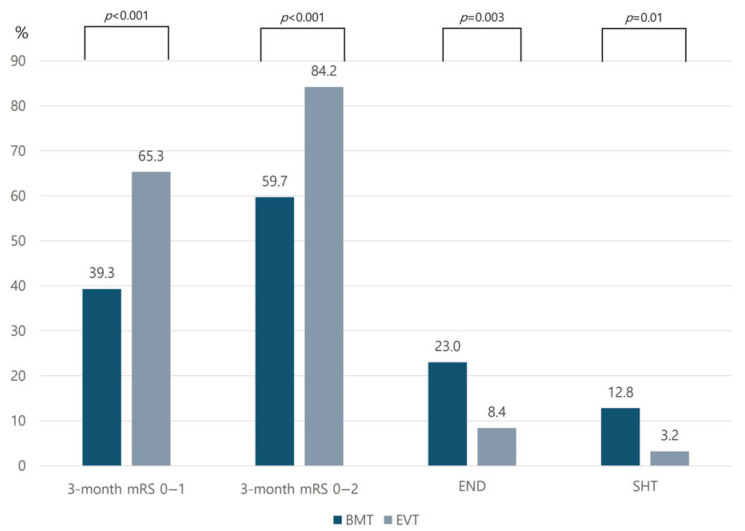 Figure 2
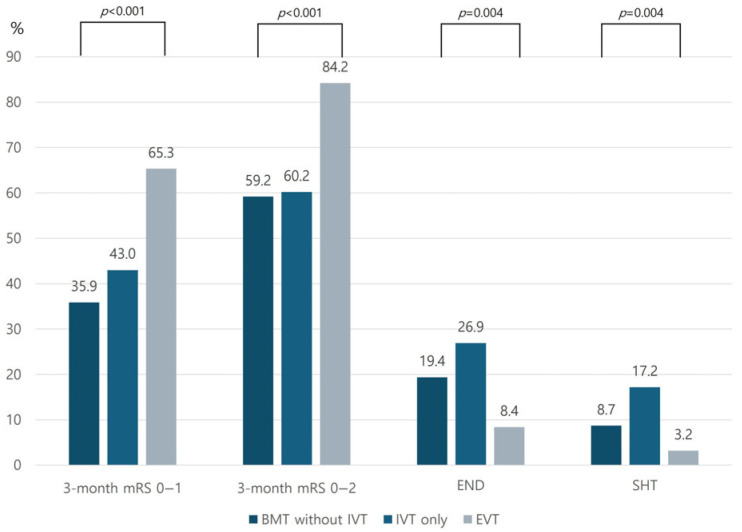 Figure 3
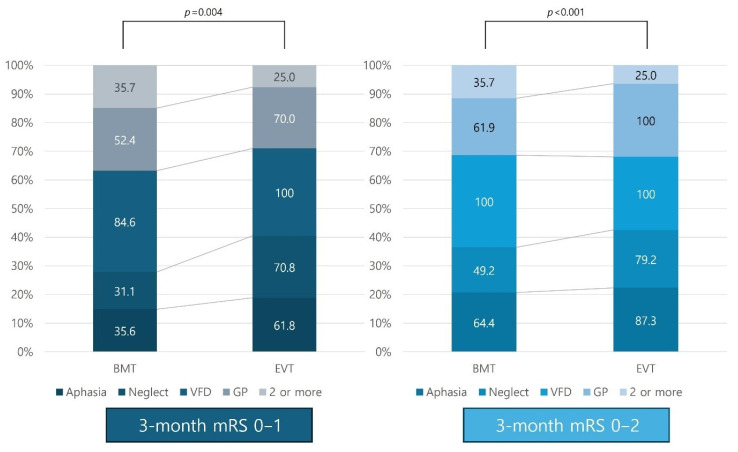 Figure 4
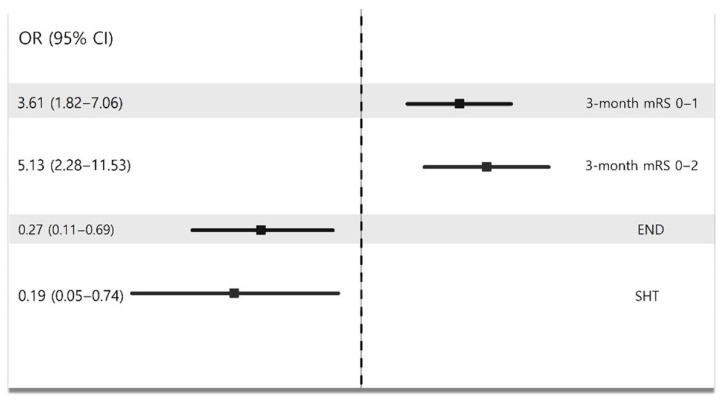 Figure 5
Peer Reviews
No public reviews on file for this paper yet. If you reviewed it on a platform where reviews are public (OpenReview, ICLR, NeurIPS, ICML), you can paste yours below so the community can read it here.
Videos
No videos yet. Explain this paper in a talk, walkthrough, or lecture? Add one.
Taxonomy
TopicsAcute Ischemic Stroke Management · Stroke Rehabilitation and Recovery · Cerebrovascular and Carotid Artery Diseases