Impact of Biologics and Proton Pump Inhibitors on Gastrointestinal Infection Risk in Inflammatory Bowel Disease Patients: A Retrospective Analysis of Pathogen-Specific Outcomes and Treatment Interactions
Ryan Njeim, Elie Moussa, Chapman Wei, Joelle Sleiman, Reem Dimachkie, Liliane Deeb

TL;DR
This study finds that biologic drugs significantly increase the risk of gastrointestinal infections in IBD patients, more than proton pump inhibitors or no treatment.
Contribution
The study provides new insights into the specific impact of biologics and PPIs on non-C.diff GI infections in IBD patients.
Findings
Biologic therapy alone or with PPIs significantly increases GI infection risk compared to untreated patients.
Non-C.diff infections are strongly associated with biologic use, particularly vedolizumab and adalimumab.
PPIs alone slightly increase GI infection risk, but bacterial pathogens like E. coli and Salmonella are common across treatment groups.
Abstract
Background/Objectives: Inflammatory bowel disease (IBD) patients face elevated gastrointestinal (GI) infection risks due to immune dysregulation and gut dysbiosis. While steroids and immunosuppressants are known to increase infection risk, data on biologics and proton pump inhibitors (PPIs) remain limited, particularly for non-Clostridioides difficile (C.diff) infections. Methods: This retrospective cohort study analyzed 9849 hospitalized IBD patients (2013–2023) from the Northwell Inpatient Database. Patients were categorized into four groups: biologics-only, PPIs-only, both, or neither. GI infections were identified via C.diff PCR, GI PCR, and chart review. Multivariate logistic regression adjusted for demographics, BMI, and IBD type. Results: GI infections occurred in 1.75% of patients, with significantly higher odds in those on biologics alone (OR 21.5, 95% CI 11.7–39.4) or with…
Genes, proteins, chemicals, diseases, species, mutations and cell lines named across the full text — each resolved to its canonical identifier and authoritative record.
Click any figure to enlarge with its caption.
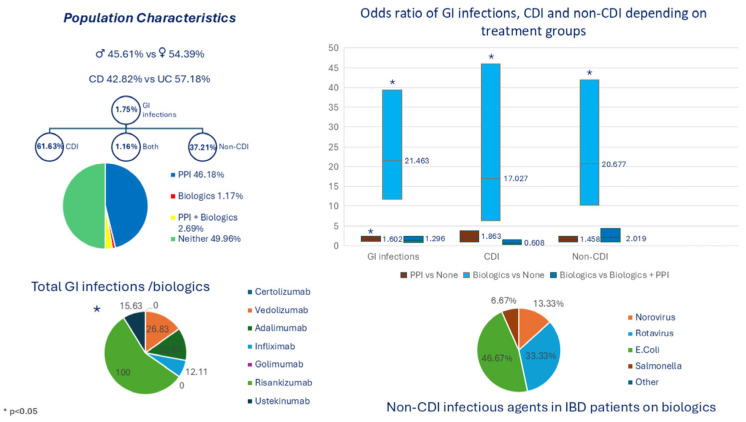 Figure 1
Peer Reviews
No public reviews on file for this paper yet. If you reviewed it on a platform where reviews are public (OpenReview, ICLR, NeurIPS, ICML), you can paste yours below so the community can read it here.
Videos
No videos yet. Explain this paper in a talk, walkthrough, or lecture? Add one.
Taxonomy
TopicsClostridium difficile and Clostridium perfringens research · Microscopic Colitis · Helicobacter pylori-related gastroenterology studies