Caspase-14-like Proteases: An Epidermal Caspase and Its Evolutionarily Ancient Relatives
Leopold Eckhart, Attila Placido Sachslehner, Julia Steinbinder, Heinz Fischer

TL;DR
This paper explores caspase-14-like proteases, focusing on their roles in skin function and evolution across amniotes.
Contribution
The paper provides a comprehensive review of the molecular and evolutionary characteristics of caspase-14-like proteases.
Findings
Caspase-14 is uniquely expressed in epithelial cells and is linked to skin barrier function.
Caspase-15 and -16 are evolutionarily older and have distinct structural features compared to caspase-14.
Mutations in the human CASP14 gene are associated with the skin disorder ichthyosis.
Abstract
Caspases are a family of cysteine-dependent aspartate-directed proteases implicated in programmed cell death. Humans have eleven proteolytically active caspases, namely caspase-1 through -10 and caspase-14. The latter is expressed exclusively in epithelial cells and constitutively resides in its active form in the cornified layer of the human epidermis. Molecular phylogenetics has revealed that caspase-14 belongs to a subfamily of caspases, which also includes caspase-15 and -16. The latter are evolutionarily more ancient than caspase-14 and have been lost in the phylogenetic lineage leading to humans. Here, we review the molecular properties, the species distributions, and the biological roles of caspase-14-like proteases in amniotes. In contrast to the prodomain-less caspase-14, caspase-15 contains a prodomain that is predicted to assume a pyrin fold, and caspase-16 features a…
Genes, proteins, chemicals, diseases, species, mutations and cell lines named across the full text — each resolved to its canonical identifier and authoritative record.
Click any figure to enlarge with its caption.
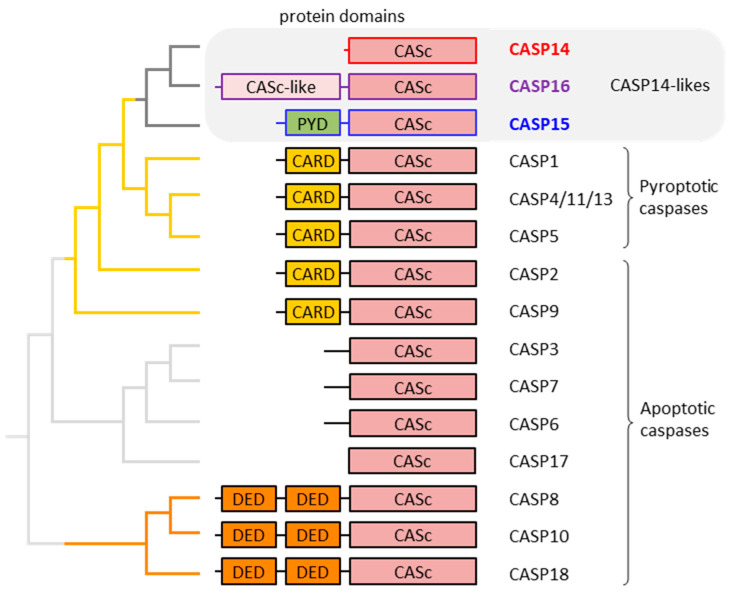 Figure 1
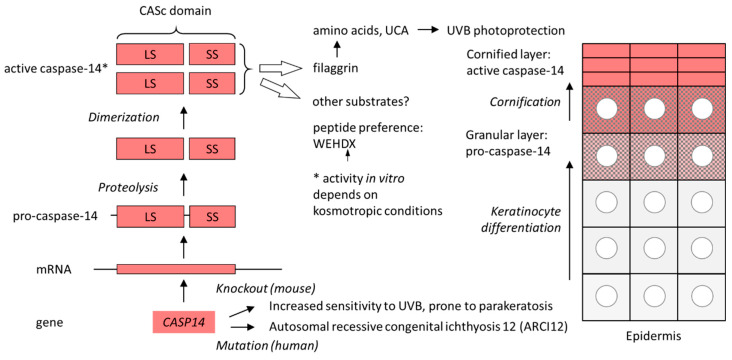 Figure 2
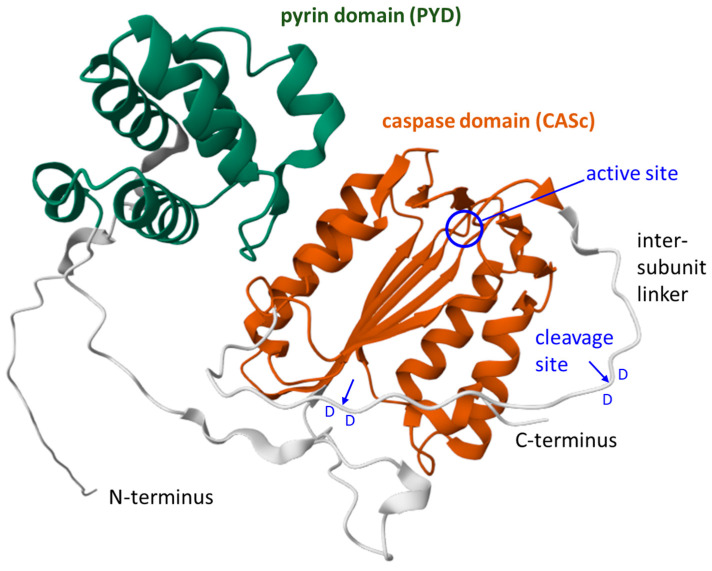 Figure 3
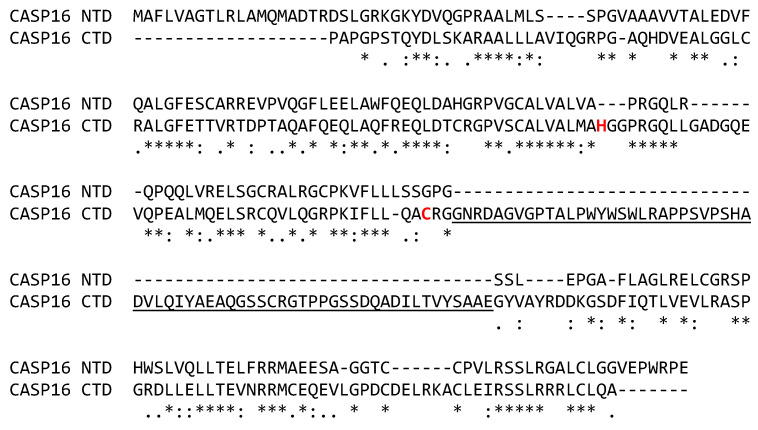 Figure 4
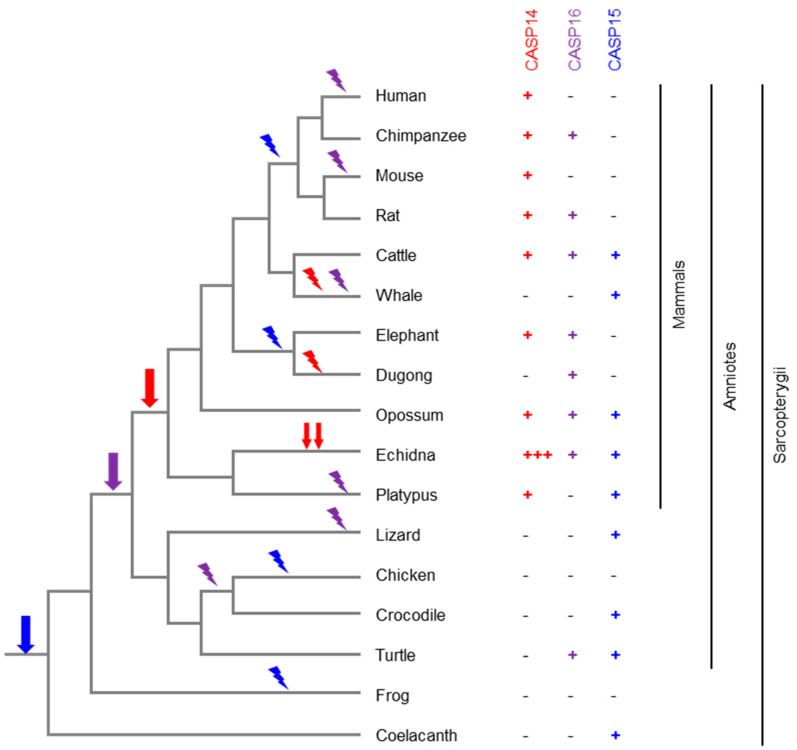 Figure 5
Peer Reviews
No public reviews on file for this paper yet. If you reviewed it on a platform where reviews are public (OpenReview, ICLR, NeurIPS, ICML), you can paste yours below so the community can read it here.
Videos
No videos yet. Explain this paper in a talk, walkthrough, or lecture? Add one.
Taxonomy
TopicsCell death mechanisms and regulation · Ubiquitin and proteasome pathways · Autophagy in Disease and Therapy