Persistence of L. V. braziliensis in the Nasal Mucosa of Treated Patients
Jackeline Maria de Sousa Lima Lopes, Aline de Fatima Filha Santos, Renata Gabriella Ribeiro Ferreira, Thalion Gabriel Alves Moreira, Veronica Maria Gonçalves Furtado, Keven Styvenn Brito Santana, Thallyta Maria Vieira, Daniel Holanda Barroso

TL;DR
This study shows that L. V. braziliensis DNA can persist in the nasal mucosa of treated leishmaniasis patients, indicating a risk of future mucosal disease.
Contribution
The study introduces nasal mucosa DNA testing as a novel method to assess long-term risk of mucosal leishmaniasis.
Findings
7% of treated patients tested positive for L. V. braziliensis DNA in nasal mucosa.
60% of these positive patients had mucosal lesions before treatment, compared to 13.4% of negatives (p = 0.031).
Molecular detection in nasal mucosa could improve follow-up for leishmaniasis patients.
Abstract
Background/Objectives: Cutaneous leishmaniasis is an infectious disease that most frequently affects neglected populations. Besides its incidence, a high disease burden is associated with the possibility of mucosal sequelae. Clinical follow-up of these patients is difficult due to the limited access of the affected population to healthcare and the long lapse between the development of cutaneous and mucosal diseases. In this study, we evaluated the positivity of L. V. braziliensis DNA on the nasal mucosa of patients treated for leishmaniasis in an attempt to estimate the possible long-term risk of developing mucosal leishmaniasis and its association with important clinical characteristics. Methods: Samples were collected immediately after treatment completion using a nasal swab and specific DNA was amplified and detected using real-time PCR. Clinical and laboratorial data was…
Genes, proteins, chemicals, diseases, species, mutations and cell lines named across the full text — each resolved to its canonical identifier and authoritative record.
Click any figure to enlarge with its caption.
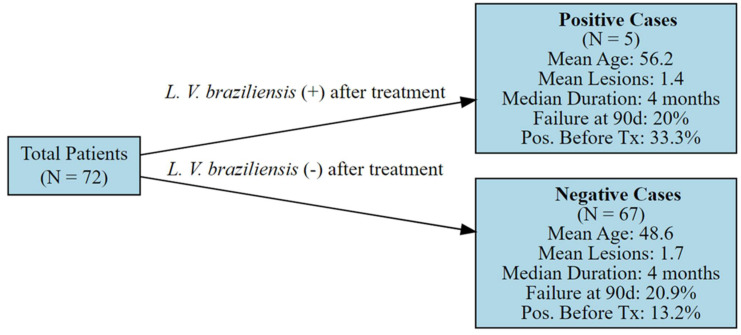 Figure 1
Peer Reviews
No public reviews on file for this paper yet. If you reviewed it on a platform where reviews are public (OpenReview, ICLR, NeurIPS, ICML), you can paste yours below so the community can read it here.
Videos
No videos yet. Explain this paper in a talk, walkthrough, or lecture? Add one.
Taxonomy
TopicsResearch on Leishmaniasis Studies