Too Close to Speak Up? How Group Network Density and Status Conflict Affect Group Voice
Yumi Ko, Myung-Ho Chung, Dongwon Choi

TL;DR
This study explores how close relationships and status conflicts in work groups affect how much members speak up.
Contribution
The study introduces the moderating role of status conflict on the relationship between group network density and group voice.
Findings
Group network density has an inverted U-shaped relationship with group voice.
High status conflict reduces overall group voice and intensifies the decline on the downward side of the curve.
Abstract
Although group network characteristics significantly influence a group’s ability to exchange and absorb knowledge by listening to group members’ opinions, previous research on voice behavior has not yet fully addressed the social and relational factors in work groups that affect group-level voice. Specifically, in line with the “dark side of social capital” argument, this study examined the effects of group network density on group voice. In addition, drawing on the notion of status conflict, we further examined the moderating role of status conflict on the relationship between group network density and group voice. Using data from 55 work groups, we found an inverted U-shaped relationship between group network density and group voice. Moreover, we found that status conflict moderated the inverted-U effect of group density on group voice, such that when status conflict was high, (1) the…
Genes, proteins, chemicals, diseases, species, mutations and cell lines named across the full text — each resolved to its canonical identifier and authoritative record.
Click any figure to enlarge with its caption.
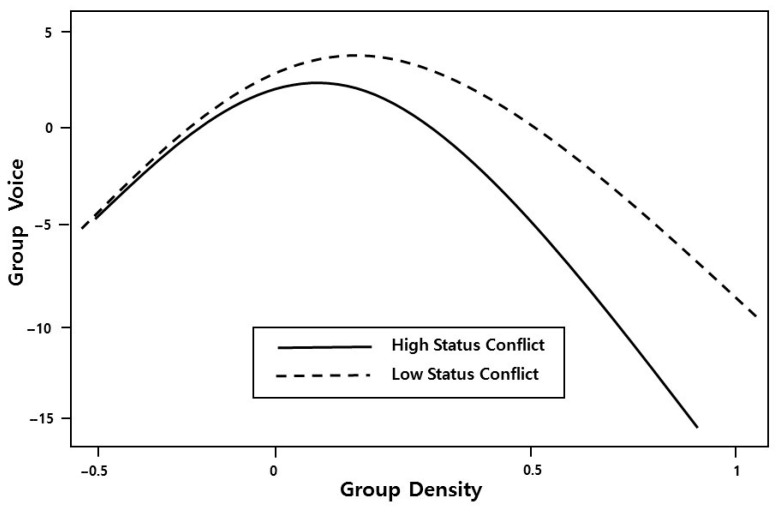 Figure 1
Peer Reviews
No public reviews on file for this paper yet. If you reviewed it on a platform where reviews are public (OpenReview, ICLR, NeurIPS, ICML), you can paste yours below so the community can read it here.
Videos
No videos yet. Explain this paper in a talk, walkthrough, or lecture? Add one.
Taxonomy
TopicsTeam Dynamics and Performance · Opinion Dynamics and Social Influence · Social Power and Status Dynamics