Correction: “Impact of Virtual Care With Remote Automated Monitoring on the Rate of Acute Hospital Care Post Discharge and Index Length of Hospital Stay: Protocol for the Post Discharge After Surgery Virtual Care With Remote Automated Monitoring Technology 3 (PVC-RAM-3) Trial”
Sandra Ofori, Michael H McGillion, Flavia K Borges, Carley Ouellette, Ameen Patel, David Conen, Maura Marcucci, Michael Ke Wang, Lily Jaeyoung Park, Conor Bell, Jennifer Lounsbury, Kanae Nagatani, Vikas Tandon, Trevor J Wilkieson, Ahraaz Wyne, Valerie Harvey, Stephanie Harrison

TL;DR
This study tests if virtual care with remote monitoring after surgery can reduce hospital readmissions and shorten initial hospital stays.
Contribution
The PVC-RAM-3 trial introduces a novel approach using virtual care and remote monitoring to improve post-surgery recovery outcomes.
Findings
The trial compares VC-RAM to standard care in 2500 patients across 3 Canadian hospitals.
Patients in the VC-RAM group use monitoring technology to track vital signs and wound healing.
The study aims to determine if VC-RAM reduces acute hospital care and shortens hospital stays.
Abstract
A substantial proportion of patients require acute hospital care after hospital discharge post surgery, and many regions and countries have surgical backlogs. The Post Discharge After Surgery Virtual Care with Remote Automated Monitoring Technology-3 (PCV-RAM-3) trial tests the hypothesis that informing surgeons and patients of virtual care with remote automated monitoring (VC-RAM) assignment will promote earlier discharge, thereby reducing the index length of hospital stay, and that postdischarge VC-RAM will reduce acute hospital care. The PVC-RAM-3 trial is a randomized controlled trial that compares VC-RAM to standard postdischarge care among 2500 adults undergoing elective noncardiac surgery in 3 Canadian hospitals. Following the randomization of patients prior to surgery, surgeons and patients are immediately notified whether the patient has been allocated to the VC-RAM or control…
Genes, proteins, chemicals, diseases, species, mutations and cell lines named across the full text — each resolved to its canonical identifier and authoritative record.
Click any figure to enlarge with its caption.
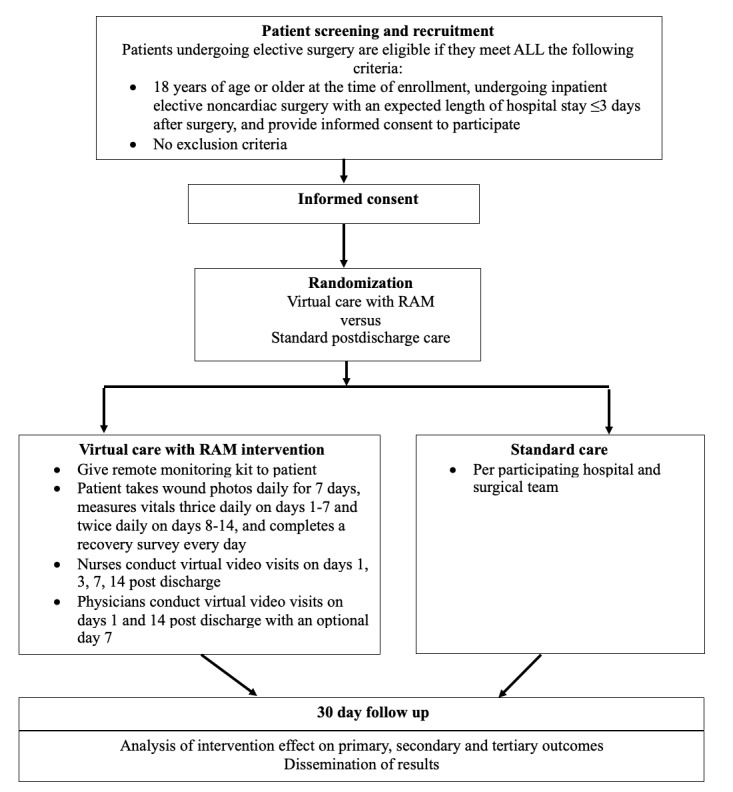 Figure 1
Peer Reviews
No public reviews on file for this paper yet. If you reviewed it on a platform where reviews are public (OpenReview, ICLR, NeurIPS, ICML), you can paste yours below so the community can read it here.
Videos
No videos yet. Explain this paper in a talk, walkthrough, or lecture? Add one.
Taxonomy
TopicsHemodynamic Monitoring and Therapy
In “Impact of Virtual Care With Remote Automated Monitoring on the Rate of Acute Hospital Care Post Discharge and Index Length of Hospital Stay: Protocol for the Post Discharge After Surgery Virtual Care With Remote Automated Monitoring Technology 3 (PVC-RAM-3) Trial” (JMIR Res Protoc 2025;14:e72672) the authors made one correction to Figure 1.
In the originally published version, the text in Figure 1 appeared as “Patient takes wound photos daily for 7 days, measures vitals every day on days 1-7 and every other day on days 8-14, and complete recovery survey everyday”. The original Figure is available in Multimedia Appendix 1.
The text in Figure 1 has been corrected to “Patient takes wound photos daily for 7 days, measures vitals thrice daily on days 1-7 and twice daily on days 8-14, and completes a recovery survey every day”.
The correction will appear in the online version of the paper on the JMIR Publications website together with the publication of this correction notice. Because this was made after submission to PubMed, PubMed Central, and other full-text repositories, the corrected article has also been resubmitted to those repositories.