Correction: Plumbagin protects mice from lethal Sepsis by modulating immunometabolism upstream of PKM2
Zhaoxia Zhang, Wenjun Deng, Rui Kang, Min Xie, Timothy Billiar, Haichao Wang, Lizhi Cao, Daolin Tang

Abstract
Genes, proteins, chemicals, diseases, species, mutations and cell lines named across the full text — each resolved to its canonical identifier and authoritative record.
Click any figure to enlarge with its caption.
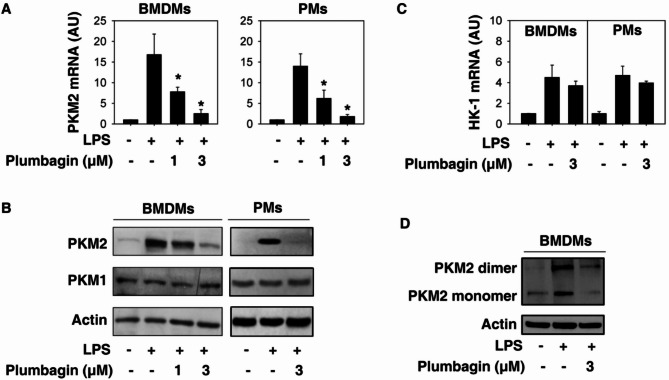 Figure 1
Peer Reviews
No public reviews on file for this paper yet. If you reviewed it on a platform where reviews are public (OpenReview, ICLR, NeurIPS, ICML), you can paste yours below so the community can read it here.
Videos
No videos yet. Explain this paper in a talk, walkthrough, or lecture? Add one.
Taxonomy
TopicsBioactive Compounds and Antitumor Agents · Coenzyme Q10 studies and effects · Synthesis of Indole Derivatives
Correction: Mol Med 22, 162–172 (2016)
** https://doi.org/10.2119/molmed.2015.00250**
Following publication of the original article (Zhang et al. 2016), the wrong figure appeared as Fig. 2.; the figure should have appeared as shown below.
Fig. 2. Plumbagin inhibits PKM2 expression in activated macrophages. (A–C) Indicated macrophages were treated with lipopolysaccharide (LPS) (100 ng/mL) in the absence or presence of plumbagin for 24 h. The mRNA or protein levels of PKM2 (A-B) or HK-1 (C) were assayed using Q-PCR and western blot, respectively (n = 3, *, p < 0.05 versus LPS group). (D) Native gel electrophoresis was performed using whole-cell extracts from BMDMs after treatment with LPS (100 ng/mL) and/or plumbagin (3 µmol/L) for 24 h