Phenotypic Screening of the MMV Global Health Priority Box Identifies Selective Compounds with Anti-Toxoplasma gondii Activity
Gabriel Candido Moura, Juliana Quero Reimão

TL;DR
This study screens a collection of 240 diverse compounds to find new treatments for toxoplasmosis, a parasitic disease with limited current therapies.
Contribution
The study identifies six selective anti-Toxoplasma gondii compounds from the MMV Global Health Priority Box with high selectivity indices.
Findings
Three compounds (MMV689404, MMV1794214, MMV1794211) showed selectivity indices exceeding 100, with the highest over 1000.
In silico ADMET profiling showed favorable pharmacokinetic and toxicity profiles for most compounds.
Several compounds had previously reported antiparasitic activity, supporting their potential for drug repurposing.
Abstract
Toxoplasmosis remains a globally significant parasitic disease, with limited treatment options and reports of drug intolerance and inadequate efficacy, particularly against chronic stages. This study aimed to identify novel anti-Toxoplasma gondii compounds through the phenotypic screening of the Medicines for Malaria Venture (MMV) Global Health Priority Box (GHPB), a curated library of 240 chemically diverse molecules. Parasite viability and host cell cytotoxicity assays identified six lead compounds with the selectivity index (SI) exceeding 100, with MMV689404 (Triflumuron), MMV1794214 (Vaniliprole), and MMV1794211 showing SI >103, > 756, and >1000, respectively. In silico ADMET profiling revealed favorable pharmacokinetic and toxicity parameters for most hits, although Vaniliprole showed suboptimal gastrointestinal absorption and potential tumorigenicity. Comparative analysis with…
Genes, proteins, chemicals, diseases, species, mutations and cell lines named across the full text — each resolved to its canonical identifier and authoritative record.
Click any figure to enlarge with its caption.
 1
1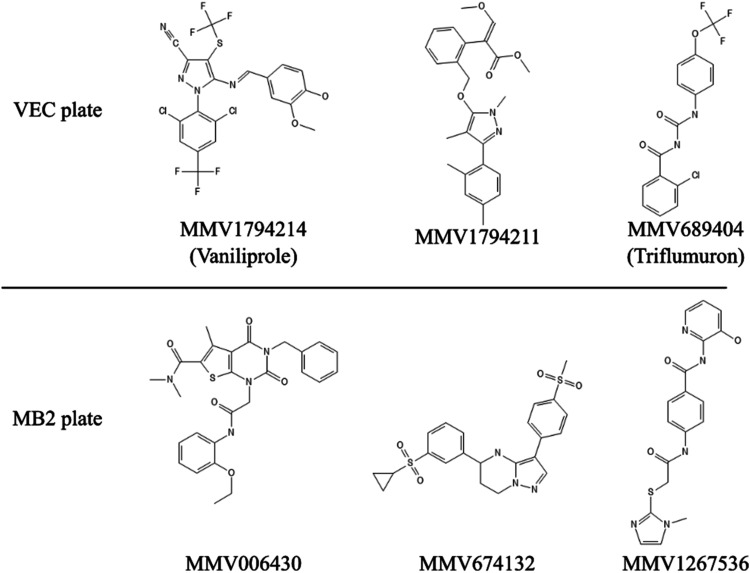 2
2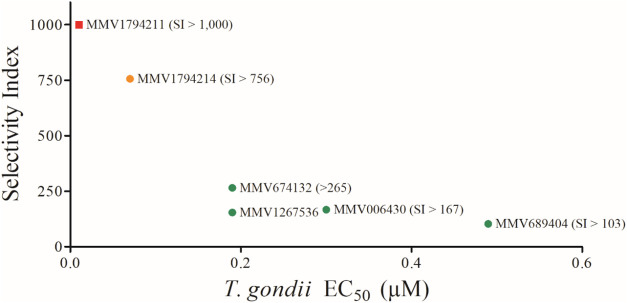 3
3| GHPB plate | compound ID | EC50 (μM) ± SD | CC50 (μM) ± SD | SI |
|---|---|---|---|---|
| VEC | MMV1794214 | 0.07 ± 0.04 | >50 | >756 |
| MMV1794211 | 0.01 ± 0.01 | >10 | >1000 | |
| MMV689404 | 0.49 ± 0.03 | >50 | >103 | |
| MMV027339 | 0.50 ± 0.02 | 5.51 ± 0.86 | 11 | |
| MMV1577471 | 0.51 ± 0.01 | 4.62 ± 1.95 | 9 | |
| MMV1634081 | 0.52 ± 0.01 | 30.83 ± 4.55 | 59 | |
| MB2 | MMV1841740 | 0.90 ± 0.12 | 6.47 ± 0.76 | 7 |
| MMV006187 | 0.51 ± 0.12 | >50 | >98 | |
| MMV006430 | 0.30 ± 0.03 | >50 | >167 | |
| MMV024638 | 0.50 ± 0.04 | 4.98 ± 0.90 | 10 | |
| MMV674132 | 0.19 ± 0.04 | >50 | >265 | |
| MMV1267536 | 0.19 ± 0.03 | 29.20 ± 2.79 | 154 | |
| MMV1266067 | 0.73 ± 0.13 | >50 | >68 | |
| MMV019421 | 0.62 ± 0.15 | 30.39 ± 10.32 | 49 | |
| MMV1435700 | 0.34 ± 0.08 | 20.00 ± 3.80 | 59 | |
| MMV024825 | 0.62 ± 0.08 | 22.24 ± 0.17 | 36 | |
| MMV1103183 | 0.72 ± 0.39 | >50 | >70 | |
| ZND | MMV1795508 | 0.59 ± 0.15 | 6.80 ± 0.46 | 11 |
| MMV692115 | 0.56 ± 0.08 | 3.38 ± 0.06 | 6 | |
| MMV1593278 | 0.21 ± 0.09 | 6.36 ± 0.22 | 30 | |
| MMV1828776 | 0.24 ± 0.13 | 2.77 ± 0.78 | 11 | |
| MMV1828058 | 0.10 ± 0.08 | 2.43 ± 0.2 | 25 | |
| MMV1828026 | 0.74 ± 0.12 | 1.33 ± 0.36 | 2 | |
| MMV884814 | 0.76 ± 0.06 | 4.10 ± 1.18 | 5 | |
| MMV1545678 | 0.81 ± 0.15 | 6.47 ± 0.14 | 8 | |
| MMV692630 | 0.72 ± 0.03 | 10.99 ± 0.54 | 15 | |
| MMV689635 | 0.61 ± 0.04 | >50 | >81 | |
| MMV689463 | 0.83 ± 0.21 | 2.66 ± 0.95 | 3 | |
| MMV1848726 | 0.63 ± 0.12 | 0.38 ± 0.26 | 0.6 | |
| MMV688723 | 0.73 ± 0.09 | >50 | >68 | |
| external control | Pyrimethamine | 0.38 ± 0.03 | >50 | >131 |
| compound ID | molecular formula | GI | BBB | mutagenic risk | tumorigenic risk | irritant risk | reproductive effect risk | |
|---|---|---|---|---|---|---|---|---|
| VEC | MMV1794214 | C20H10Cl2F6N4O2S | low | no | no | medium | no | no |
| MMV1794211 | C25H28N2O4 | high | yes | no | high | medium | high | |
| MMV689404 | C15H10ClF3N2O3 | high | no | no | no | no | no | |
| MMV027339 | C15H8Cl2F6N2O | low | no | no | no | no | no | |
| MMV1577471 | C25H24F6N4 | low | no | no | no | no | no | |
| MMV1634081 | C13H11Cl2N3O4 | high | no | no | no | no | high | |
| MB2 | MMV1841740 | C20H18F3N5 | high | no | no | no | no | no |
| MMV006187 | C24H20FN3OS | low | no | no | no | no | no | |
| MMV006430 | C27H28N4O5S | high | no | no | no | no | No | |
| MMV024638 | C23H20FN3 | high | yes | no | no | no | no | |
| MMV674132 | C22H23N3O4S2 | high | no | no | no | no | no | |
| MMV1267536 | C18H17N5O3S | high | no | no | no | no | no | |
| MMV1266067 | C16H14N4O2 | high | no | no | no | no | no | |
| MMV019421 | C26H28ClN5O2S | high | no | no | no | high | no | |
| MMV1435700 | C18H17N3O4S2 | low | no | no | no | no | no | |
| MMV024825 | C25H26F2N4O | high | yes | no | no | no | no | |
| MMV1103183 | C15H16N4O3 | high | no | no | no | no | no | |
| ZND | MMV1795508 | C17H15ClF3N5 | high | no | no | no | no | no |
| MMV692115 | C21H21Cl2N5O | high | yes | no | no | no | no | |
| MMV1593278 | C18H25FN4 | high | yes | no | no | no | no | |
| MMV1828776 | C23H25N5O | high | yes | no | no | no | no | |
| MMV1828058 | C26H30FN5O | high | no | no | no | no | no | |
| MMV1828026 | C26H26N6O2 | high | no | high | high | no | no | |
| MMV884814 | C24H23ClF3N5O | high | no | no | no | no | no | |
| MMV1545678 | C21H24Cl2N6 | high | no | no | no | no | no | |
| MMV692630 | C21H16ClF3N4O2 | high | no | no | no | no | no | |
| MMV689635 | C23H19ClN6O2 | high | no | no | no | no | no | |
| MMV689463 | C23H24ClN5O | high | yes | no | no | medium | no | |
| MMV1848726 | C19H17N5O2 | high | no | no | no | no | no | |
| MMV688723 | C21H19ClN4O3S | high | no | no | no | no | no | |
| pyrimethamine | C12H13ClN4 | high | yes | high | high | no | high |
- —Funda??o de Amparo ? Pesquisa do Estado de S?o Paulo10.13039/501100001807
- —Funda??o de Amparo ? Pesquisa do Estado de S?o Paulo10.13039/501100001807
- —Funda??o de Amparo ? Pesquisa do Estado de S?o Paulo10.13039/501100001807
Peer Reviews
No public reviews on file for this paper yet. If you reviewed it on a platform where reviews are public (OpenReview, ICLR, NeurIPS, ICML), you can paste yours below so the community can read it here.
Videos
No videos yet. Explain this paper in a talk, walkthrough, or lecture? Add one.
Taxonomy
TopicsToxoplasma gondii Research Studies · Cytomegalovirus and herpesvirus research · Mosquito-borne diseases and control
Introduction
Toxoplasmosis is a globally prevalent zoonotic infection caused by the protozoan parasite Toxoplasma gondii, affecting nearly one-third of the world’s population.? While most immunocompetent individuals experience asymptomatic or mild disease, the parasite poses serious health risks to immunocompromised individualssuch as patients with AIDS or undergoing immunosuppressive therapiesand to pregnant women, in whom congenital transmission can result in miscarriage, stillbirth, or severe neurological sequelae in the fetus.? Despite the global burden and clinical relevance, therapeutic options for toxoplasmosis have remained largely unchanged for decades.
Current first-line treatments, typically based on the combination of pyrimethamine and sulfadiazine, are associated with significant drawbacks, including bone marrow suppression, hypersensitivity reactions, and poor activity against the latent bradyzoite stage. Moreover, growing concerns over drug tolerance and suboptimal parasite clearance emphasize the urgent need for new, safer, and more effective treatment alternatives.?
In this context, drug repurposing has emerged as a promising approach, offering the advantage of accelerating therapeutic discovery by evaluating compounds with known safety and pharmacological profiles. One particularly valuable resource is the Global Health Priority Box (GHPB), assembled by the Medicines for Malaria Venture (MMV). This curated collection comprises 240 chemically diverse compounds with established bioactivity against malaria and other neglected pathogens,? yet their potential against T. gondii remains unexplored.
In this study, we conducted a phenotypic screening of the GHPB library to identify compounds with anti-T. gondii activity. Our aim was to prioritize candidates with favorable selectivity indices and pharmacokinetic properties for further preclinical development, contributing to the discovery of novel chemotherapeutic options for toxoplasmosis.
Results
A primary screening of 240 compounds from the Global Health Priority Box (GHPB) library was performed at a fixed concentration of 1 μM with a 72 h incubation period. Compounds were considered active if they inhibited T. gondii growth by ≥80% under these conditions.
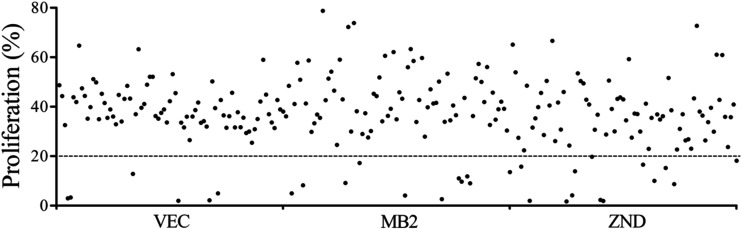
This screening identified 30 active compounds: 6 from the VEC subset, 10 from MB2, and 14 from ZND (Figure). These hits were selected for further characterization, including the determination of their EC_50_ in intracellular T. gondii tachyzoites, CC_50_ in human foreskin fibroblasts (HFF), and selectivity index (SI = CC_50_/EC_50_). Pyrimethamine, a standard drug used to treat toxoplasmosis, was included as a reference.
Screening of 240 compounds of the GHPB collection in fixed 1 μM concentration against T. gondii proliferation.
Potency and Selectivity
EC_50_ values of the selected compounds ranged from 0.01 to 0.90 μM, indicating a wide spectrum of anti-T. gondii potency. CC_50_ values ranged from 0.38 to >50 μM, the highest concentration tested. Selectivity indices varied considerably among the compounds, from <1 to >1000 (Table).
1: EC50, CC50, and SI of the GHPB Compounds
Six compounds showed particularly high selectivity (SI > 100): MMV1794211 (SI > 1,000), MMV1794214 (SI > 756), MMV674132 (SI
265), MMV1267536 (SI = 154), MMV006430 (SI > 167), and MMV689404 (SI 103). The chemical structures of these compounds are shown in Figure.
Chemical structure of compounds with SI > 100.
On the other hand, several compounds such as MMV1828026 and MMV1848726 presented low SI values (2 and 0.6, respectively), indicating high toxicity relative to antiparasitic activity. Pyrimethamine showed an EC_50_ of 0.38 μM and an SI > 131, serving as a useful benchmark.
ADMET Profile
To assess drug-likeness and predict potential safety issues, the 30 active compounds were subjected to in silico ADMET profiling, including predictions of gastrointestinal (GI) absorption, blood–brain barrier (BBB) permeability, and toxicity risks (Table).
2: Results of ADMET Predictions of the Selected Compounds from GHPB ,
Most compounds (25/30) were predicted to have high GI absorption. Five compounds, MMV1794214, MMV027339, MMV1577471, MMV006187, and MMV1435700, showed low predicted GI absorption, which may impact oral bioavailability.
Only seven compounds were predicted to cross the BBB, including MMV1794211, MMV024638, MMV024825, MMV692115, MMV1593278, MMV1828776, and MMV689463. This may be advantageous for the potential treatment of cerebral toxoplasmosis.
Most compounds showed low predicted toxicity, but six were flagged for potential safety concerns: MMV1794211, MMV1794214, MMV1634081, MMV019421, MMV1828026, and MMV689463.
Interestingly, despite the highlighted risks in some candidates, pyrimethamine itself was predicted to have high mutagenic, tumorigenic, and reproductive toxicity risks, underscoring the unmet need for safer alternatives.
To better visualize the relationship between compound potency and selectivity, a scatter plot was generated comparing EC_50_ and SI for the six most selective compounds (SI > 100). Each compound was color-coded according to its predicted ADMET-related toxicological risks, including mutagenicity, tumorigenicity, irritancy, and reproductive effects. This visualization (Figure) highlights the most promising candidates based on their pharmacological profiles and simultaneously flags compounds with potential safety concerns. Notably, several compounds with SI
100 also exhibit favorable ADMET predictions (e.g., MMV674132 and MMV1267536), whereas others, such as Vaniliprole, despite high SI, raise concerns due to predicted tumorigenic risk.
Correlation between anti-T. gondii in vitro activity (EC50) and the selectivity index (SI) for the six most selective compounds (SI > 100). Colors indicate predicted toxicological risks: green = no major risks; orange = moderate risk in at least one category; and red = high or multiple predicted risks. Square indicates the predicted blood–brain barrier (BBB) permeability, while circles indicate no predicted BBB permeability.
Discussion
Previous screenings of the GHPB library have demonstrated bioactivity against fungi, including Candida auris and Madurella mycetomatis; ?,? protozoa such as Plasmodium falciparum, Plasmodium berghei, Leishmania amazonensis, Trypanosoma cruzi, and Naegleria fowleri; ?−? ? helminths such as Hemonchus contortus; ? and SARS-CoV-2.? Nevertheless, its efficacy against T. gondii remains unexplored, presenting a critical gap in the discovery of novel therapies targeting toxoplasmosis.
Screening of the GHPB library identified 30 promising compounds that were subjected to additional in vitro assays. To contextualize these findings, we analyzed compound in vitro activity using EC_50_ against the selectivity index (SI) of the most selective compounds (SI > 100). Among these, Vaniliprole (MMV1794214) stood out with an SI > 756 and potent activity (EC_50_ = 0.07 μM), but its predicted ADMET profile suggests potential tumorigenic effects and low gastrointestinal (GI) absorption, reducing its suitability as a drug lead despite promising in vitro data.
A particularly notable finding emerged with MMV1794211, for which cytotoxicity could not be determined under our experimental conditions, even after repeated assays. Given this limitation, we adopted the CC_50_ value >10 μM reported by Tali et al.,? which, combined with its observed antiparasitic activity (EC_50_ = 0.01 μM), results in a calculated SI > 1000. This extraordinarily high selectivity places MMV1794211 among the top candidates in the library. Despite the absence of reliable in-house cytotoxicity data, its lack of predicted ADMET toxicological risks, coupled with its exceptional SI, strongly supports its prioritization for further evaluation. Future studies will be necessary to clarify its safety profile and determine its mechanism of action.
In contrast, compounds MMV006430, MMV674132, and MMV1267536 from the MB2 plate combine high SI values (>167, >265, and 154, respectively) with favorable ADMET predictions (high GI absorption, no toxicity alerts), making them strong candidates for further development. Notably, MMV674132 and MMV1267536 have also shown activity against Plasmodium liver stages,? indicating potential for dual antiparasitic applications. In addition, MMV006430 and MMV674132 have been experimentally characterized as fast-acting compounds against P. falciparum ring stages, showing activity under 65 h.?
Our findings for Vaniliprole (MMV1794214) align with previous reports of its antiparasitic potential. Shanley et al. (2024)? demonstrated that this compound impairs motility and larval development in H. contortus, highlighting its anthelmintic efficacy. In our study, Vaniliprole also showed potent activity against T. gondii (EC_50_ = 0.07 μM) and an exceptionally high SI (>756), supporting its broad antiparasitic potential.
Similarly, our data for Triflumuron (MMV689404) corroborate some aspects of its known pharmacological profile. We observed an SI > 100 and favorable in silico ADMET parameters, including high GI absorption and low toxicity prediction. However, Timoumi et al.? reported CC_50_ values of 120 μM and 200 μM in HepG2 and HEK293 cell lines, respectively, and subsequent in vivo studies showed hepatotoxicity and oxidative stress at doses of 350–500 mg/kg (Timoumi et al.,).? These toxicological findings, which contrast with our predictive data and in vitro results, underscore the importance of integrating in vivo toxicity data early in the candidate selection process, particularly for compounds with prior regulatory or pesticidal usage.
While no compounds from the ZND plate exceeded SI > 100, this may reflect methodological limitations, as CC_50_ values were capped at 50 μM, potentially underestimating actual selectivity. Indeed, several ZND compounds cluster near the high-potency, moderate-selectivity region, suggesting that they warrant further cytotoxicity profiling using expanded concentration ranges.
The integrated analysis reveals that selectivity alone is insufficient for prioritization; compounds must also exhibit an acceptable predicted safety. This is exemplified by MMV1828026, a ZND compound with reasonable potency (EC_50_ = 0.74 μM) but a predicted high mutagenic and tumorigenic risk, rendering it unsuitable despite initial interest.
In summary, the visual synthesis of potency, selectivity, and safety predictions enabled the rational prioritization of lead-like compounds. MMV1794211, MMV674132, and MMV1267536 emerge as especially promising based on their combined potency, selectivity, and predicted safety profiles, warranting further evaluation through mechanism-of-action studies and in vivo models.
Conclusions
This study screened compounds from the GHPB library and identified several candidates with potent anti-T. gondii activity and favorable selectivity profiles. Notably, six compounds (MMV1794211, MMV1794214, MMV674132, MMV1267536, MMV006430, and MMV689404) exhibited SI values greater than 100. While Vaniliprole and Triflumuron stood out for their strong efficacy, their translational potential is limited by ADMET concerns and previously reported in vivo toxicity. In contrast, compounds from the MB2 plate, such as MMV674132 and MMV1267536, combined promising efficacy with more favorable in silico safety profiles, warranting further investigation. Collectively, our findings underscore the potential of the GHPB library as a valuable resource for the discovery of new anti-T. gondii agents and lay the groundwork for future studies aimed at confirming efficacy, elucidating mechanisms of action, and evaluating in vivo efficacy and safety.
Methods
Drugs
and Chemicals
All chemicals and reagents were obtained from Thermo Fisher Scientific (Leicestershire, U.K.). The Global Health Priority Box (GHPB) library (240 compounds) was generously provided by the Medicines for Malaria Venture (MMV, Geneva, Switzerland). The library consists of three distinct 80-compound subsets: the first plate is notable for containing compounds with reported activity against various disease vectors (VEC), the second plate comprises drugs demonstrating confirmed efficacy against resistant malaria (MB2), while the third plate contains a library of compounds previously screened against neglected zoonotic diseases (ZND).? Stock solutions (10 mM in DMSO) were prepared under sterile conditions and stored at – 20 °C.
Parasite and Host Cell
Culture
Toxoplasma gondii RH-2F1 tachyzoites, which express β-galactosidase, were maintained in human foreskin fibroblasts (HFFs). HFFs were cultured in Dulbecco’s Modified Eagle Medium (DMEM) supplemented with 10% fetal bovine serum (FBS), 2 mM l-glutamine, and 40 μg/mL gentamicin (referred to as D10) and incubated at 37 °C in a 5% CO_2_ humidified atmosphere. For infection assays, confluent monolayers were maintained in DMEM with 2% FBS (D2) prior to parasite inoculation.?
For in vitro assays in 96-well plates, HFFs were seeded at 5 × 10^3^ cells/well in the D10 medium and incubated for 12–16 h to allow adherence. For cytotoxicity (CC_50_) evaluation, cells were treated with test compounds in serial dilutions ranging from 50 to 0.78 μM for 72 h. For antiparasitic assays, HFFs were infected with RH-2F1 tachyzoites at a multiplicity of infection (MOI) of 1:1 for 3 h. After infection, compounds were added either at a fixed concentration (1 μM for screening) or in serial dilutions (1 to 0.008 μM for EC_50_ determination), followed by 72 h incubation under standard conditions.
β-Galactosidase Quantification
Parasite proliferation was assessed by quantifying β-galactosidase activity, as previously described.? Briefly, after the 72 h incubation, cells were lysed in 100 μL of lysis buffer (100 mM HEPES pH 7.5, 1 mM MgSO_4_, 0.1% Triton X-100, 5 mM DTT) for 15 min at room temperature. Subsequently, 160 μL of assay buffer (100 mM sodium phosphate, pH 7.3, 102 mM β-mercaptoethanol, 9 mM MgCl_2_) and 40 μL of CPRG substrate (6.25 mM) were added to each well. Following a 30 min incubation at 37 °C, absorbance was measured at 570 nm using a Varioskan LUX microplate reader (Thermo Scientific). Each assay included viability controls (untreated infected cells), solvent controls (1% DMSO), a positive control (1 μM pyrimethamine), and experimental blanks (no cells). All conditions were tested in two biological replicates in three independent experiments.
GHPB Library Screening
Compounds from the GHPB library were screened at a final concentration of 1 μM in infected HFF monolayers, using the β-galactosidase assay as a readout for parasite viability after 72 h. Compounds exhibiting ≥80% inhibition of parasite proliferation were selected for further evaluation in dose–response assays to determine the EC_50_ and CC_50_ values.
Cytotoxicity Assay (Resazurin Reduction)
The resazurin assay was used to evaluate the compound cytotoxicity in uninfected HFFs. Following 72 h treatment, 100 μM resazurin was added to each well and incubated for 4 h at 37 °C. Fluorescence was measured using excitation/emission wavelengths of 565/590 nm. Controls included untreated cells (viability control), 1% DMSO (solvent control), 50 μM pyrimethamine (reference drug), and blank wells (no cells). Each condition was tested in duplicate in three independent experiments.
In Silico ADMET Analysis
ADMET (absorption, distribution, metabolism, excretion, and toxicity) properties of selected hits were predicted using SwissADME (http://www.swissadme.ch)[?](#ref17) and OSIRIS Property Explorer.? The evaluated parameters included gastrointestinal (GI) absorption, blood–brain barrier (BBB) permeability, and predicted toxicity (mutagenicity, tumorigenicity, irritation, and reproductive effects).
The reference list from the paper itself. Each links out to its DOI / PubMed record.
- 1Martinez V. O.de Mendonça Lima F. W.De Carvalho C. F.Menezes-Filho J. A.Toxoplasma gondii infection and behavioral outcomes in humans: a systematic review Parasitol. Res.20181173059306510.1007/s 00436-018-6040-230109417 · doi ↗ · pubmed ↗
- 2Saadatnia G.Golkar M.A review on human toxoplasmosis Scand. J. Infect. Dis.20124480581410.3109/00365548.2012.69319722831461 · doi ↗ · pubmed ↗
- 3Konstantinovic N.Guegan H.Stäjner T.Belaz S.Robert-Gangneux F.Treatment of toxoplasmosis: Current options and future perspectives Food Waterborne Parasitol.201915 e 0003610.1016/j.fawpar.2019.e 0003632095610 PMC 7033996 · doi ↗ · pubmed ↗
- 4Adam A.Besson D.Bryant R.Rees S.Willis P. A.Burrows J. N.van Huisjduijnen R. H.Laleu B.Norton L.Canan S.Global Health Priority Box–Proactive Pandemic Preparedness ACS Infect. Dis.2024104030403910.1021/acsinfecdis.4c 0070039488746 PMC 11650653 · doi ↗ · pubmed ↗
- 5Tali, T. ; Brice, M. ; Dize, D. ; Kamache, A. Y. ; Kamdem, B. P. ; Hassan, S. ; Ngansop, C. A. N. ; Fokou, P. V. T. ; Laleu, B. ; Duffy, J. ; Boyom, F. Discovery of a Picomolar Antiplasmodial Pyrazole Derivative from a Broad Antiparasitic Screening of Compounds from the MMV Open Access Global Health Priority Box. Veri Xiv 2024; Vol. 1, 15 10.12688/verixiv.197.1. · doi ↗
- 6Retore Y. I.Lucini F.Pimentel L. R.Oliveira H. C.Simionatto S.Rossato L.Screening of the global health priority Box reveals potential new disinfectants against the emerging multidrug-resistant pathogen Candida auris Microb. Pathog.202419410682810.1016/j.micpath.2024.10682839079575 · doi ↗ · pubmed ↗
- 7Ma J.Eadie K.Schippers M.Fahal A.Laleu B.Verbon A.van de Sande W. W. J.Novel compound MMV 1804559 from the global health priority box exhibits in vitro and in vivo activity against Madurella mycetomatis Int. J. Mol. Sci.202425622710.3390/ijms 2511622738892422 PMC 11172423 · doi ↗ · pubmed ↗
- 8Nguyen G.-B.Cooper C. A.Mc Whorter O.Sharma R.Elliot A.Ruberto A.Freitas R.Pathak A. K.Kyle D. E.Maher S. P.Screening the Global Health Priority Box against Plasmodium berghei liver stage parasites using an inexpensive luciferase detection protocol Malar. J.20242335710.1186/s 12936-024-05155-y 39580415 PMC 11585928 · doi ↗ · pubmed ↗