Safety assessment of the process EREMA VACUNITE (EREMA Vacurema Basic and Polymetrix SSP V‐LeaN) used to recycle post‐consumer PET into food contact materials
Claude Lambré, Riccardo Crebelli, Maria da Silva, Koni Grob, Maria Rosaria Milana, Marja Pronk, Gilles Rivière, Mario Ščetar, Georgios Theodoridis, Els Van Hoeck, Nadia Waegeneers, Vincent Dudler, Constantine Papaspyrides, Maria de Fátima Tavares Poças, Vasiliki Sfika

TL;DR
This paper evaluates the safety of a recycling process for post-consumer PET used in food contact materials.
Contribution
The study confirms the decontamination efficiency of the EREMA VACUNITE recycling process for food contact PET.
Findings
Steps 2 and 5 of the recycling process are critical for decontamination.
The process ensures migration of contaminants is below safe thresholds.
Recycled PET is safe for food contact under specified conditions.
Abstract
The EFSA Panel on Food Contact Materials (FCM) assessed the safety of the recycling process EREMA VACUNITE (EREMA Vacurema Basic and Polymetrix SSP V‐LeaN) (EU register number RECYC332). The input is hot caustic/surfactant‐washed and dried poly(ethylene terephthalate) (PET) flakes originating from collected post‐consumer PET containers, with no more than 5% PET from non‐food consumer applications. The flakes are first decontaminated in a ■■■■■ flake reactor under ■■■■■ (step 2), then extruded, pelletised and ■■■■■ (step 3). The ■■■■■ pellets are ■■■■■ (step 4) and submitted to solid‐state polycondensation (SSP) in a ■■■■■ reactor at ■■■■■ under ■■■■■ and ■■■■■ (step 5). Having examined the challenge tests provided, the Panel concluded that steps 2 and 5 are critical for determining the decontamination efficiency of the process. The operating parameters to control the performance of…
Genes, proteins, chemicals, diseases, species, mutations and cell lines named across the full text — each resolved to its canonical identifier and authoritative record.
Click any figure to enlarge with its caption.
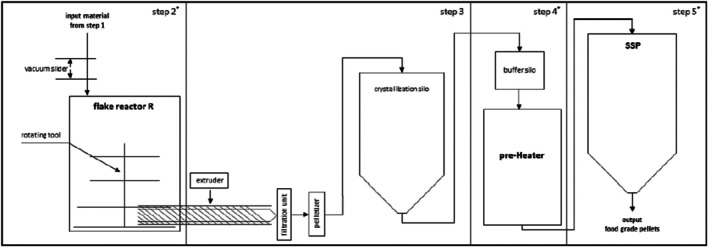 FIGURE 1
| Surrogates | Concentration of the surrogates before step 2 (mg/kg PET) | Concentration of the surrogates after step 2 (mg/kg PET) | Decontamination efficiency (%) |
|---|---|---|---|
|
| 319.5 | 32.4 | 81.2 |
|
| 676.5 | 46.5 | 87.3 |
|
| 670.0 | 68.7 | 81.0 |
|
| 825.6 | 173.7 | 61.0 |
|
| 930.7 | 201.1 | 59.9 |
|
| 1118.3 | 137.9 | 77.1 |
| Surrogates | Concentration of the surrogates before step 5 (mg/kg PET) | Concentration of the surrogates after step 5 (mg/kg PET) | Decontamination efficiency (%) |
|---|---|---|---|
|
| 19.4 | < 0.6 | 96.9 |
|
| 25.2 | 0.8 | 96.8 |
|
| 67.5 | 8.2 | 87.9 |
|
| 12.5 | < 0.2 | 98.4 |
|
| 139.8 | 14.9 | 89.3 |
|
| 142.1 | 3.8 | 97.3 |
| Surrogates | Decontamination efficiency (%) step 2 | Decontamination efficiency (%) step 5 | Combined decontamination efficiency (%) |
|---|---|---|---|
|
| 81.2 | 96.9 | 99.4 |
|
| 87.3 | 96.8 | 99.6 |
|
| 81.0 | 87.9 | 97.7 |
|
| 61.0 | 98.4 | 99.4 |
|
| 59.9 | 89.3 | 95.7 |
|
| 77.1 | 97.3 | 99.4 |
| Surrogates | Decontamination efficiency (%) |
|
|
|---|---|---|---|
|
| 99.4 | 0.02 | 0.04 |
|
| 99.6 | 0.01 | 0.05 |
|
| 97.7 | 0.07 | 0.13 |
|
| 99.4 | 0.02 | 0.12 |
|
| 95.7 | 0.13 | 0.15 |
|
| 99.4 | 0.02 | 0.29 |
Peer Reviews
No public reviews on file for this paper yet. If you reviewed it on a platform where reviews are public (OpenReview, ICLR, NeurIPS, ICML), you can paste yours below so the community can read it here.
Videos
No videos yet. Explain this paper in a talk, walkthrough, or lecture? Add one.
Taxonomy
TopicsRecycling and Waste Management Techniques · Effects and risks of endocrine disrupting chemicals
INTRODUCTION
1
Background
1.1
Recycled plastic materials and articles shall only be placed on the market if the recycled plastic is from an authorised recycling process. Before a recycling process is authorised, the European Food Safety Authority (EFSA)'s opinion on its safety is required. This procedure has been established in Articles 17 and 18 of Commission Regulation (EU) 2022/16161 on recycled plastic materials and articles intended to come into contact with foods. More specifically, according to Article 18 of Commission Regulation (EU) 2022/1616 on recycled plastic materials intended to come into contact with foods, EFSA is required to carry out risk assessments on the risks originating from the migration of substances from recycled food contact plastic materials and articles into food, to evaluate the microbiological safety of these materials and articles and to deliver a scientific opinion on the recycling process examined.
According to this procedure, the process developers submit applications to the competent authorities of Member States, which transmit the applications to EFSA for evaluation. In this case, EFSA received an application from the Austrian Bundesministerium für Soziales, Gesundheit, Pflege und Konsumentenschutz (Federal Ministry of Social Affairs, Health, Care and Consumer Protection) for evaluating the recycling process EREMA VACUNITE (EREMA Vacurema Basic and Polymetrix SSP V‐LeaN), European Union (EU) register No RECYC332. The request has been registered in EFSA's register of received questions under the number EFSA‐Q‐2023‐00463. The dossier was submitted by EREMA Engineering Recycling Maschinen und Anlagen Ges.m.b.H, Unterfeldstrasse 3, A‐4052, Ansfelden, Austria (see ‘Documentation provided to EFSA’).
Terms of reference
1.2
The Bundesministerium für Soziales, Gesundheit, Pflege und Konsumentenschutz (Federal Ministry of Social Affairs, Health, Care and Consumer Protection) requested the safety evaluation of the recycling process EREMA VACUNITE (EREMA Vacurema Basic and Polymetrix SSP V‐LeaN), in compliance with Article 17 of Commission Regulation (EU) 2022/1616. The recycling process uses the recycling technology number 1 of the list of suitable recycling technologies of Table 1 of Annex 1 of Commission Regulation (EU) 2022/1616.
DATA AND METHODOLOGIES
2
Data
2.1
The applicant submitted a confidential and a non‐confidential version of a dossier, following EFSA's ‘Scientific Guidance on the criteria for the evaluation and on the preparation of applications for the safety assessment of post‐consumer mechanical PET recycling processes intended to be used for manufacture of materials and articles in contact with food’ (EFSA CEP Panel, 2024) and EFSA's ‘Administrative guidance for the preparation of applications for the authorisation of individual recycling processes to produce recycled plastics materials and articles intended to come into contact with food’ (EFSA, 2024).
Additional information was received from the applicant during the assessment process, in response to a request from EFSA sent on 30 July 2024 and 02 April 2025 (see ‘Documentation provided to EFSA’). A clarification teleconference was held on 13 January 2025.
In accordance with Art. 38 of the Regulation (EC) No 178/20022 and taking into account the protection of confidential information and the personal data in accordance with Articles 39 to 39e of the same Regulation, and of the Decision of the EFSA's Executive Director laying down practical arrangements concerning transparency and confidentiality,3 the non‐confidential version of the dossier has been published on Open.EFSA.4
According to Art. 32c(2) of Regulation (EC) No 178/2002 and to the Decision of EFSA's Executive Director laying down the practical arrangements on pre‐submission phase and public consultations^4^, EFSA carried out a public consultation on the non‐confidential version of the application from 24 September to 15 October 2024, for which no comments were received.
The following information on the recycling process was provided by the applicant and used for the evaluation (EFSA, 2024; EFSA CEP Panel, 2024):
- –Recycling process,
- –Determination of the decontamination efficiency of the recycling process,
- –Table of operating parameters,
- –Self‐evaluation of the recycling process.
Methodologies
2.2
The risks associated with the use of recycled plastic materials and articles in contact with food come from the possible migration of chemicals into the food in amounts that would endanger human health. The quality of the input, the efficiency of the recycling process to remove contaminants as well as the intended use of the recycled plastic are crucial points for the risk assessment (EFSA CEP Panel, 2024).
The criteria for the safety evaluation of a mechanical recycling process to produce recycled PET intended to be used for the manufacture of materials and articles in contact with food are described in the scientific guidance developed by the EFSA Panel on Food Contact Materials, Enzymes and Processing Aids (EFSA CEP Panel, 2024). The principle of the evaluation is to apply the decontamination efficiency of a recycling process, obtained from a challenge test with surrogate contaminants, to a reference contamination level for post‐consumer PET, conservatively set at 3 mg/kg PET for contaminants resulting from possible misuse. The resulting residual concentration of each surrogate contaminant in recycled PET (C res) is compared with a modelled concentration of the surrogate contaminants in PET (C mod). This C mod is calculated using generally recognised conservative migration models so that the related migration does not give rise to a dietary exposure exceeding 0.0025 μg/kg body weight (bw) per day (i.e. the human exposure threshold value for chemicals with structural alerts for genotoxicity), below which the risk to human health would be negligible, considering different dietary exposure scenarios (EFSA CEP Panel, 2024). If the C res is not higher than the C mod, the recycled PET manufactured by such recycling process is not considered a safety concern for the defined conditions of use (EFSA CEP Panel, 2024).
The assessment was conducted in line with the principles described in the EFSA Guidance on transparency in the scientific aspects of risk assessment, considering the relevant guidance from the EFSA Scientific Committee (EFSA, 2009).
ASSESSMENT
3
General information
5
3.1
According to the applicant, the recycling process EREMA VACUNITE (EREMA Vacurema Basic and Polymetrix SSP V‐LeaN) is intended to recycle food‐grade PET containers. The recycled PET is intended to be used at up to 100% for the manufacture of materials and articles, such as pre‐forms for PET bottles or PET sheets for thermoformed trays and containers for direct contact with all kinds of foodstuffs, such as bottles for mineral water, carbonated or non‐carbonated soft drinks as well as trays and containers for fruits, vegetables, cooked and uncooked meats, dairy products and desserts. These are intended for long‐term storage at room temperature or below, with or without hot‐fill. The final articles are not intended to be used in microwave or conventional ovens.
Description of the process
3.2
General description
6
3.2.1
The EREMAVACUNITE recycling process produces PET pellets from PET materials originating from post‐consumer collection systems (kerbside and deposit collection systems).
Input
- In step 1, the post‐consumer PET is sorted and processed into hot caustic soda/surfactant‐washed and dried flakes.
The decontamination process comprises the four steps below.
Decontamination and production of recycled PET material
- In step 2, the flakes are decontaminated under ■■■■■ and ■■■■■.
- In step 3, the decontaminated flakes are extruded to pellets that are then ■■■■■.
- In step 4, the ■■■■■ pellets are ■■■■■ to ■■■■■.
- In step 5, the ■■■■■ pellets are further decontaminated during solid‐state polycondensation (SSP) under ■■■■■, ■■■■■ and ■■■■■.
The operating conditions of the process have been provided to EFSA.
Characterisation of the input
7
3.2.2
According to the applicant, the input material for the recycling process EREMA VACUNITE consists of hot washed and dried flakes obtained from PET materials, e.g. bottles, previously used for food packaging, from post‐consumer collection systems (kerbside and deposit systems). A small fraction may originate from non‐food applications. According to the applicant, the proportion will be no more than 5%.
Technical data on the hot washed and dried flakes were provided on physical properties and residual contents of moisture, poly(vinyl chloride) (PVC), polyamide (PA), polycarbonate (PC), polyolefins and other foreign polymer particles including polystyrene (PS), paper, mass of flakes containing residual glue, metals, dust as well as size and thickness of the PET flakes (see Appendix A).
The EREMA VACUNITE (EREMA Vacurema Basic and Polymetrix SSP V‐LeaN) process
3.3
Description of the main steps
8
3.3.1
The process flow diagram provided by the applicant is reported in Figure 1. The steps are:
- Decontamination in the flake reactor (step 2): The flakes are ■■■■■ fed into a reactor equipped with a rotating device, running under ■■■■■ temperature and vacuum for a predefined minimum residence time.
- Extrusion, pelletisation and crystallisation of the decontaminated flakes (step 3): The flakes are ■■■■■ fed from the previous reactor and molten in the extruder. Residual solid particles (e.g. paper or aluminium) are filtered out before the melt is converted to pellets. The pellets are then ■■■■■.
- Preheating of the pellets (step 4): The crystallised pellets are ■■■■■.
- SSP (step 5): The ■■■■■ pellets are ■■■■■ fed to a reactor running under ■■■■■, ■■■■■, and counter‐current ■■■■■ for a predefined minimum residence time.
General scheme of the EREMA VACUNITE process (provided by the applicant).
The process is running under defined operating parameters9 of temperature, pressure, ■■■■■ and residence time (Appendix C). All critical parameters are automatically monitored. A dedicated software checks their values, and as soon as one or more parameters are out of the specified range, the exiting material is automatically transferred to a non‐food grade storage.10
According to the applicant, the pellets, the final product of the process, are checked against technical requirements, such as intrinsic viscosity, colour and black spots.
Decontamination efficiency of the recycling process
11
3.3.2
To demonstrate the decontamination efficiency of the recycling process, separate challenge tests performed for steps 2 and 5 were submitted to EFSA.
PET flakes were contaminated with toluene, chlorobenzene, methyl salicylate, phenylcyclohexane, benzophenone and methyl stearate, selected as surrogates in agreement with the EFSA Scientific Guidance (EFSA CEP Panel, 2024) and in accordance with the recommendations of the US Food and Drug Administration (FDA, 2021).
A batch of 200 kg green PET flakes was divided into 10 barrels of 20 kg flakes each. Twenty millilitres (20 mL) of each liquid surrogate (toluene, chlorobenzene, methyl salicylate and phenylcyclohexane) and 20 g of each solid surrogate (benzophenone and methyl stearate) were added to each barrel. The barrels were kept at 50°C for 7 days with daily agitation. The contaminated flakes were then rinsed with 10% ethanol. After removal of the remaining 10% ethanol, the concentrations of the surrogates were determined in the flakes.
Step 2 of the process was challenged at an industrial scale. Contaminated flakes (■■■■■ kg) were fed into a reactor corresponding to that of step 2 of the process, between non‐contaminated flakes added before and afterwards. At various time points, samples were taken from the exit of the reactor. The contaminated (green) flakes were separated from the non‐contaminated (colourless) flakes and analysed. Cross‐contamination from the contaminated to the non‐contaminated flakes was accounted for by assuming a concentration of the surrogates in the non‐contaminated flakes as 10% of the concentration in the contaminated ones.
The flakes were then extruded (step 3; not challenged). Extruded pellets (1 kg) were used to challenge step 4 (■■■■■) and step 5 (SSP) at laboratory scale in batch mode. Since the continuous SSP reactor in the process operates in the first‐in–first‐out mode, the Panel considered that this challenge test is representative of the process when run under the same operating conditions.
The decontamination efficiencies of step 2 (flake reactor) and step 5 (SSP reactor) were calculated from the concentration of the surrogates before and after each reactor (Tables 1 and 2, respectively).
The combined decontamination efficiency of the process was then calculated from the decontamination efficiencies of steps 2 and 5 (Table 3).
As shown in Table 3, the decontamination efficiency ranged from 95.7% for benzophenone to 99.6% for chlorobenzene.
Discussion
3.4
Considering the high temperatures used during the process, the possibility of contamination by microorganisms can be discounted. Therefore, this evaluation focuses on the chemical safety of the final product.
Specifications on the input material (i.e. washed and dried flakes, step 1) are listed in Appendix A.
The flakes are produced from PET containers, e.g. bottles, previously used for food packaging, collected through post‐consumer collection systems. However, a small fraction may originate from non‐food applications, such as bottles for soap, mouthwash or kitchen hygiene agents. According to the applicant, the collection system and the sorting are managed in such a way that this fraction will be no more than 5% in the input stream, as recommended by the EFSA CEP Panel in its Guidance (EFSA CEP Panel, 2024).
The process is adequately described. It comprises the continuous decontamination in the flake reactor (step 2), followed by extrusion, pelletisation and ■■■■■ (step 3), ■■■■■ (step 4) and ■■■■■ decontamination in the SSP reactor (step 5). The operating parameters of temperature, pressure, residence time and nitrogen velocity/flow have been provided to EFSA.
For step 2 (flake reactor), the challenge test was conducted at industrial scale and for step 5 (SSP reactor) at laboratory scale. The reactors were operated under pressure, temperature and ■■■■■ (for step 5) conditions as well as residence times corresponding to worst‐case conditions compared to the process in respect to the decontamination efficiency.
The Panel considered that these challenge tests were performed correctly according to the recommendations of the EFSA guidelines (EFSA CEP Panel, 2024) and that steps 2 and 5 were critical for the decontamination efficiency of the process. Consequently, temperature, pressure and residence time of steps 2 and 5, as well as the ■■■■■ or ■■■■■ in step 5 of the process should be controlled to guarantee the performance of the decontamination (Appendix C).
The decontamination efficiencies obtained for each surrogate, ranging from 95.7% to 99.6%, have been used to calculate the residual concentrations of potential unknown contaminants in PET (C res) (EFSA CEP Panel, 2024). By applying the decontamination efficiency percentage to the reference contamination level of 3 mg/kg PET, the C res for the different surrogates was obtained (Table 4).
According to the evaluation principles (EFSA CEP Panel, 2024), the dietary exposure must not exceed 0.0025 μg/kg body weight (bw) per day, below which the risk to human health is considered negligible. The C res value should not exceed the modelled concentration in PET (C mod) that, after 1 year at 25°C, results in a migration giving rise to a dietary exposure of 0.0025 μg/kg bw per day. As the recycled PET is intended for the manufacturing of articles (e.g. bottles) to be used in direct contact with drinking water, the exposure scenario for infants has been applied for the calculation of C mod (Exposure Scenario A; water could be used to prepare infant formula). A maximum dietary exposure of 0.0025 μg/kg bw per day corresponds to a maximum migration of 0.0481 μg/kg (= 5 × 0.00962 μg/kg) or 0.0962 μg/kg (= 10 × 0.00962 μg/kg), depending on the molar mass of a contaminant substance into infants' food and has been used to calculate C mod (EFSA CEP Panel, 2024). C res reported in Table 4 is calculated for 100% recycled PET. The results of these calculations are shown in Table 4. The relationship between the key parameters for the evaluation scheme is reported in Appendix B.
TABLE 4: Decontamination efficiency from the challenge test, residual concentrations of the surrogates (C res) related to the reference contamination level and calculated concentrations of the surrogates in PET corresponding to the modelled migration for Scenario A (C mod).
On the basis of the provided data from the challenge test and the applied conservative assumptions, the Panel considered that, under the given operating conditions, the recycling process EREMA VACUNITE is able to ensure that the level of migration of unknown contaminants from the recycled PET into food is below the conservatively modelled migration of 0.0481 or 0.0962 μg/kg (depending on the molar mass of a contaminant substance) into infant's food. At this level, the risk to human health is considered negligible when the recycled PET is used at up to 100% to produce materials and articles intended for contact with all types of foodstuffs, including drinking water (exposure scenario A), for long‐term storage at room temperature or below, with or without hot‐fill.
CONCLUSIONS
4
The Panel considered that the process EREMA VACUNITE (EREMA Vacurema Basic and Polymetrix SSP V‐LeaN) is adequately characterised and that the main steps used to recycle the PET flakes into decontaminated PET pellets have been identified. Having examined the challenge tests provided, the Panel concluded that temperature, pressure and residence time in steps 2 and 5 as well as the ■■■■■ in step 5 are critical for the decontamination efficiency.
The Panel concluded that the recycling process is able to reduce foreseeable accidental contamination of post‐consumer food contact PET to a concentration that does not give rise to concern for a risk to human health if:
- It is operated under conditions that are at least as severe as those applied in the challenge tests used to measure the decontamination efficiency of the process;
- The input material of the process is washed and dried post‐consumer PET flakes originating from materials and articles that have been manufactured in accordance with the EU legislation on food contact materials and contains no more than 5% of PET from non‐food consumer applications;
- The recycled PET obtained from the process is used at up to 100% for the manufacture of materials and articles for contact with all types of foodstuffs, including drinking water, for long‐term storage at room temperature, with or without hotfill.
The final articles made of this recycled PET are not intended to be used in microwave and conventional ovens, and such uses are not covered by this evaluation.
RECOMMENDATION
5
The Panel recommended periodic verification that the input to be recycled originates from materials and articles that have been manufactured in accordance with the EU legislation on food contact materials and that the proportion of PET from non‐food consumer applications is no more than 5%. This adheres to good manufacturing practice and the Commission Regulation (EU) 2022/1616. Critical steps in recycling should be monitored and kept under control. In addition, supporting documentation should be available on how it is ensured that the critical steps are operated under conditions at least as severe as those in the challenge test used to measure the decontamination efficiency of the process.
DOCUMENTATION PROVIDED TO EFSA
6
Dossier ‘EREMA VACUNITE (EREMA Vacurema Basic and Polymetrix SSP V‐LeaN)’. December 2023. Submitted by EREMA Engineering Recycling Maschinen und Anlagen Ges.m.b.H, Austria.
Additional information, July 2024. Submitted by EREMA Engineering Recycling Maschinen und Anlagen Ges.m.b.H, Austria.
Additional information, April 2025. Submitted by EREMA Engineering Recycling Maschinen und Anlagen Ges.m.b.H, Austria.ABBREVIATIONSbwbody weightCEPPanel on Food Contact Materials, Enzymes and Processing Aids C mod modelled concentration in PET C res residual concentration in PETiVintrinsic viscosityPETpoly(ethylene terephthalate)PVCpoly(vinyl chloride)SSPsolid‐state polycondensation
REQUESTOR
Bundesministerium Soziales, Gesundheit, Pflege und Konsumentenschutz (Federal Ministry of Social Affairs, Health, Care and Consumer Protection)
QUESTION NUMBER
EFSA‐Q‐2023‐00463
COPYRIGHT FOR NON‐EFSA CONTENT
EFSA may include images or other content for which it does not hold copyright. In such cases, EFSA indicates the copyright holder and users should seek permission to reproduce the content from the original source.
PANEL MEMBERS
Claude Lambré, Riccardo Crebelli, Maria da Silva, Koni Grob, Evgenia Lampi, Maria Rosaria Milana, Marja Pronk, Gilles Rivière, Mario Ščetar, Georgios Theodoridis, Els Van Hoeck, and Nadia Waegeneers.
WAIVER
In accordance with Article 21 of the Decision of the Executive Director on Competing Interest Management a waiver was granted to an expert of the Working Group. Pursuant to Article 21(6) of the aforementioned Decision, the concerned expert was allowed to take part in the preparation and discussion of the scientific output but was not allowed to take up the role of rapporteur within that time frame. Any competing interests are recorded in the respective minutes of the meetings of the FCM Panel Working Group on Recycling Plastics.
LEGAL NOTICE
Relevant information or parts of this scientific output have been blackened in accordance with the confidentiality requests formulated by the applicant pending a decision thereon by EFSA. The full output has been shared with the European Commission, EU Member States (if applicable) and the applicant. The blackening may be subject to review once the decision on the confidentiality requests is adopted by EFSA and in case it rejects some of the confidentiality requests.
The reference list from the paper itself. Each links out to its DOI / PubMed record.
- 1EFSA (European Food Safety Authority) . (2009). Guidance of the Scientific Committee on transparency in the scientific aspects of risk assessments carried out by EFSA. Part 2: General principles. EFSA Journal, 7(5), 1051. 10.2903/j.efsa.2009.1051 · doi ↗
- 2EFSA (European Food Safety Authority) . (2024). Administrative guidance for the preparation of applications on recycling processes to produce recycled plastics intended to be used for manufacture of materials and articles in contact with food. EFSA Journal, 21(7), EN‐8968. 10.2903/sp.efsa.2024.EN-8968 · doi ↗
- 3EFSA CEP Panel (EFSA Panel on Food Contact Materials, Enzymes and Processing Aids) . (2024). Scientific Guidance on the criteria for the evaluation and on the preparation of applications for the safety assessment of post‐consumer mechanical PET recycling processes intended to be used for manufacture of materials and articles in contact with food. EFSA Journal, 22(7), 8879. 10.2903/j.efsa.2024.8879 PMC 1128719439081816 · doi ↗ · pubmed ↗
- 4FDA (Food and Drug Administration) . (2021). Guidance for industry: Use of recycled plastics in food packaging: Chemistry considerations. https://www.fda.gov/regulatory‐information/search‐fda‐guidance‐documents/guidance‐industry‐use‐recycled‐plastics‐food‐packaging‐chemistry‐considerations.