Garlic allergy in an infant: Identification of alliin lyase 1 and 2 as causative allergens
Yoshinori Morita, Karin Tsuchiya, Kazuyuki Sogawa, Naoki Shimojo

TL;DR
A 13-month-old girl developed a garlic allergy, and the study identified alliin lyase 1 and 2 as the responsible allergens.
Contribution
This is the first report confirming alliin lyase 1 and 2 as causative allergens in garlic allergy.
Findings
Alliin lyase 1 and 2 were identified as major allergens in a garlic-allergic patient.
The patient's allergic reaction varied with garlic heating duration.
Skin prick tests showed different reactivity based on garlic cooking time.
Abstract
Garlic allergy is rare and is infrequently reported as a food allergy. This report details the case of a 13-month-old girl who developed an allergy to garlic. The consumption of a stew containing undercooked garlic triggered her allergic reaction. Blood tests revealed a garlic-specific IgE level of 10.3 kUA/L. In addition, in the skin prick test, a 4 × 4 mm, 2 × 2 mm, and 1 × 1 mm wheal was induced by raw garlic, garlic heated for 5 min, and garlic heated for 10 min, respectively. She had a known history of egg allergy. The foods consumed at the time did not contain eggs and included all other foods she had previously tolerated, except garlic. Therefore, we diagnosed her with a garlic allergy. We performed western blotting and mass spectrometric analysis and identified alliin lyase 1 and alliin lyase 2 as the major allergens. We further confirmed that the patient’s sera reacted with…
Genes, proteins, chemicals, diseases, species, mutations and cell lines named across the full text — each resolved to its canonical identifier and authoritative record.
Click any figure to enlarge with its caption.
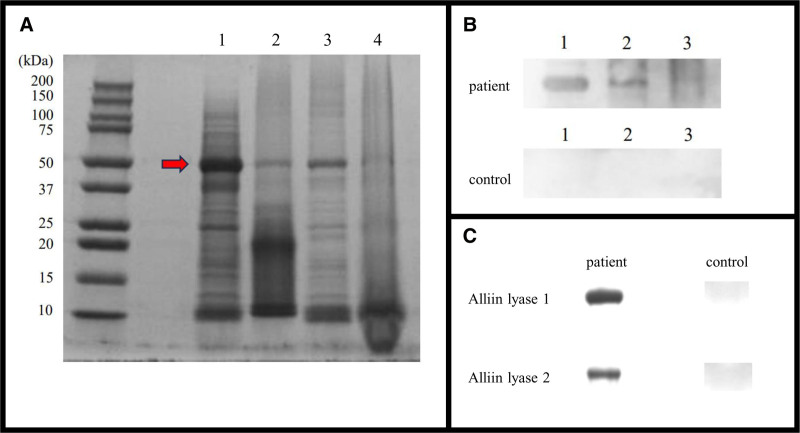 Figure 1
| Accession | Protein Name | UProt E. Name | MW [kDa] | Calc.pI | Coverage |
|---|---|---|---|---|---|
| Alliin lyase 1 | (ALLN1_ALLSA) | 55.6 | 8.12 | 52.06% | |
| Alliin lyase 2 | (ALLN2_ALLSA) | 54.1 | 7.37 | 47.36% |
Peer Reviews
No public reviews on file for this paper yet. If you reviewed it on a platform where reviews are public (OpenReview, ICLR, NeurIPS, ICML), you can paste yours below so the community can read it here.
Videos
No videos yet. Explain this paper in a talk, walkthrough, or lecture? Add one.
Taxonomy
TopicsFood Allergy and Anaphylaxis Research · Garlic and Onion Studies · Mast cells and histamine
1. Introduction
In developed countries, 5% to 10% of infants have food allergies, with eggs and cow’s milk being the most common triggers [1]. Garlic, a member of the Amaryllidaceae family, is used widely as a seasoning and medicine. Although occupational garlic allergies due to inhalation or contact have been reported [2], food allergies to garlic are uncommon [3, 4]. Herein, we report a case of garlic allergy in an infant and the causative allergens identified after a series of tests.
2. Case report
A 13-month-old female ingested a stew mixed with a commercially available tube of raw garlic product that was heated in a microwave oven for 20 seconds. Thirty minutes later, she developed urticaria involving the neck, submandibular region, and upper anterior chest. Despite receiving an oral antihistamine (fexofenadine hydrochloride 15 mg), her symptoms did not improve, prompting a visit to the emergency department. Upon arrival, she presented with generalized urticaria, erythema, and worsening cutaneous symptoms that were refractory to prehospital treatment. Other systemic symptoms were absent, including hypotension, gastrointestinal symptoms, and respiratory distress. However, irritability was noted. Following a single intramuscular injection of adrenaline, her symptoms resolved rapidly with no recurrence, including urticaria. After a brief period of observation in the emergency department, she was discharged home. The infant had a history of urticaria from egg ingestion.
Serological test findings revealed a total IgE level of 166 IU/mL. Specific IgE levels for garlic, egg white, and ovomucoid, measured using the ImmunoCAP system, were 10.3, 3.61, and 3.53 kUA/L, respectively. We performed skin prick tests (SPTs) to evaluate hypersensitivity to garlic, the effect of heat on its allergenic properties, and potential cross-reactivity to other foods. Garlic was wrapped in aluminum foil to prevent burning and heated in a frying pan for a specified duration. In the positive control (histamine) test, a 5 × 5 mm wheal appeared, whereas in the negative control (saline) test, no wheal was observed. In the prick-to-prick test, a 4 × 4 mm, 2 × 2 mm, and 1 × 1 mm wheal was induced by raw garlic, garlic heated for 5 min, and garlic heated for 10 min, respectively. Wheals were not induced by raw or heated onions or leeks. The stew contained everything she had already eaten previously except garlic and no eggs. Although the patient had a known history of egg allergy, based on the clinical presentation and diagnostic findings, we diagnosed her with a garlic allergy.
We then performed an immunological analysis of crude garlic extracts, as previously described (Fig. 1A) [5]. Proteins were analyzed via western blotting for immunoreactivity. IgE bands were observed only in patient sera and disappeared in the garlic sample heated for 15 minutes (Fig. 1B). Proteins were identified using liquid chromatography-tandem mass spectrometry, with trypsin-digested peptides analyzed via a hybrid ion-trap Fourier transform mass spectrometer and matched to the UniProt database. The bands corresponded to alliin lyase 1 (Q01594) and alliin lyase 2 (Q41233), with sequence identities of 52.06% and 47.36%, respectively (Table 1). Reactivity was confirmed via western blotting using recombinant alliin lyase 1 and 2 expressed in Escherichia coli. Bands were observed only in patient sera, confirming these proteins as the major allergens in garlic for our patient (Fig. 1C). Detailed methods are provided in the Supplementary Material, http://links.lww.com/PA9/A62.
Western blot results. (A) SDS-PAGE. Lane 1: raw garlic (sliced), lane 2: raw grated garlic product, lane 3: 10-min heated garlic, lane 4: 15-min heated garlic. (B) IgE western blotting with serum from patient and healthy volunteers. Lane 1: raw garlic (sliced), lane 2: raw grated garlic product, lane 3: 15-min heated garlic. (C) Western blotting of alliin lyase 1 (upper panel) and alliin lyase 2 (lower panel). SDS-PAGE, Sodium dodecyl sulfate–polyacrylamide gel electrophoresis
Tests indicated that garlic cooked for at least 15 minutes could be safely ingested, but the parents declined an oral food challenge, deeming garlic unnecessary in the infant’s diet.
Written consent was obtained from the parents, and the study was approved by the ethics committees of IMS Memorial Hospital (2022-07) and Azabu University (2004).
3. Discussion
Reports on garlic allergies are limited, and research on allergen identification is scarce. While alliin lyase is a known major allergen, this case is the first to identify alliin lyases 1 and 2 accurately. SPT and immunoblotting showed significantly reduced allergenicity with increasing heat. Therefore, differences in reactivity due to heating should be considered when evaluating garlic allergy.
Cross-reactivity within the Amaryllidaceae family is possible in garlic allergy. A Spanish study reported 27 cases of hypersensitivity to onions or garlic among 8109 patients, with 7 sensitized to both [6]. Similarly, a Saudi study found that 15 of 108 adults were sensitized to onion or garlic, with 12 testing positive for both [7]. These findings suggest significant cross-reactivity. However, in our patient, SPTs showed no cross-reactivity with onion or leek, emphasizing the need for individual assessment of cross-reactivity and tolerance in garlic allergy.
Garlic proteins containing alliin lyase are heat-labile [4, 8]. One study showed reduced allergenicity after 30 minutes of heating, with allergenic bands varying by heating duration [4]. In our case, the 50-kDa alliinase band was detected in raw garlic, raw grated garlic product, and garlic heated for 10 minutes, but it disappeared after 15 minutes. The faint band in the raw grated garlic product (Fig. 1A) may result from chemical additives, low protein concentration, or mechanical grating. Similarly, in Figure 1B, the raw grated garlic product is thinner than raw garlic, indicating differences in allergenicity based on product type and state. Heating for at least 15 minutes appears to reduce garlic allergenicity, which is relevant for food processing and allergen management. Patients with garlic allergy may tolerate long-cooked dishes but react to briefly cooked ones, such as stir-frying.
In this study, we used a protein expressed in E. coli to investigate the patient’s reactivity. Although E. coli-derived proteins lack post-translational modifications such as glycosylation, which may affect their structure and allergenicity [9], specific reactivity was observed only in this patient. Despite these limitations, this result supports the protein’s potential role as the allergen. Further investigation of other potential allergens is warranted.
While garlic allergy can manifest with various symptoms, patients with garlic allergy rarely present with food allergy or anaphylaxis. In our patient, generalized urticaria and worsening cutaneous symptoms refractory to prehospital treatment were observed, with rapid resolution following a single intramuscular injection of adrenaline. Alliin lyases 1 and 2 were identified as the causative allergens; these proteins should be further examined in individuals who experience severe allergic reactions to garlic ingestion.
Conflicts of interest
The authors have no financial conflicts of interest.
Author contributions
Morita managed the patient and drafted the manuscript. Sogawa performed the examinations, contributed to manuscript preparation, and analyzed the data. Tsuchiya performed the examinations. Shimojo provided therapeutic advice and critically reviewed the manuscript. All authors approved the final version.
Editing support
We thank Editage (www.editage.com) for English language editing.
Supplementary material
Supplementary Material can be found via 10.5415/apallergy.2022.12.e38
Supplementary Material
Click here to view
The reference list from the paper itself. Each links out to its DOI / PubMed record.
- 1Ebisawa M Ito K Fujisawa T; Committee for Japanese Pediatric Guideline for Food Allergy, The Japanese Society of Pediatric Allergy and Clinical Immunology. Japanese guidelines for food allergy 2020. Allergol Int. 2020;69:370-386.33289637 10.1016/j.alit.2020.03.004 · doi ↗ · pubmed ↗
- 2Van Der Walt A Singh T Baatjies R Lopata AL Jeebhay MF. Work-related allergic respiratory disease and asthma in spice mill workers is associated with inhalant chili pepper and garlic exposures. Occup Environ Med. 2013;70:446-452.23493379 10.1136/oemed-2012-101163 · doi ↗ · pubmed ↗
- 3Nacaroğlu HT Ayman FNÇelebi M. Garlic allergy: a rare cause of anaphylaxis in infants. Asthma Allergy Immunol. 2020;18:102-104.
- 4Hellu TS Schuldt MM Gomez RA Adams KE. Garlic: a potential food allergen? J Food Allergy. 2023;5:65-67.39022755 10.2500/jfa.2023.5.230012 PMC 11250451 · doi ↗ · pubmed ↗
- 5Sogawa K Takahashi Y Shibata Y Satoh M Kodera Y Nomura F Tanaka T Sato H Yamaide F Nakano T Iwahashi K Sugita-Konishi Y Shimada A Shimojo N. Search for a novel allergen in hen’s egg allergy using an Ig E immunoblotting assay. Int Arch Allergy Immunol. 2018;176:189-197.29669337 10.1159/000488144 · doi ↗ · pubmed ↗
- 6Armentia A Martín-Armentia S Pineda F Martín-Armentia B Castro M Fernández S Moro A Castillo M. Allergic hypersensitivity to garlic and onion in children and adults. Allergol Immunopathol (Madr). 2020;48:232-236.31477394 10.1016/j.aller.2019.06.005 · doi ↗ · pubmed ↗
- 7Almogren A Shakoor Z Adam MH. Garlic and onion sensitization among Saudi patients screened for food allergy: a hospital based study. Afr Health Sci. 2013;13:689-693.24250308 10.4314/ahs.v 13i 3.24PMC 3824438 · doi ↗ · pubmed ↗
- 8Kao SH Hsu CH Su SN Hor WT Chang TWH Chow LP. Identification and immunologic characterization of an allergen, alliin lyase, from garlic (Allium sativum). J Allergy Clin Immunol. 2004;113:161-168.14713923 10.1016/j.jaci.2003.10.040 · doi ↗ · pubmed ↗