Development of an atrazine immunoassay based on highly catalytically active Au@PtNPs and specific nanobody
Jia Kang, Meng Qi, Yasen Wang, Linchun Li, Xinda Zhou, Xiaoshuo An, Bruce D. Hammock, Jinlin Zhang, Jingqian Huo

TL;DR
Researchers developed a sensitive and specific immunoassay for detecting atrazine, a common herbicide, using nanobodies and nanoenzymes.
Contribution
A novel immunoassay combining nanobodies and Au@PtNPs nanoenzymes for enhanced detection of atrazine is introduced.
Findings
An ic-ELISA with an IC50 of 0.062 μg/mL and detection limit of 0.01 μg/mL was developed using nanobodies.
A dc-ELISA with an IC50 of 0.032 μg/mL was achieved by combining Au@PtNPs and nanobodies.
A LFIA model was constructed with a detection limit of 5 ng/mL for atrazine.
Abstract
Atrazine, one of the mostly used herbicides globally, is characterized as long residual effects on sensitive crops such as wheat, soybeans, and sweet potatoes. Also, its prolonged residues in the environment can jeopardize the health of non-target organisms and the safety of environmental ecosystems. Therefore, it is important to develop efficient and sensitive methods to detect trace atrazine in the environment. In this study, the nanobodies specifically recognizing atrazine were successfully obtained through immunize alpaca and phage display libraries, and an indirect competitive immunoassay (ic-ELISA) based on nanobodies was constructed with an IC50 of 0.062 μg/mL and a minimum detection limit of 0.01 μg/mL. Meanwhile, an Au@PtNPs with excellent colorimetric performance, high catalytic activity, and high stability was synthesized. The combination of Au@PtNPs and nanobodies led to the…
Genes, proteins, chemicals, diseases, species, mutations and cell lines named across the full text — each resolved to its canonical identifier and authoritative record.
Click any figure to enlarge with its caption.
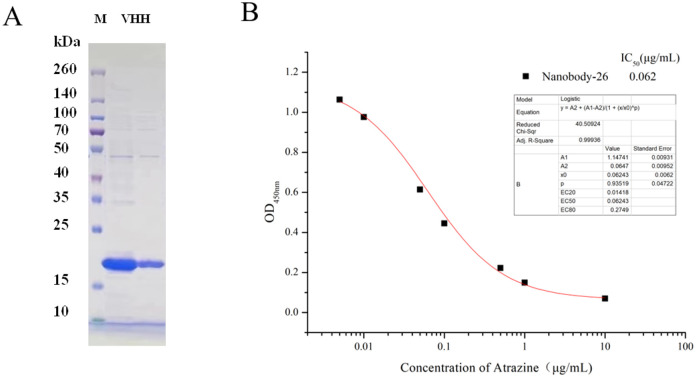 Figure 1
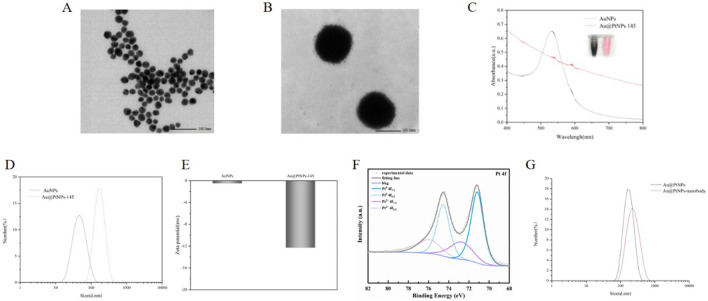 Figure 2
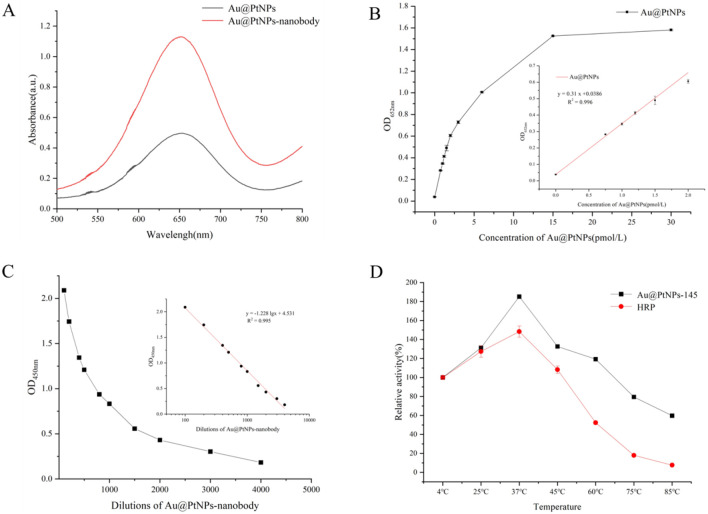 Figure 3
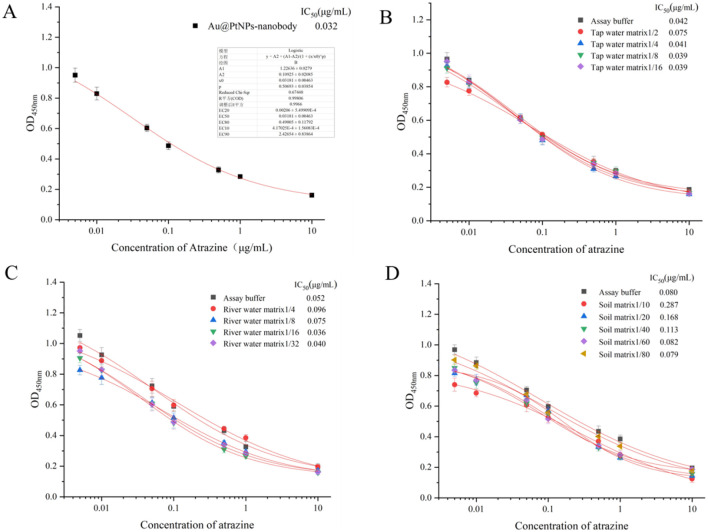 Figure 4
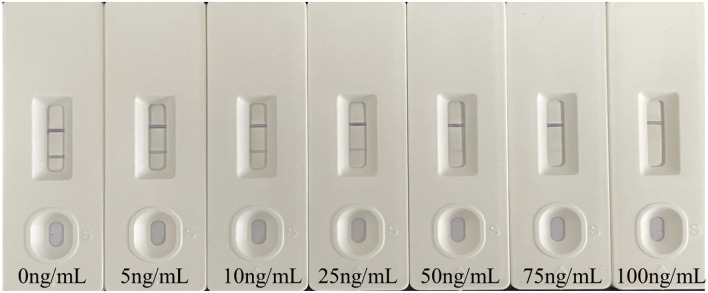 Figure 5
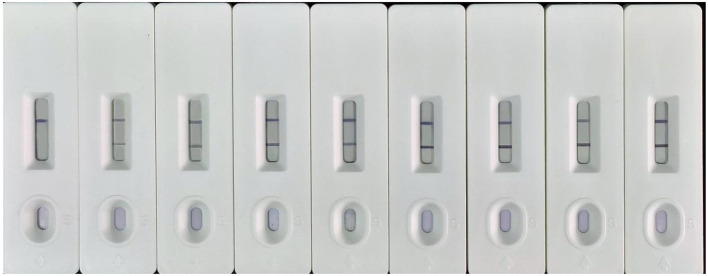 Figure 6
Peer Reviews
No public reviews on file for this paper yet. If you reviewed it on a platform where reviews are public (OpenReview, ICLR, NeurIPS, ICML), you can paste yours below so the community can read it here.
Videos
No videos yet. Explain this paper in a talk, walkthrough, or lecture? Add one.
Taxonomy
TopicsAdvanced biosensing and bioanalysis techniques · Advanced Nanomaterials in Catalysis · Gold and Silver Nanoparticles Synthesis and Applications