A randomized trial of Adapted versus Standard versions the Transdiagnostic Intervention for Sleep and Circadian Dysfunction (TSC) implemented via facilitation and delivered by community mental health providers using train-the-trainer
Allison Harvey, Emma R. Agnew, Rafael Esteva Hache, Catherine A. Callaway, Estephania Ovalle Patino, Anne Milner, Julia M. Spencer, Marlen Diaz, Lu Dong, Amy M. Kilbourne, Daniel J. Buysse, Eric Stice, Laurel D. Sarfan

TL;DR
This study tested a training method to help community mental health providers deliver a sleep and circadian intervention, showing it can be effective when adapted to local needs.
Contribution
The study provides new evidence on the effectiveness of a train-the-trainer model for delivering a transdiagnostic sleep intervention in community mental health settings.
Findings
TSC improved sleep disturbance, impairment, psychiatric symptoms, and functional impairment in patients compared to usual care.
Higher provider perception of TSC fit predicted better patient outcomes.
The train-the-trainer model successfully delivered TSC with strong outcomes in community mental health centers.
Abstract
Grounded in the Integrated Promoting Action on Research Implementation in Health Services (i-PARIHS) framework, we investigated the Train-the-Trainer (TTT) to expand access to evidence-based psychological treatments (EBPTs) in community mental health centers (CMHCs), focusing on the Transdiagnostic Intervention for Sleep and Circadian Dysfunction (TSC). Eight Californian counties were cluster-randomized to Standard TSC or an adapted version designed to improve the “fit” of TSC to CMHCs. University-based trainers trained CMHC providers (“Generation 1 providers”) in either Adapted or Standard TSC. These trained providers were then trained to become local CMHC trainers (“Generation 1 trainers”), who then trained a new cohort of providers (“Generation 2 providers”) in TSC. Within each county, patients diagnosed with serious mental illness (SMI) were randomized to receive either immediate…
Genes, proteins, chemicals, diseases, species, mutations and cell lines named across the full text — each resolved to its canonical identifier and authoritative record.
Click any figure to enlarge with its caption.
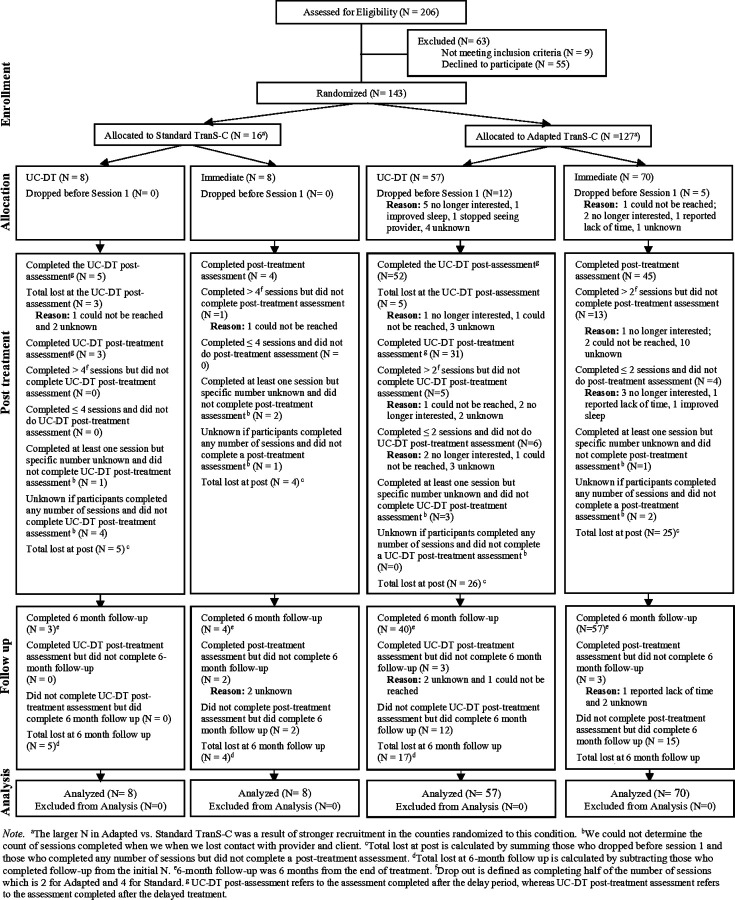 Figure 1
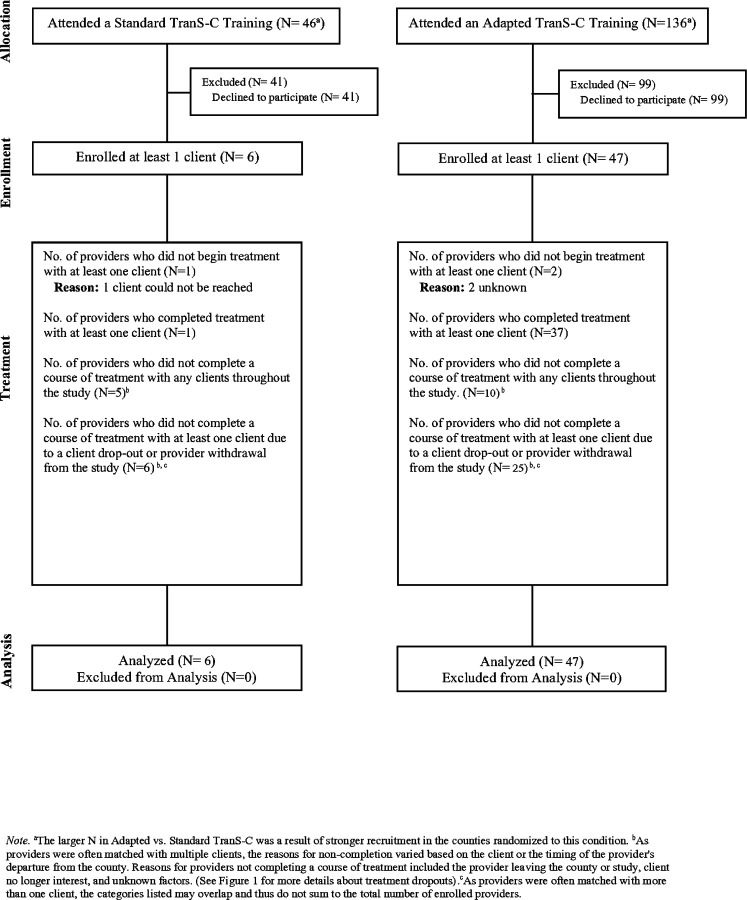 Figure 2
Peer Reviews
No public reviews on file for this paper yet. If you reviewed it on a platform where reviews are public (OpenReview, ICLR, NeurIPS, ICML), you can paste yours below so the community can read it here.
Videos
No videos yet. Explain this paper in a talk, walkthrough, or lecture? Add one.
Taxonomy
TopicsSleep and related disorders · School Health and Nursing Education · Obesity, Physical Activity, Diet