Multiple ctDNA- based biomarkers predict benefit from selective RET Inhibition in non-small cell lung cancer patients: exploratory analysis of a prospective study
Chang Lu, Chong-Rui Xu, Yi-Chen Zhang, E-E Ke, Yue-Li Sun, Xiao-Yan Bai, Zhi-Hong Chen, Jian Su, Yu Deng, Ting Hou, Fei Zhao, Min Li, Bin-Chao Wang, Hai-Yan Tu, Zhen Wang, Xu-Chao Zhang, Hua-Jun Chen, Jin-Ji Yang, Wen-Zhao Zhong, Qing Zhou, Yi-Long Wu

TL;DR
This study shows that measuring ctDNA in patients with RET fusion-positive lung cancer can predict treatment response and disease progression, offering non-invasive biomarkers for early intervention.
Contribution
The study introduces multiple ctDNA-based biomarkers that predict benefit from RET inhibition in RET fusion-positive NSCLC patients.
Findings
Baseline PIK3CA co-mutations were linked to worse progression-free survival in RET fusion-positive NSCLC patients.
Lower baseline ctDNA levels were associated with better progression-free survival across multiple metrics.
Early ctDNA clearance correlated with prolonged PFS and better disease control.
Abstract
Selective RET inhibitors such as pralsetinib have become the standard of care for patients with RET fusion-positive non-small cell lung cancer (NSCLC). Serial analysis of circulating tumor DNA (ctDNA) has proven effective in monitoring disease control/progression and therapeutic response in NSCLC. In this prospective study, we analyzed longitudinal ctDNA profiles (at baseline, week 8, and at progression) in Chinese patients with advanced RET fusion-positive NSCLC treated with pralsetinib (NCT03037385), utilizing allele frequency-based, cfDNA quantity-normalized, and methylation-based metrics. Associations between ctDNA dynamics, tumor response, and genomic alterations were assessed. A total of 21 patients were enrolled. Baseline PIK3CA co-mutations were associated with inferior progression-free survival (PFS; 3.0 vs. 12.4 months, P < 0.001). Superior PFS was observed in patients with…
Genes, proteins, chemicals, diseases, species, mutations and cell lines named across the full text — each resolved to its canonical identifier and authoritative record.
Click any figure to enlarge with its caption.
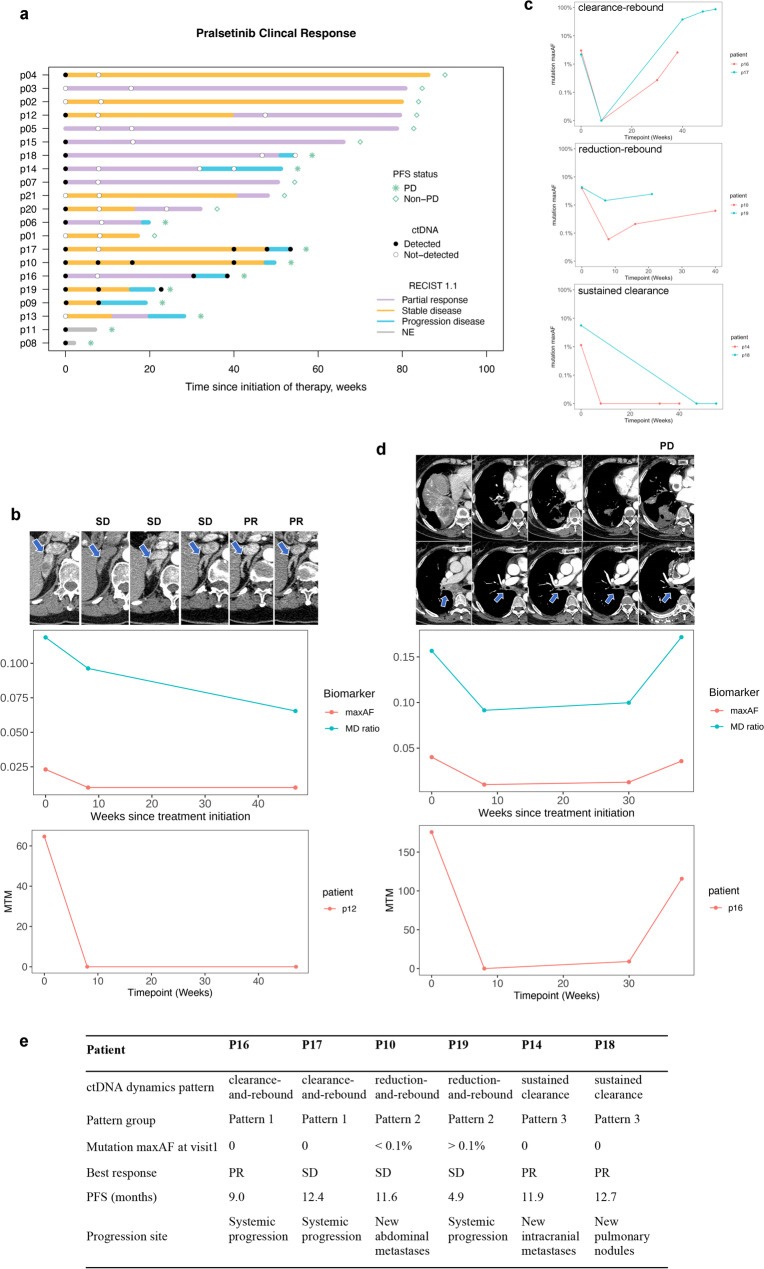 Figure 1
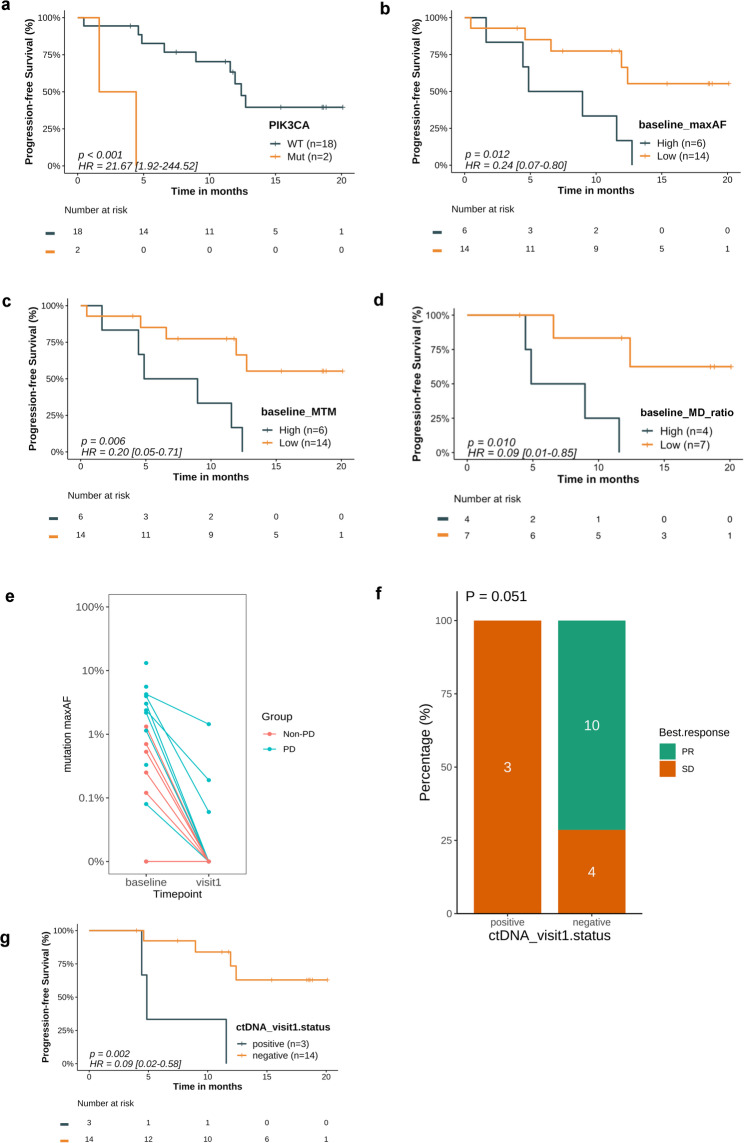 Figure 2
Peer Reviews
No public reviews on file for this paper yet. If you reviewed it on a platform where reviews are public (OpenReview, ICLR, NeurIPS, ICML), you can paste yours below so the community can read it here.
Videos
No videos yet. Explain this paper in a talk, walkthrough, or lecture? Add one.
Taxonomy
TopicsCancer Genomics and Diagnostics · Lung Cancer Treatments and Mutations · Genetic factors in colorectal cancer