An Extended Energy-Biased Aggregation-Volume-Bias Monte Carlo (EB-AVBMC) Method for Nucleation Simulation of a Reactive Water Potential
Anthony Val Canillas Camposano, Even Marius Nordhagen, Anders Malthe-So̷renssen, Henrik Andersen Sveinsson

TL;DR
This paper introduces an improved Monte Carlo method for simulating water nucleation using a reactive water model, enabling accurate calculation of liquid-vapor properties.
Contribution
The paper extends the EB-AVBMC method to reactive water models with revised acceptance rules and constraints for bond topology.
Findings
The modified EB-AVBMC method accurately calculates nucleation free energies and surface tension for water at 298.15 K.
The method prevents biased sampling by considering intramolecular energy and avoiding deletion of dissociated water molecules.
Results are consistent with those from rigid water models, showing the method's reliability and generalizability.
Abstract
The aggregation-volume-bias Monte Carlo (AVBMC) algorithm has been widely used with empirical water models like TIP3P, SPC/E, TIP4P, and TIP4P/2005 to study nucleation and vapor–liquid properties, but its application to reactive water models remains underexplored. Here, we present an extension of the energy-bias aggregation-volume-bias Monte Carlo (EB-AVBMC) method for calculating nucleation free energies and liquid–vapor properties, such as gas density and surface tension, using a three-body reactive force field based on the Vashishta potential functional form [Phys. Rev. B 1990, 41, 12197–12209]. Key modifications include revised acceptance rules that consider the intramolecular energy of the inserted/deleted molecule to prevent high acceptance probabilities that could bias the sampling and constraints to avoid the deletion of dissociated water molecules. These adjustments ensure…
Genes, proteins, chemicals, diseases, species, mutations and cell lines named across the full text — each resolved to its canonical identifier and authoritative record.
Click any figure to enlarge with its caption.
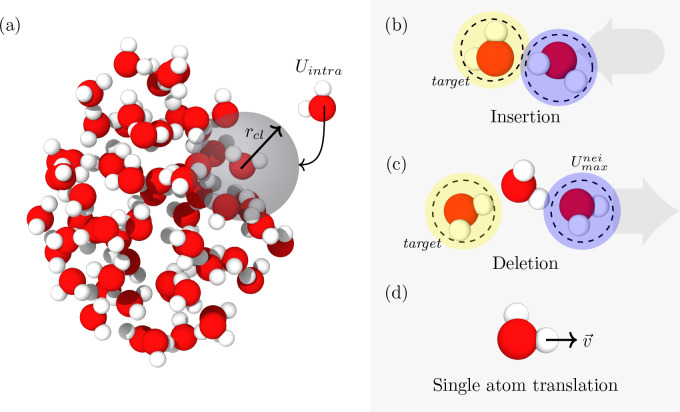 Figure 1
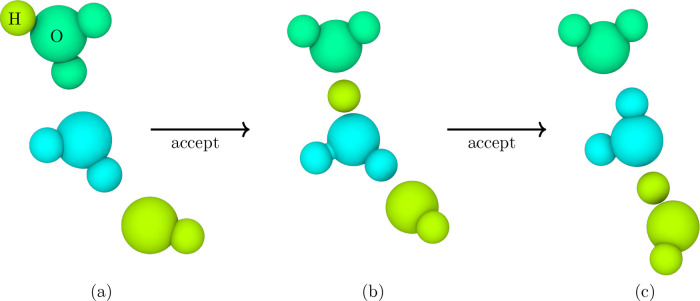 Figure 2
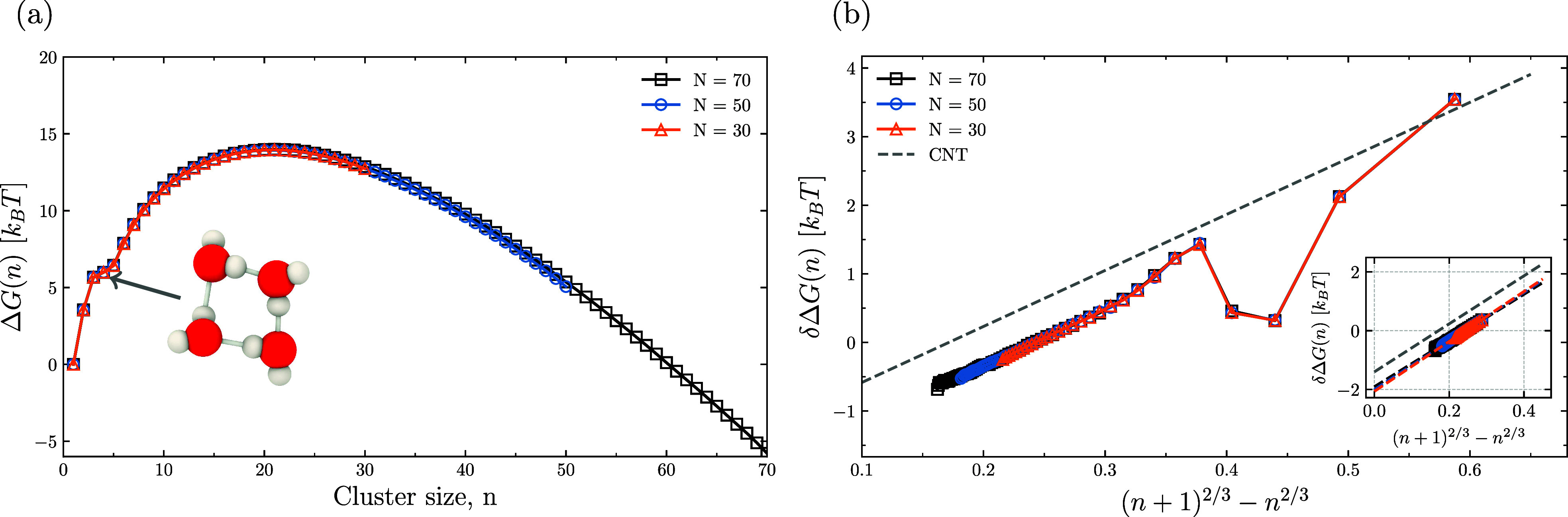 Figure 3
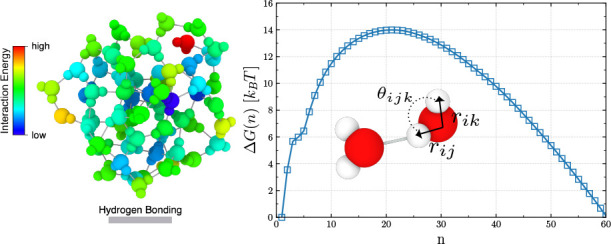 Figure 4
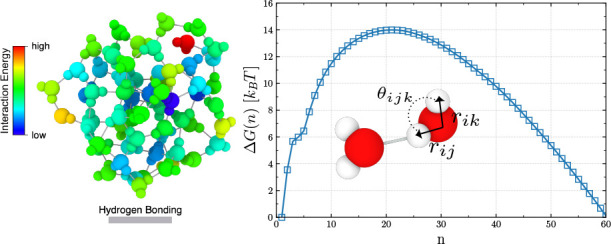 Figure 5
 Figure 6
 Figure 7
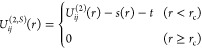 Figure 8
 Figure 9
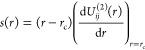 Figure 10
 Figure 11
 Figure 12
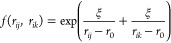 Figure 13
 Figure 14
 Figure 15
 Figure 16
 Figure 17
 Figure 18
 Figure 19
 Figure 20
 Figure 21
 Figure 22
 Figure 23
 Figure 24
 Figure 25
 Figure 26
 Figure 27
 Figure 28
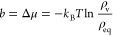 Figure 29
Peer Reviews
No public reviews on file for this paper yet. If you reviewed it on a platform where reviews are public (OpenReview, ICLR, NeurIPS, ICML), you can paste yours below so the community can read it here.
Videos
No videos yet. Explain this paper in a talk, walkthrough, or lecture? Add one.
Taxonomy
Topicsnanoparticles nucleation surface interactions · Phase Equilibria and Thermodynamics · Spectroscopy and Quantum Chemical Studies