Behavioural, psychiatric, and cognitive phenotypes associated with numbers of repeats of the FRAXE allele on the FMR2 gene
Jean Golding, Marcus E. Pembrey, Rosie Clark, Yasmin Iles-Caven, Steven Gregory, Susan M. Ring, Sarah Ennis, Matthew Suderman, Marsha R Mailick, Yasmin Iles-Caven, Paul J Hagerman, Yasmin Iles-Caven

TL;DR
This study found that boys with higher numbers of FRAXE repeats (up to 60) show increased risks of certain behavioral and psychiatric issues, but no cognitive benefits.
Contribution
The study is the first to investigate behavioral and psychiatric associations of FRAXE repeats within the normal range (<60) in a general population of boys.
Findings
Boys with >24 FRAXE repeats had higher risks of psychosis-like experiences, eating disorders, and drug use.
Increased FRAXE repeats were linked to better recognition of facial anger but no cognitive advantages.
No evolutionary neurocognitive benefit was found for higher FRAXE repeat numbers in boys.
Abstract
The FRAXE site on the X-chromosome has a variable number of trinucleotide repeats. The rare condition Fragile XE has >200 repeats, but most X chromosomes have <60 such repeats, with evidence of a bimodal distribution. It is known that when the number of repeats is <60, the repeat number can increase from mother to son, which raises the question as to whether there is an evolutionary advantage in the size of these repeats. This paper investigates whether the higher of the <60 repeats are associated with neurocognitive differences among boys in a general population. We hypothesised that although there was previous evidence of a link between higher numbers of repeats in the boys in this population with maternal grandmothers with schizophrenia, there may be cognitive or behavioural advantages to their grandsons of increased levels of repeats. We compared 1951 behavioural, psychiatric, and…
Genes, proteins, chemicals, diseases, species, mutations and cell lines named across the full text — each resolved to its canonical identifier and authoritative record.
Click any figure to enlarge with its caption.
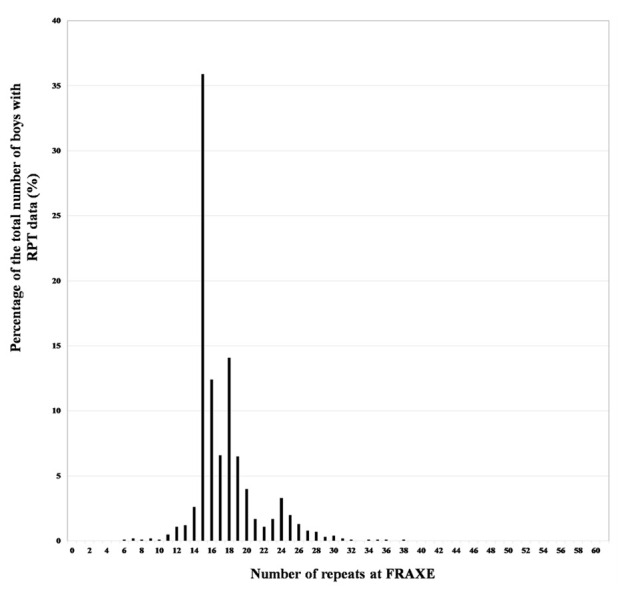 Figure 1
Peer Reviews
No public reviews on file for this paper yet. If you reviewed it on a platform where reviews are public (OpenReview, ICLR, NeurIPS, ICML), you can paste yours below so the community can read it here.
Videos
No videos yet. Explain this paper in a talk, walkthrough, or lecture? Add one.
Taxonomy
TopicsHealth, Environment, Cognitive Aging · Birth, Development, and Health