Rupture of Life‐Threatening Hepatic Artery Pseudoaneurysm After Endoscopic Ultrasonography‐guided Hepaticogastrostomy: Successful Management With Emergency Transcatheter Arterial Embolization
Hiroshi Yukimoto, Akino Okamoto, Kohsaku Ohnishi, Keitaro Masuko, Junping Wang, Kazuya Ogawa, Ken Ueda, Motohiro Hirao, Yasuhiro Nakaya, Atsushi Hosui

TL;DR
A patient developed a life-threatening pseudoaneurysm after a procedure to treat jaundice, which was successfully treated with emergency embolization.
Contribution
This case highlights a rare complication of EUS-HGS and emphasizes the importance of CECT evaluation before stent manipulation.
Findings
A pseudoaneurysm in the hepatic artery caused massive bleeding after EUS-HGS stent manipulation.
Transcatheter arterial embolization successfully managed the pseudoaneurysm.
Only three prior cases of pseudoaneurysm after EUS-HGS have been reported, all involving metal stents.
Abstract
A 70‐year‐old male with lung cancer and interstitial pneumonia was diagnosed with ampullary carcinoma, causing obstructive jaundice. After the failure of endoscopic retrograde cholangiopancreatography, endoscopic ultrasound‐guided hepaticogastrostomy (EUS‐HGS) was performed with a 7‐Fr plastic stent (PS) into the B2 bile duct. Three months later, mild bleeding was observed during stent exchange, but was stopped by stent replacement. The patient developed recurrent cholangitis, and 1 month later, when the PS was removed to add supplementary drainage, massive bleeding occurred from the endosonographically created route into the stomach. Contrast‐enhanced computed tomography (CECT) revealed a pseudoaneurysm in the A2 branch of the hepatic artery. Emergency angiography confirmed active extravasation, and successful transcatheter arterial embolization with N‐butyl‐2‐cyanoacrylate was…
Genes, proteins, chemicals, diseases, species, mutations and cell lines named across the full text — each resolved to its canonical identifier and authoritative record.
Click any figure to enlarge with its caption.
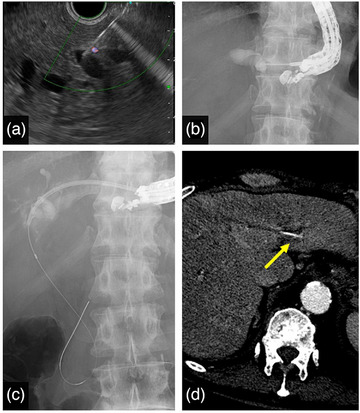 Figure 1
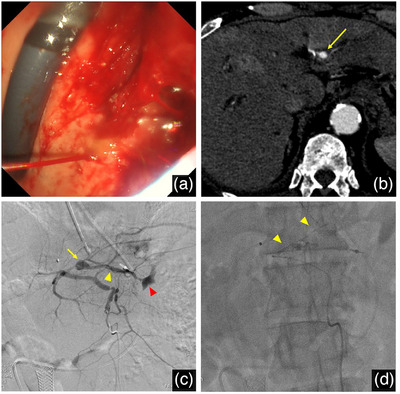 Figure 2
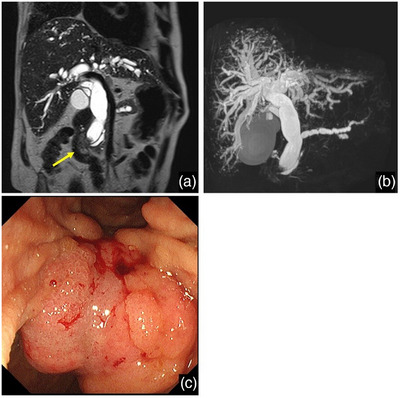 Figure 3
Peer Reviews
No public reviews on file for this paper yet. If you reviewed it on a platform where reviews are public (OpenReview, ICLR, NeurIPS, ICML), you can paste yours below so the community can read it here.
Videos
No videos yet. Explain this paper in a talk, walkthrough, or lecture? Add one.
Taxonomy
TopicsAbdominal vascular conditions and treatments · Gallbladder and Bile Duct Disorders · Esophageal and GI Pathology