Successful Endoscopic Submucosal Dissection for Giant Inflammatory Fibroid Polyp in Terminal Ileum
Sayuri Watanabe, Yuki Nakajima, Masato Aizawa, Jun Wada, Kakeru Otomo, Goro Shibukawa, Tadayuki Takagi, Kenichi Utano, Osamu Suzuki, Kazutomo Togashi

TL;DR
A 55-year-old woman with a large intestinal tumor underwent successful endoscopic removal using a novel technique, marking the largest such case ever reported.
Contribution
The paper presents a successful endoscopic submucosal dissection technique for a giant inflammatory fibroid polyp in the terminal ileum.
Findings
Endoscopic submucosal dissection using the underwater pocket-creation method successfully removed a 62 × 40 × 22 mm inflammatory fibroid polyp.
The combination of the pocket-creation method, underwater technique, and lesion anchoring enabled safe en bloc resection without perforation.
The patient had an uneventful recovery and no recurrence was observed at 6-month follow-up.
Abstract
A 55‐year‐old woman presented with postprandial abdominal pain and diarrhea. Contrast‐enhanced abdominal computed tomography revealed a large tumor in the ileocecal region. Colonoscopy demonstrated a pedunculated polyp originating from the terminal ileum, intermittently prolapsing into the cecum with a stalk‐like base. Biopsy specimens showed nonspecific inflammatory changes. Initial hot snare polypectomy was unsuccessful due to the polyp's large size and mobility. Therefore, endoscopic submucosal dissection using the underwater pocket‐creation method was performed, with the polyp stabilized using a traction device anchored to its apex and the opposite side of the ileocecal valve. This technique enabled safe resection of the lesion from its broad stalk. Although marked submucosal fibrosis was observed beneath the lesion, en bloc resection was successfully completed without perforation…
Genes, proteins, chemicals, diseases, species, mutations and cell lines named across the full text — each resolved to its canonical identifier and authoritative record.
Click any figure to enlarge with its caption.
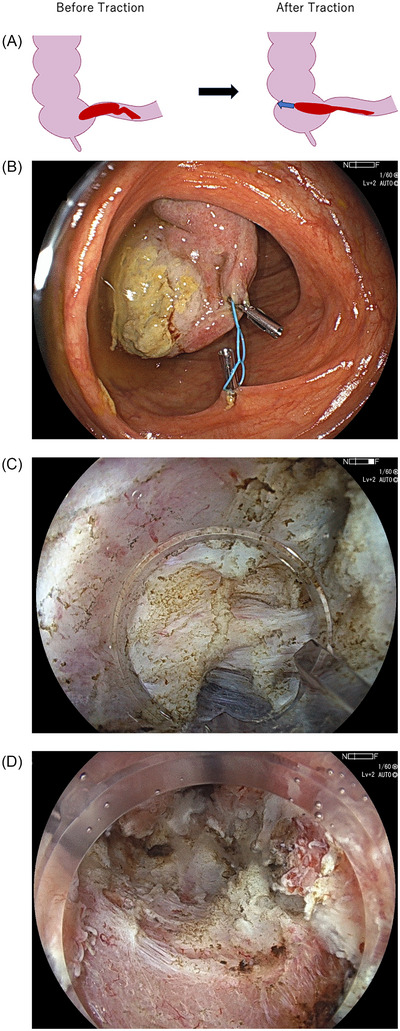 Figure 1
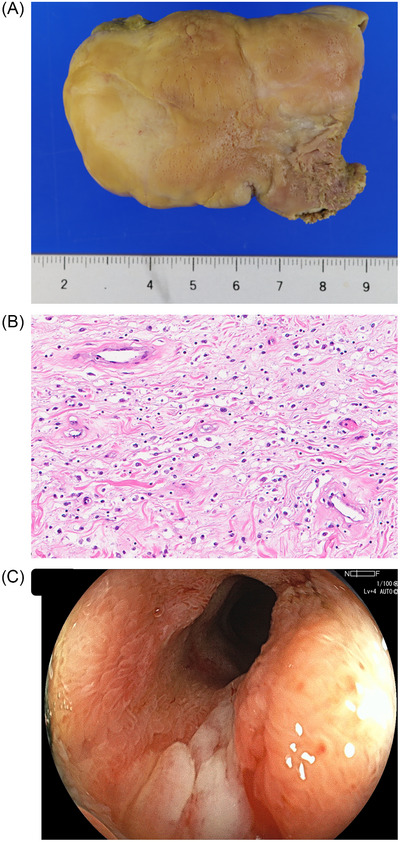 Figure 2
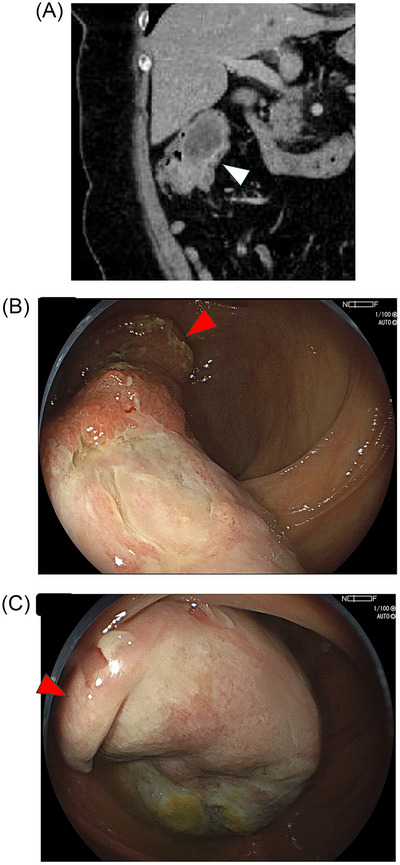 Figure 3
Peer Reviews
No public reviews on file for this paper yet. If you reviewed it on a platform where reviews are public (OpenReview, ICLR, NeurIPS, ICML), you can paste yours below so the community can read it here.
Videos
No videos yet. Explain this paper in a talk, walkthrough, or lecture? Add one.
Taxonomy
TopicsGastrointestinal disorders and treatments · Gastrointestinal Tumor Research and Treatment · Metastasis and carcinoma case studies