Circadian rhythmicity in prepulse inhibition of the acoustic startle response: A study of chronotype and time-of-day effects in young healthy adults
Satyam Chauhan, Ulrich Ettinger, Kaja Fassbender, Ray Norbury, Veena Kumari

TL;DR
This study found that the time of day and chronotype do not significantly affect a brain function measure called PPI in healthy young adults.
Contribution
The study provides evidence that PPI is a stable biomarker not influenced by chronotype or time of day in healthy individuals.
Findings
No significant effects of chronotype or synchrony on PPI were observed.
Greater startle amplitude in the late afternoon was linked to higher schizotypy.
PPI on 120-ms trials increased in the late afternoon but was not significant after adjusting for schizotypy.
Abstract
Prepulse inhibition (PPI) of the acoustically elicited startle response is a widely used cross-species measure of sensorimotor gating. It is known to be reduced in various psychiatric disorders. Given previous reports of (a) disrupted PPI in young adults following overnight sleep deprivation and (b) disrupted sleep–wake cycles and psychiatric disorders being more common in evening than morning chronotypes, it is possible that there are chronobiological influences on human PPI. We investigated chronotype, time of day (ToD) and synchrony effects (i.e. optimal functioning at preferred ToD) in acoustic PPI in young healthy adults. Thirty-six adults, selected from a larger pool (N = 213) to represent morning, intermediate or evening chronotypes, were assessed on PPI (prepulse-to-pulse intervals: 30, 60 and 120-ms) on two occasions, 1 week apart: once in the morning (8:00–10:00) and once…
Genes, proteins, chemicals, diseases, species, mutations and cell lines named across the full text — each resolved to its canonical identifier and authoritative record.
Click any figure to enlarge with its caption.
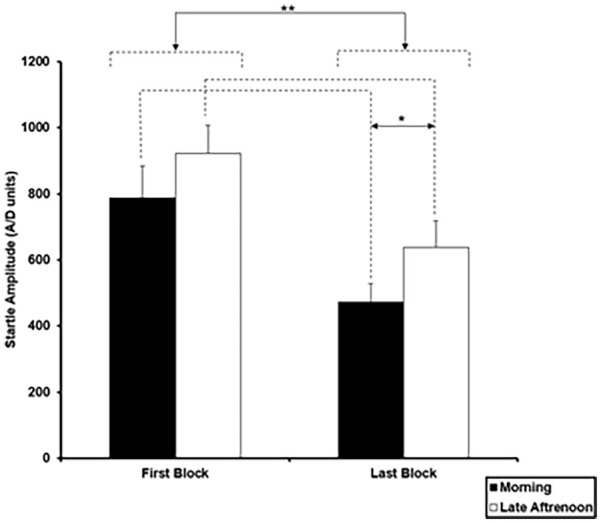 Figure 1
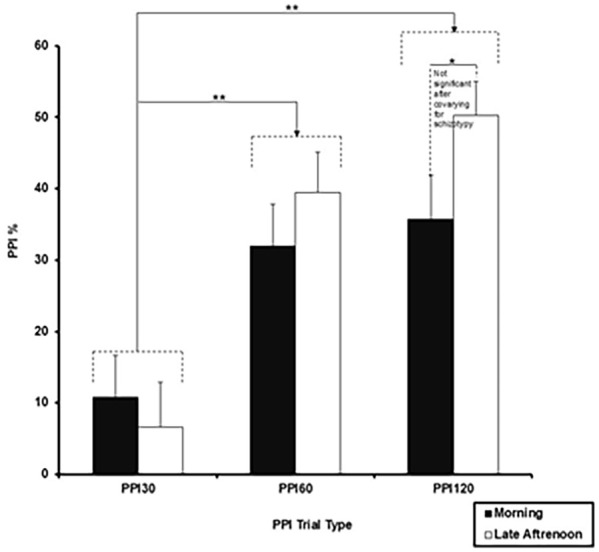 Figure 2
 Figure 3
 Figure 4
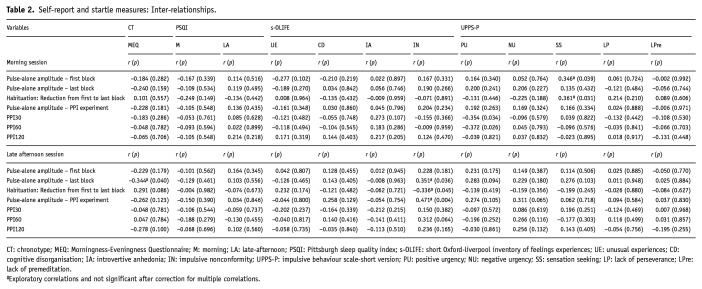 Figure 5
Peer Reviews
No public reviews on file for this paper yet. If you reviewed it on a platform where reviews are public (OpenReview, ICLR, NeurIPS, ICML), you can paste yours below so the community can read it here.
Videos
No videos yet. Explain this paper in a talk, walkthrough, or lecture? Add one.
Taxonomy
TopicsSleep and Wakefulness Research · Sleep and related disorders · Circadian rhythm and melatonin