Utility of pH monitoring in surgical decision-making and outcome prediction in revisional antireflux surgery for anatomical failure
Inanc S. Sarici, Sven E. Eriksson, Naveed Chaudhry, Ping Zheng, Johnathan Nguyen, Shahin Ayazi

TL;DR
This study shows that pH monitoring helps predict the need for and success of revisional antireflux surgery in patients with anatomical failure.
Contribution
The study demonstrates that abnormal pH levels are a strong predictor of both the need for and success of revisional antireflux surgery.
Findings
Patients with abnormal DeMeester scores were more likely to need revisional surgery.
Abnormal pH scores predicted better outcomes after revisional surgery.
Abnormal DeMeester scores were the strongest predictor of favorable post-surgery results.
Abstract
Antireflux surgery (ARS) is effective for controlling GERD, but 10–20% of patients experience anatomical failure, and 3–7% eventually require revisional surgery. While pH monitoring is routinely used preoperatively, its role in guiding revisional ARS remains unclear. This study aimed to evaluate the role of pH monitoring in predicting the need for and outcomes of revisional ARS. We reviewed 278 patients (68% female, mean age 55) with anatomical failure after fundoplication who underwent 48-h pH monitoring from 2015 to 2023. Patients were stratified by DeMeester score at failure: normal vs. abnormal (≥ 14.7). Primary outcome was need for revisional ARS. Secondary outcome was favorable outcome at 1-year post-revision, defined as freedom from PPIs and patient satisfaction. Multivariable logistic regression evaluated the impact of pH monitoring on need for and outcome of revisional ARS.…
Genes, proteins, chemicals, diseases, species, mutations and cell lines named across the full text — each resolved to its canonical identifier and authoritative record.
Click any figure to enlarge with its caption.
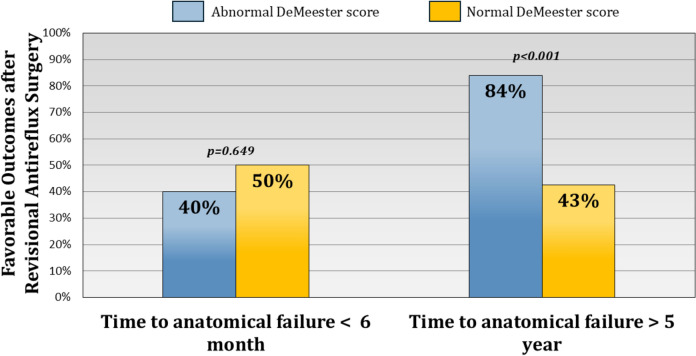 Figure 1
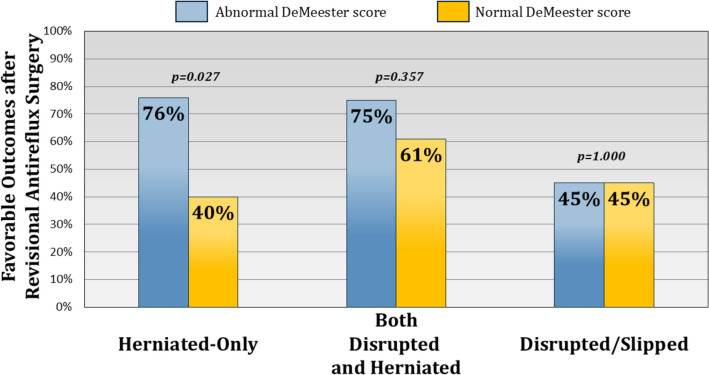 Figure 2
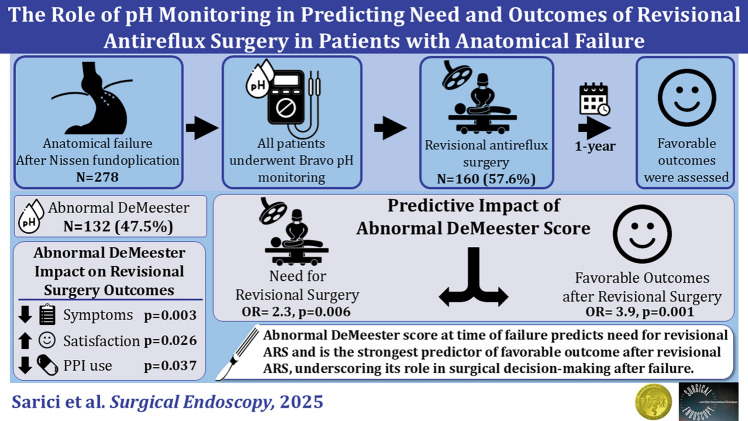 Figure 3
Peer Reviews
No public reviews on file for this paper yet. If you reviewed it on a platform where reviews are public (OpenReview, ICLR, NeurIPS, ICML), you can paste yours below so the community can read it here.
Videos
No videos yet. Explain this paper in a talk, walkthrough, or lecture? Add one.
Taxonomy
TopicsGastroesophageal reflux and treatments · Thermodynamic properties of mixtures · Helicobacter pylori-related gastroenterology studies